


A structural explanation of how pixie haircuts interact with different face shapes.
Pixie haircuts are often perceived as bold but universally flattering.
This assumption comes from their simplicity and short length.
However, in structural haircut logic, pixie haircuts by face shape behave in a highly sensitive and unforgiving way.
Unlike longer haircuts, pixie cuts remove most of the buffering effect created by length.
They expose the face almost completely.
This article explains how pixie haircuts interact with face shapes from a proportion and structure perspective, rather than style trends.
In This Guide
What Defines a Pixie Haircut Structurally
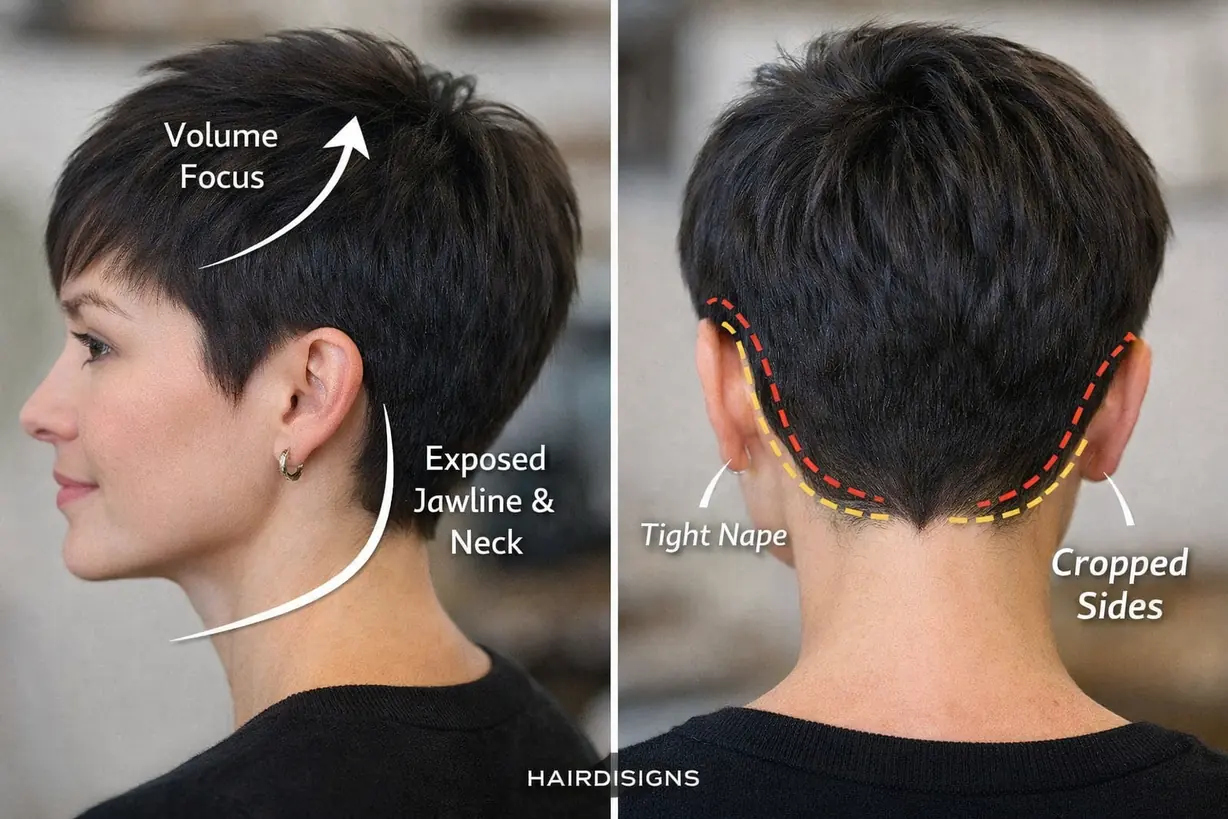
A pixie haircut is defined by minimal length and exposed perimeter.
The hair typically sits above the ears and neckline.
However, the defining factor is not just shortness, but:
- Volume concentration (top vs sides)
- Perimeter exposure (fully visible jaw and neck)
- Internal weight distribution
Because of this, pixie haircuts operate closer to the bone structure than longer cuts.
A deeper distinction between structure and appearance is explained in haircut vs hairstyle: structure vs temporary form.
Why Pixie Haircuts Are Structurally Sensitive
Pixie haircuts remove length, which normally helps balance proportions.
Without that length:
- Face shape becomes more visually dominant
- Volume placement becomes critical
- Small structural errors become more visible
This means pixie haircuts by face shape require more precision, not less.
The relationship between length and proportion is explained further in how hair length changes face proportions.
Round Face: Controlling Width Without Adding Bulk
Round faces are defined by horizontal width and soft contours.
The challenge with pixie haircuts is that removing length can expose this width even more.
Effective pixie structures tend to:
- Create vertical lift at the crown
- Reduce side volume near the cheeks
- Avoid rounded silhouettes
Flat or evenly distributed volume often increases facial width.
A more detailed breakdown:haircuts for round face: structural logic.
Long Face: Avoiding Vertical Reinforcement
Long faces are characterized by vertical dominance.
Pixie haircuts can easily exaggerate this if the structure is too narrow or tall.
Balanced designs usually:
- Add width at the sides
- Reduce excessive height at the crown
- Introduce horizontal movement
Without these adjustments, pixie haircuts can make the face appear longer rather than balanced.
Further explanation: long face haircut structural mistakes.
Square Face: Managing Strong Angles
Square faces have defined jawlines and angular structure.
Pixie haircuts expose these features fully.
To avoid harshness, the structure should:
- Break sharp lines with texture
- Avoid rigid, geometric shapes
- Soften the perimeter
Overly blunt pixie cuts often align directly with jaw angles, increasing rigidity.
This limitation is explained in blunt haircut structural failure analysis.
Oval Face: Why It Still Requires Adjustment
Oval faces are often considered balanced.
However, with pixie haircuts, balance can shift easily.
Common risks include:
- Over-elongation with excessive top volume
- Flat shapes that remove dimension
Because of this, pixie haircuts by face shape still require structural control even for oval proportions.
Further explanation:oval face haircut logic.
The Role of Internal Weight in Pixie Haircuts
Internal weight becomes more critical as length decreases.
In pixie haircuts:
- Excess weight creates helmet-like shapes
- Too much removal causes collapse and lack of control
This is why pixie haircuts cannot rely on outline alone.
They require precise internal balance.
For deeper understanding:layered haircut structural logic.
Why Hair Type Becomes More Important in Pixie Cuts
With less length to distribute weight, hair type has a stronger impact.
Factors include:
- Density (thick vs thin)
- Texture (straight vs wavy vs curly)
Two identical pixie designs can behave differently depending on hair structure.
A deeper explanation:how hair type changes the way a haircut looks.
Conclusion: Pixie Haircuts Are High Precision Structures
Pixie haircuts are not inherently suitable or unsuitable.
They are highly sensitive structural designs.
- Length removal exposes facial proportions
- Volume placement controls balance
- Internal weight determines shape behavior
Understanding these variables allows pixie haircuts by face shape to be approached with precision rather than assumption.
FAQ
Are pixie haircuts harder to get right than longer cuts?
Yes.
Because they expose more of the face, small structural imbalances become more visible.
Do pixie haircuts make the face look bigger?
They can.
Without proper volume control, removing length can increase perceived facial width.
Can any face shape wear a pixie haircut?
Technically yes.
But only when structure, volume, and weight are adjusted to match proportions.
This article was written and optimized with the assistance of AI, then refined to maintain a clear, educational, and non-commercial tone.