


Medium-length haircuts by hair density reveal how strongly hair structure affects the final shape of a haircut.
Medium-length haircuts occupy an unusual position in hair design.
They are long enough to carry weight, yet short enough to expose the structural behavior of the hair. Unlike very long hair, medium lengths cannot rely entirely on gravity to control volume. Unlike short hair, they still contain enough mass to mask certain structural mistakes.
Because of this middle position, medium-length haircuts are heavily influenced by hair density. The amount of hair growing on the scalp determines how the shape expands, collapses, or holds its structure.
This article explains medium-length haircuts by hair density from a structural perspective. Rather than listing fashionable styles, it examines how density determines the internal architecture of a haircut.
In This Guide
Medium-Length Haircuts by Hair Density: Why Density Changes the Shape
Hair density refers to how many strands grow from the scalp within a given area. It is different from hair texture, which describes the thickness of individual strands.
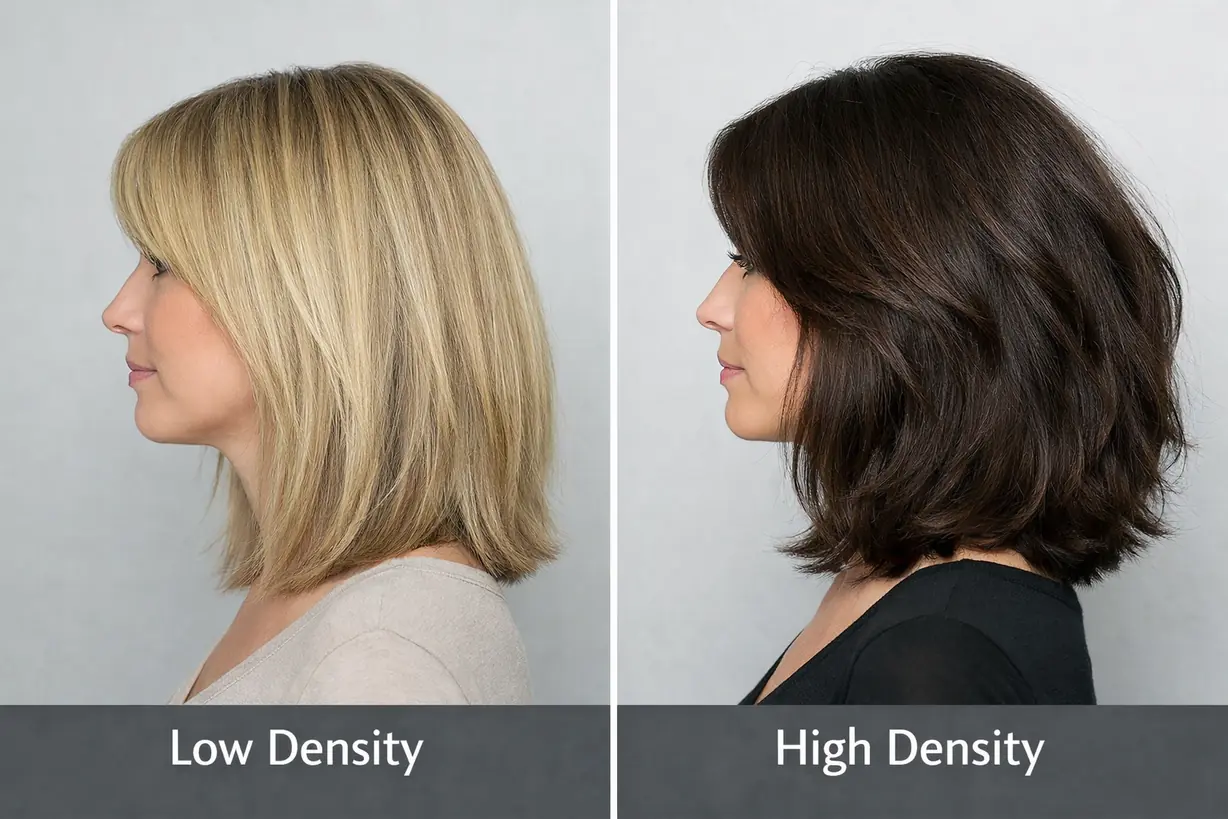
Density affects how a haircut behaves once the hair is dry and free from styling manipulation. High-density hair naturally expands outward, while low-density hair tends to collapse toward the head.
This is why the same haircut reference photo rarely produces identical results on different people. Even when texture appears similar, density changes how the shape occupies space.
Understanding this principle is part of learning how to identify your hair type. Without recognizing density, it becomes difficult to predict how a medium-length haircut will behave after it is cut.
Why Medium Length Amplifies Density Differences
Medium-length hair typically sits between the chin and the shoulders. At this length, the hair contains enough mass to create visible volume, but not enough length to stretch the structure downward.
The result is a sensitive equilibrium between gravity and expansion.
On low-density hair, this balance often collapses. The shape can appear flat or stringy if the haircut removes too much internal weight.
On high-density hair, the opposite problem occurs. The haircut may appear bulky or triangular because the internal mass pushes the silhouette outward.
This balancing act explains why medium-length haircuts by hair density must be built differently depending on the amount of hair present. Structural balance becomes more important than copying a style reference.
This technical balance is explained further in why medium-length haircuts are difficult to balance.
Low-Density Hair: Preserving Structural Mass
When density is low, the primary challenge is maintaining visible structure. If too much internal layering is introduced, the perimeter becomes thin and unstable.
Medium-length haircuts for low-density hair typically rely on controlled perimeters and limited internal removal. A stable outline preserves the illusion of fullness.
In many cases, blunt structural lines perform better than aggressive layering. Layering reduces weight, and low-density hair often cannot afford that reduction.
This structural principle appears frequently in haircuts designed for thin hair, where perimeter strength becomes the primary design strategy.
High-Density Hair: Managing Internal Expansion
High-density hair presents the opposite engineering problem. Instead of lacking structure, it often contains too much internal mass.
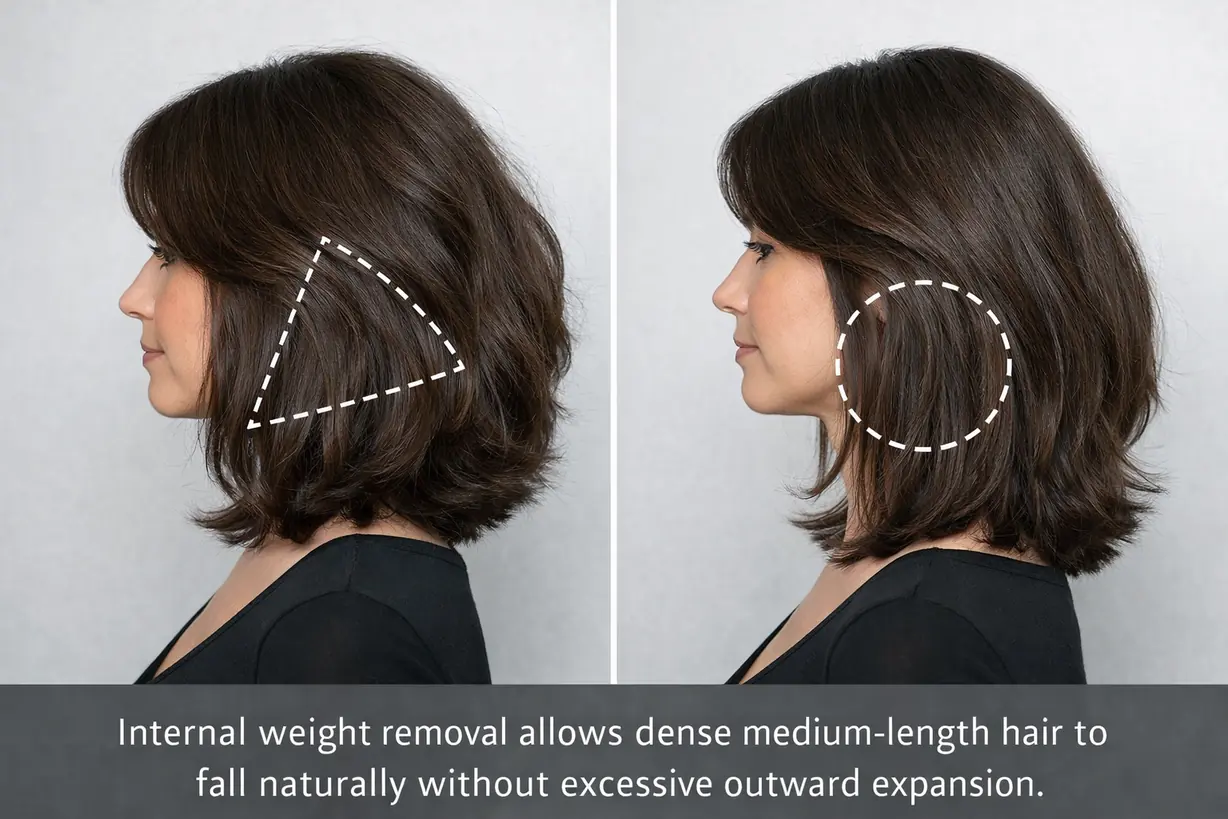
When a dense head of hair is cut to medium length without internal adjustment, the shape may expand outward dramatically, producing a triangular silhouette.
Strategic internal removal becomes necessary to control this expansion. Techniques such as channel cutting or internal layering allow the surface hair to fall naturally without excessive bulk.
The goal is not to remove volume indiscriminately, but to redistribute it. This principle is central to designing haircuts for thick hair.
The Interaction Between Density and Layering
Layering is often misunderstood as a universal solution for adding movement. In reality, layering is simply a method of redistributing weight.
On low-density hair, layering may remove too much mass and destabilize the shape. On high-density hair, layering can relieve pressure within the structure and allow the silhouette to settle.
This is why medium-length haircuts by hair density cannot rely on a single cutting technique. The same layering method can produce opposite results depending on density.
The structural logic behind layering is discussed in more detail in this guide to layered haircuts.
FAQ: Medium-Length Haircuts and Density
Do medium-length haircuts work for all hair densities?
Yes, but the internal structure of the haircut must change. Low-density hair requires perimeter strength, while high-density hair requires internal weight management.
Will layering always add volume to medium-length hair?
No. Layering redistributes weight rather than automatically creating volume. On low-density hair it may reduce visible fullness, while on dense hair it can help control expansion.
Why does my medium-length haircut look wider after drying?
This usually occurs when dense hair expands outward once moisture evaporates. If the internal mass is not properly balanced, the haircut may widen significantly as it dries.
Closing Perspective: Density Determines Structural Stability
Ultimately, medium-length haircuts by hair density succeed when the structure respects how much internal volume the hair naturally contains.
When density is ignored, the haircut may appear flat, bulky, or unstable as it grows. When density is respected, the shape maintains balance with minimal styling intervention.
The goal of haircut design is not to imitate a reference photo. It is to build a structure that cooperates with the natural material of the hair.
Research on hair growth and density variation also shows why individual hair behavior differs so widely, as documented in studies on human hair growth patterns.