


Most haircut advice assumes you already know your hair type.
But “hair type” is often reduced to a single label — straight, wavy, curly — as if that one word explains everything. It doesn’t.
Hair behaves according to structure. Texture, density, and porosity each influence how your hair moves, holds shape, absorbs moisture, and responds to cutting. If you misread any one of them, the haircut may feel unpredictable — even when the technique itself is correct.
This guide explains how to identify your hair type at home by observing behavior rather than relying on labels.
In This Guide
Step One: Identify Your Hair Texture (The Shape Pattern)
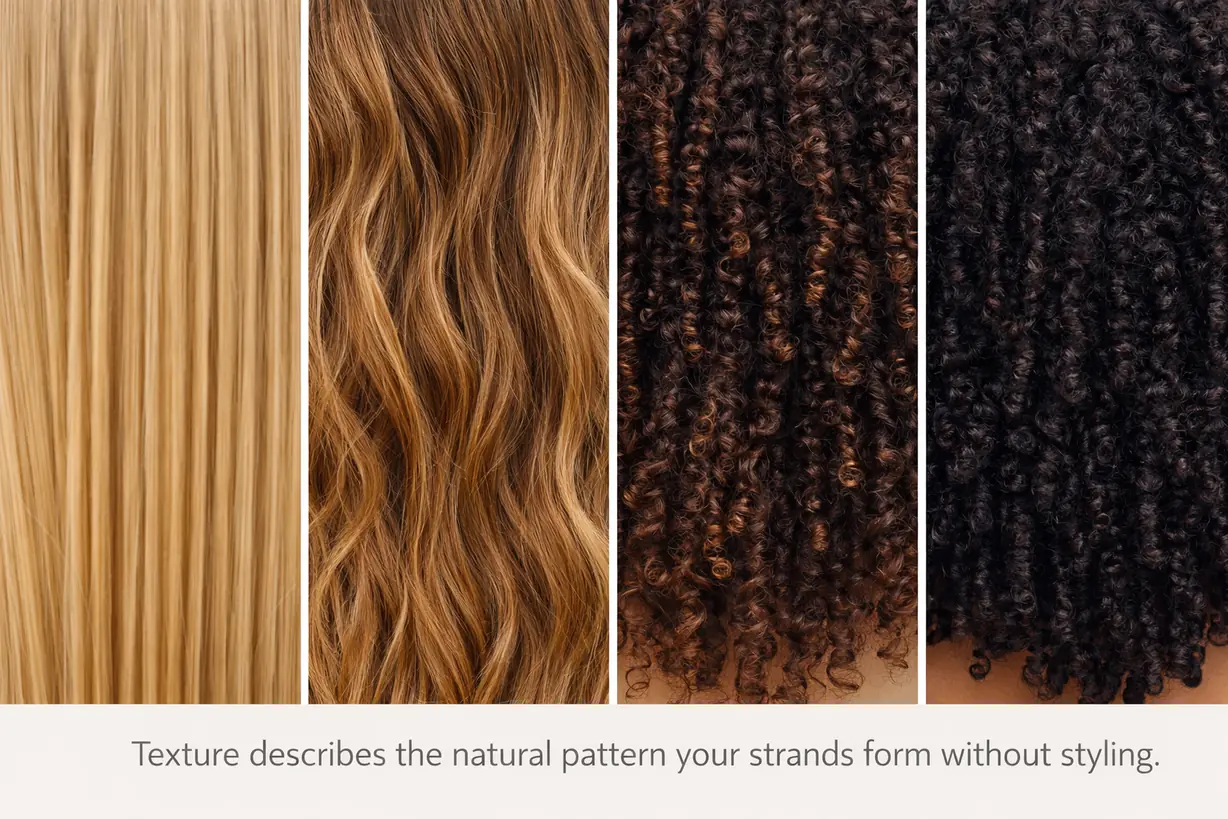
Texture refers to the visible shape pattern your strands form when they air-dry without manipulation.
Wash your hair. Avoid brushing while drying. Skip heavy styling products. Let gravity and evaporation reveal the natural pattern.
Then observe what actually forms:
Straight hair falls in a linear path. It reflects light easily because the cuticle (the outer protective layer of the strand) lies relatively flat.
Wavy hair forms loose S-shaped bends. It may appear straighter near the root and curve toward the ends.
Curly hair creates visible loops or spirals. The pattern usually begins closer to the root and shortens in apparent length as it dries.
Coily hair forms tight zigzags or compact coils with noticeable shrinkage.
Texture directly affects how a haircut distributes volume. A blunt cut on straight hair increases visual weight. The same blunt line on curly hair may increase outward expansion. Structure must follow pattern.
Step Two: Assess Hair Density (How Much Hair You Actually Have)
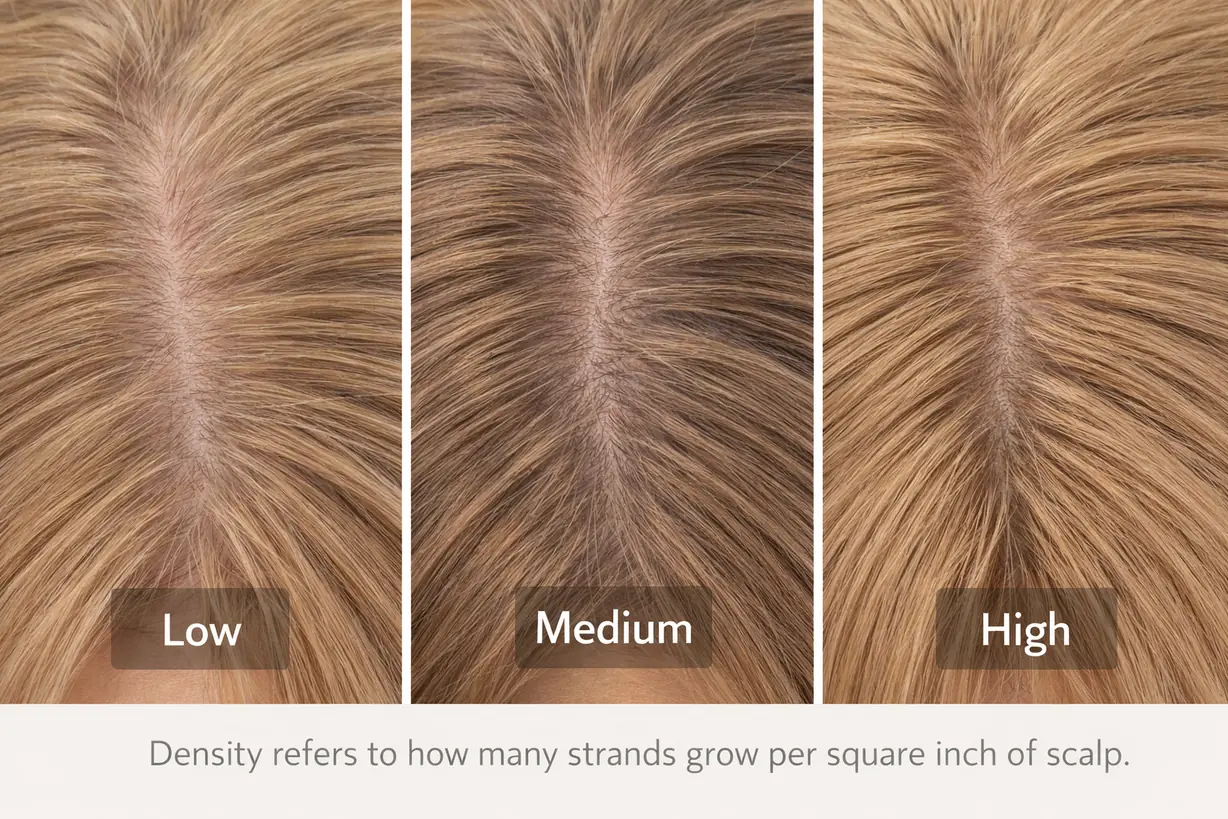
Density is often confused with strand thickness. They are different measurements.
Density refers to how many strands grow on your scalp. Strand thickness refers to the diameter of one individual hair.
To assess density at home, examine your natural part in bright, neutral lighting.
If the scalp is clearly visible along the part, density is likely lower.
If the scalp is partially visible, density is moderate.
If the scalp is barely visible, density is higher.
Density determines how much internal layering your haircut can tolerate. Removing too much weight from low-density hair can create transparency at the ends. Leaving excessive bulk in high-density hair can produce heaviness that resists movement.
Many complaints about “frizz” or “puffiness” are actually density-and-layering mismatches rather than texture problems.
Step Three: Evaluate Hair Porosity (How It Interacts With Moisture)
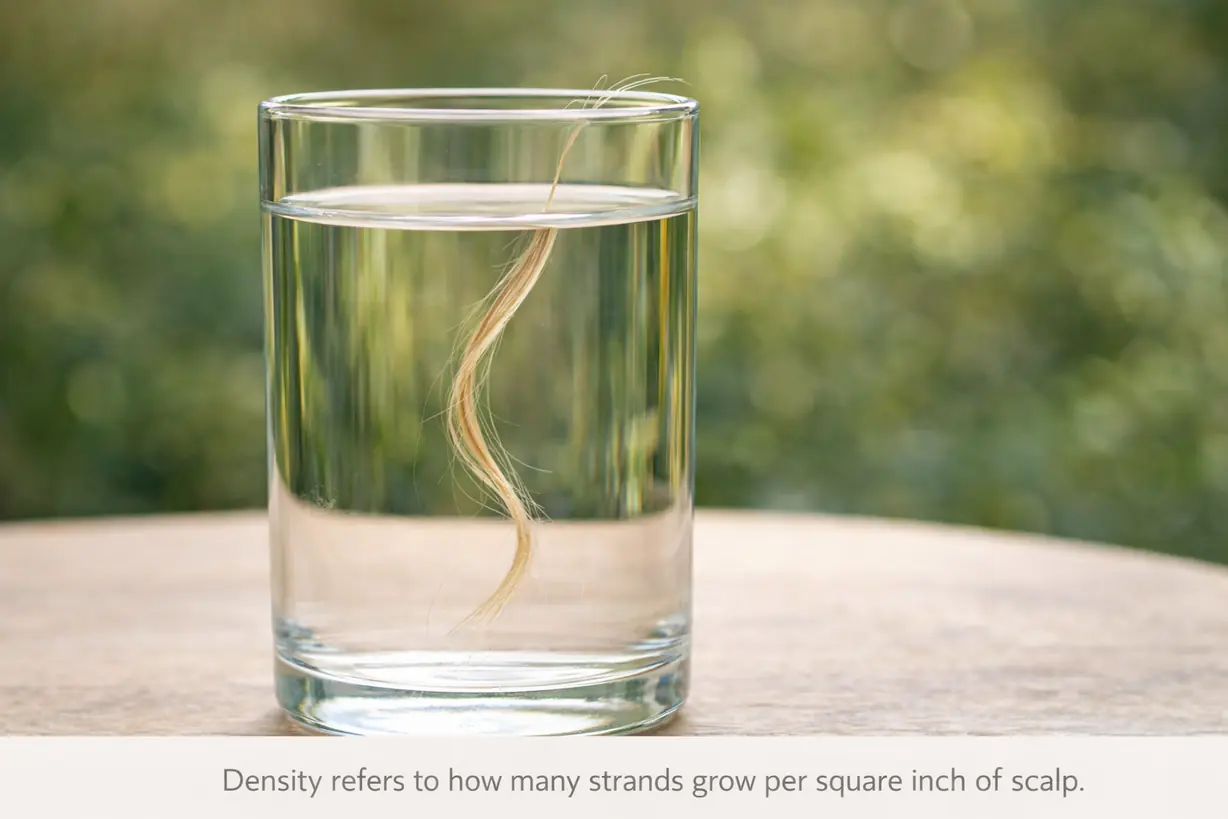
Porosity describes how open or compact the cuticle layer is.
You do not need laboratory tools to observe it. Daily behavior provides clues.
After washing, notice how quickly your hair becomes fully saturated. Then observe how long it takes to air-dry without heat.
Hair that resists getting wet and dries slowly often has lower porosity. Hair that absorbs water quickly and dries rapidly often has higher porosity.
Porosity affects how hair responds to humidity and product absorption. High-porosity hair may expand in moist air. Low-porosity hair may resist volume even when layered.
The goal is not to correct porosity, but to understand how it changes proportion over time.
Why Texture, Density, and Porosity Must Be Read Together
Texture controls shape.
Density controls weight.
Porosity controls reaction.
A haircut interacts with all three simultaneously.
Wavy hair with low density and high porosity behaves differently from wavy hair with high density and low porosity. The visible pattern may look similar in a photograph. The structural behavior is not.
This is why copying a reference image rarely guarantees identical results. Structure must match structure.
Common Misinterpretations
“My hair is frizzy.”
Frizz is usually a response to moisture interacting with texture. It is not a separate hair type.
“My hair is thick.”
Many people mean high density. Individual strands may still be fine.
“My hair won’t hold a style.”
This can relate to porosity, density imbalance, or weight distribution within the cut.
FAQ
Can my hair type change over time?
Texture is largely influenced by follicle shape and tends to remain stable. Density may gradually decrease with age. Porosity can change due to chemical processing, heat styling, or environmental exposure.
Is strand thickness the same as density?
No. Strand thickness refers to the diameter of a single hair. Density refers to how many strands grow on the scalp. Fine strands can exist in high density, and thick strands can exist in low density.
Is the glass-of-water strand test necessary?
Not necessarily. The water test can be inconsistent. Observing how your hair behaves during washing and drying usually provides more reliable information.
Understanding Before Choosing
Identifying your hair type at home is not about assigning yourself a category. It is about reading structure.
When you understand texture, density, and porosity, haircut decisions become less emotional and more predictable. You begin to anticipate behavior instead of reacting to it.
Hair is not random. It responds to physics — gravity, moisture, tension, and shape.
When you learn to read those forces, you stop fighting your hair and start designing with it.