


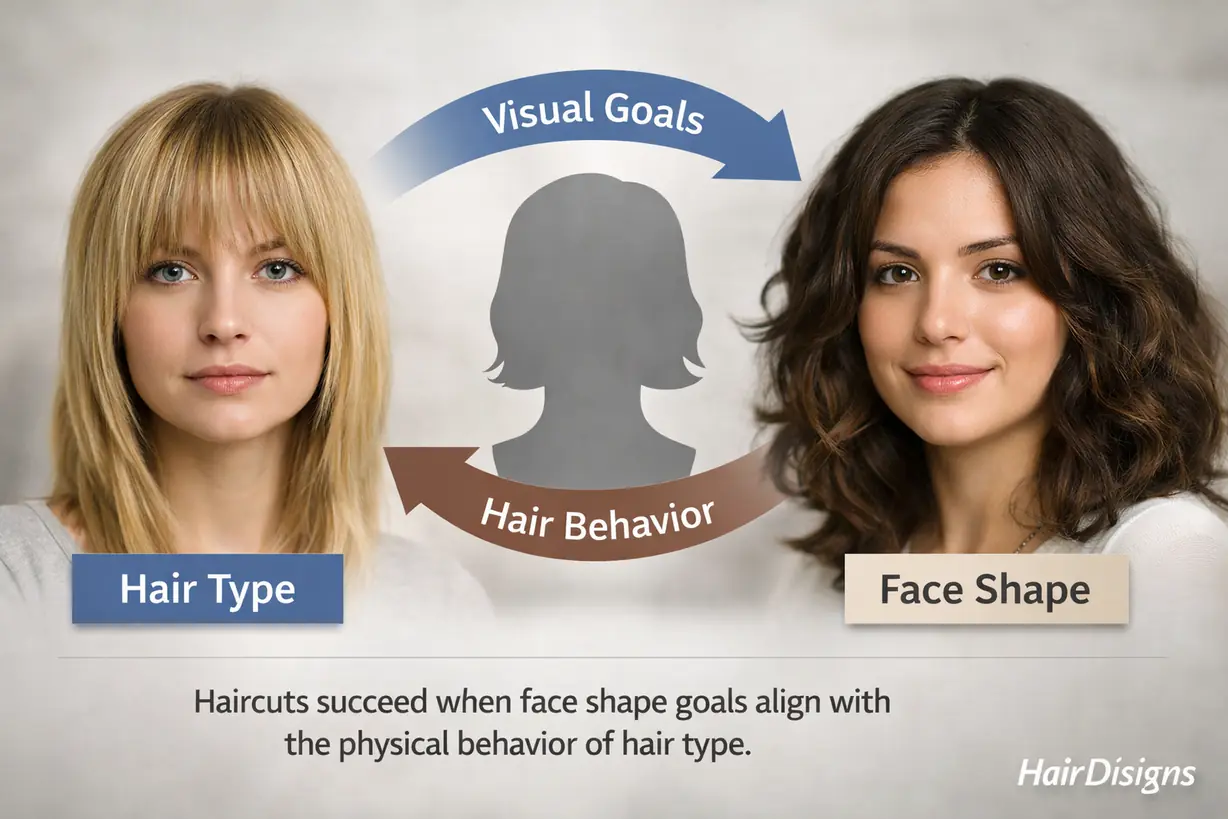
Hair type and face shape are often discussed separately, but in practical haircut design, they function as a combined system.
Face shape defines proportion and visual balance. Hair type determines how the structure behaves in reality.
A haircut only works when these two factors align. When they conflict, the result often looks correct in theory but fails in execution.
This article explains how hair type and face shape interact from a structural perspective, focusing on why certain designs succeed or collapse.
In This Guide
Hair Type vs Face Shape: Two Different Roles
Face shape controls visual proportion. It answers the question: what needs to be balanced?
Hair type controls physical behavior. It answers the question: what is actually possible?
For example:
- A round face may require vertical elongation
- A long face may require width and horizontal expansion
However, whether these adjustments can be achieved depends entirely on hair type.
This relationship is explained in more detail in
how face shape affects haircut choices.
Why Face Shape Alone Is Not Enough
Many haircut guides focus only on face shape, assuming that proportion correction is the main objective.
In reality, ignoring hair type leads to structural inconsistency.
For example:
- Thin hair cannot create stable width even if the face requires it
- Thick hair may create excessive volume even when the face requires control
- Curly hair expands outward regardless of intended shape
This is why haircut results often differ from expectations. The design may suit the face, but the material (hair type) does not support the structure.
This principle is further explained in
how hair type changes the way a haircut looks.
The Structural Conflict Between Shape and Material
The interaction between hair type and face shape can be understood as a structural negotiation.
There are three common outcomes:
- Alignment: Hair type supports the needs of the face shape
- Compromise: Adjustments are partially achievable
- Conflict: Hair type prevents the intended design
For example:
- A long face with thick hair can build width effectively (alignment)
- A round face with thin hair may struggle to create vertical lift (conflict)
Understanding this interaction prevents unrealistic expectations during haircut planning.
How Density Changes Face Shape Correction
Hair density plays a critical role in how face shape adjustments are perceived.
High-density hair increases visual weight and expansion. Low-density hair reduces visual presence.
This directly affects proportion correction:
- Thick hair can exaggerate width, which may help long faces but harm round faces
- Thin hair may fail to create structure, making proportion correction less visible
Because of this, the same haircut design produces different visual outcomes depending on density.
For a deeper breakdown, see
haircuts for thick hair: why structure matters more and
how structure creates volume in thin hair.
Why Texture Overrides Intended Shape
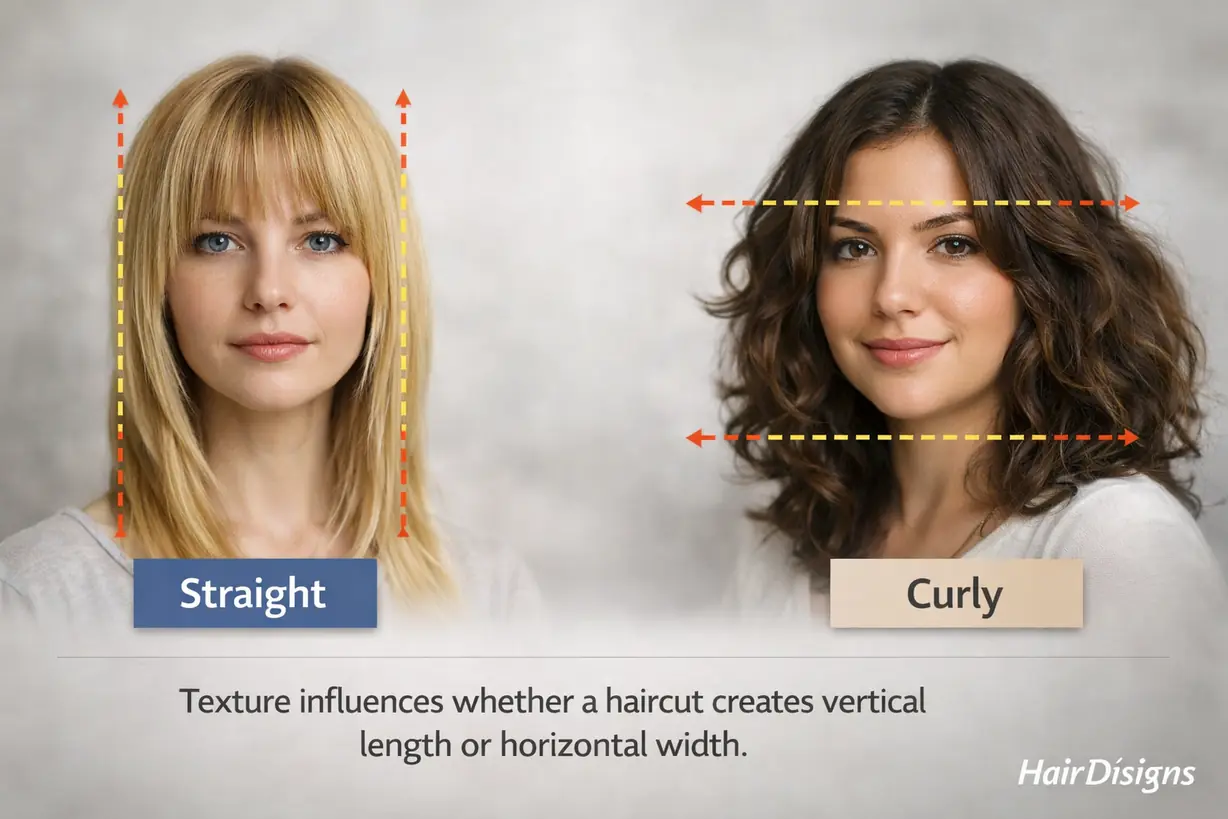
Hair texture determines movement and direction.
Straight hair tends to fall downward, emphasizing vertical lines. Curly or wavy hair expands outward, creating width.
This means:
- Straight hair naturally elongates the face
- Curly hair naturally widens the silhouette
These natural tendencies can either support or contradict the needs of the face shape.
This behavior is explained in
how hair structure changes the right cut.
Balancing Strategy: Adjusting One Variable at a Time
Effective haircut design does not attempt to force both variables simultaneously.
Instead, it prioritizes one and adapts the other.
There are two main strategies:
- Face-first approach: Adjust the haircut to correct face shape, then modify expectations based on hair type
- Hair-first approach: Respect hair type limitations, then apply subtle proportion adjustments
In most realistic scenarios, a balanced compromise is required.
This is why understanding both variables leads to more consistent and maintainable results.
FAQ: Hair Type and Face Shape
Can I choose a haircut based only on face shape?
No. Face shape defines what looks balanced, but hair type determines whether that balance can be achieved.
What matters more: hair type or face shape?
Hair type is more restrictive because it controls physical behavior. Face shape is more flexible because it can be visually adjusted.
Why does the same haircut look different on different people?
Because hair type changes how the structure behaves. The same design interacts differently with density, texture, and natural movement.
Closing Perspective: Structure Requires Compatibility
Hair type and face shape should not be treated as separate checklist items.
They form a system where one defines the goal and the other defines the limitation.
A successful haircut is not the one that follows trends, but the one that aligns structure with physical reality.
For a broader structural comparison across lengths, see
long vs short hair structure.
And if you are unsure about your own hair characteristics, start with
how to identify your hair type at home.