
Blow-drying hair shape is not a cosmetic trick—it is a structural manipulation of hydrogen bonds inside the hair fiber. While many people see blow-drying as a way to remove moisture quickly, its real function is to temporarily reorganize the internal architecture of the strand.
To control whether hair lies flat, curves inward, flips outward, or lifts at the root, you must understand the physical and thermal mechanics governing blow-drying hair shape. This guide explains how heat, tension, airflow direction, and cooling determine structural outcome.
In This Guide
The Science Behind Blow-Drying Hair Shape
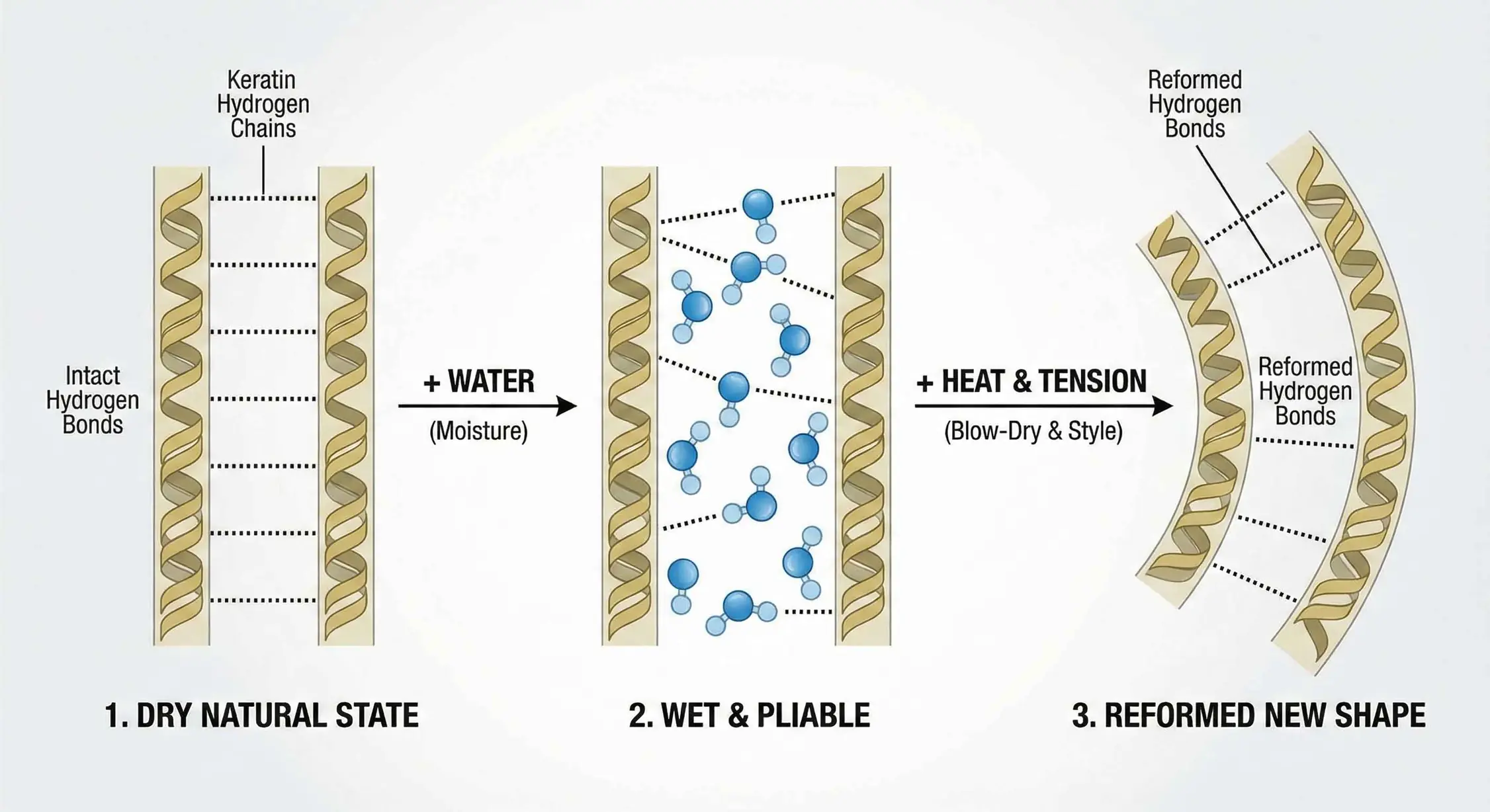
Hair is primarily composed of keratin proteins stabilized by multiple bond types. The most responsive to styling are hydrogen bonds, which account for roughly one-third of the hair’s temporary structural integrity.
When hair becomes wet, water molecules break hydrogen bonds. This renders the strand pliable and temporarily erases its natural pattern. As moisture evaporates, the bonds reform.
If hair air-dries, bonds return to their genetic configuration. If directional heat and mechanical tension are applied, hydrogen bonds reform according to the imposed shape. This is the mechanical foundation of blow-drying hair shape.
This also clarifies the structural difference between a haircut and a hairstyle: a haircut alters perimeter geometry and weight distribution, while blow-drying reorganizes internal bonds without changing mass.
Tension and Direction: Engineering Volume at the Root
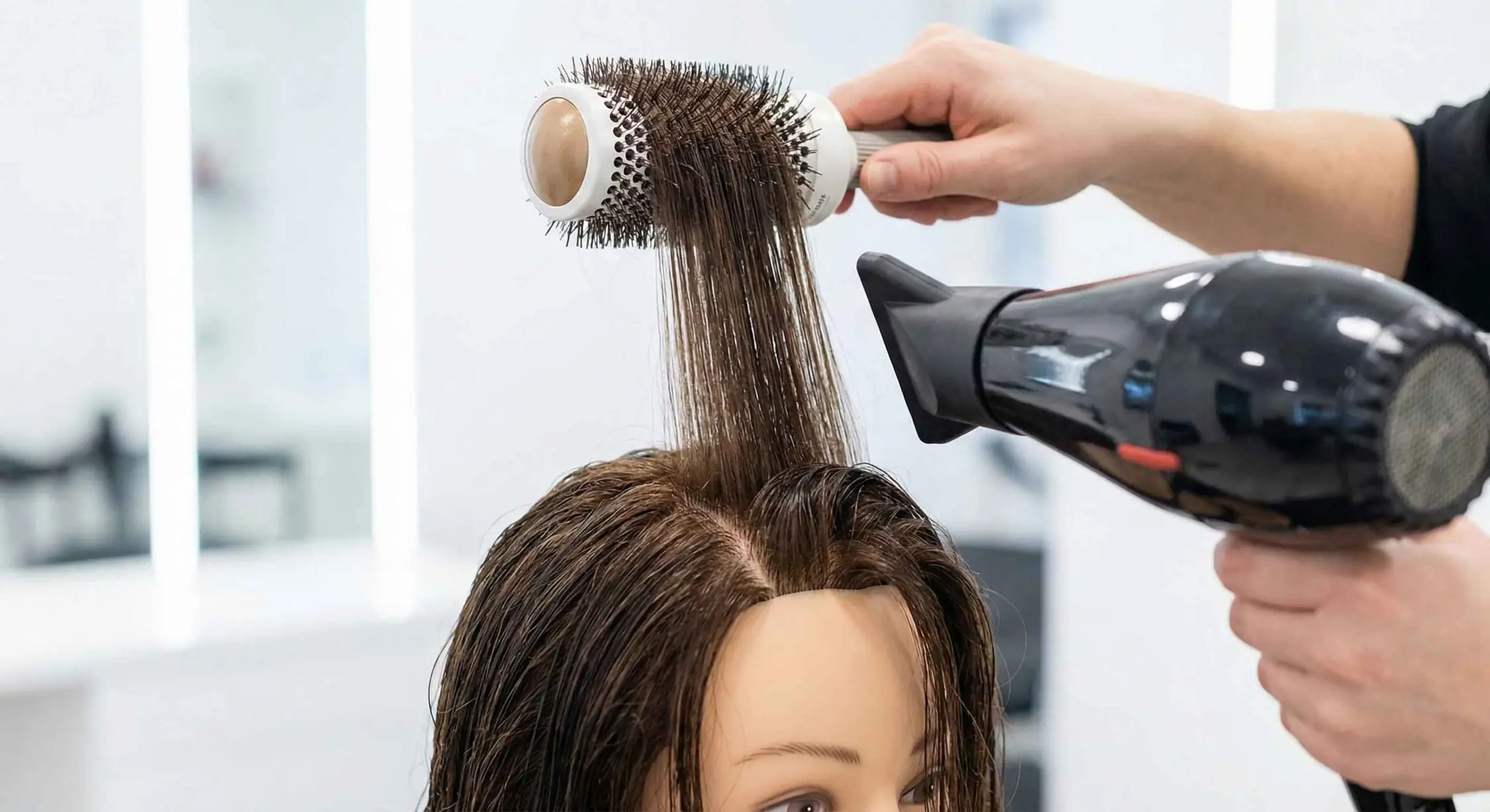
Volume is a geometric effect created by altering root elevation during the wet-to-dry transition. Gravity pulls hair downward; blow-drying hair shape counters this by redirecting the strand upward while hydrogen bonds reset.
- Over-direction: Elevating hair to 90 degrees or higher from the scalp forces vertical root formation.
- Controlled tension: Consistent brush tension compresses the cuticle layer and ensures the strand conforms to the brush radius.
- Airflow alignment: Directing airflow down the shaft smooths the cuticle and enhances surface reflection.
Hair density, diameter, and porosity influence how effectively blow-drying hair shape can be manipulated. Fine, low-density hair requires less heat and tension than coarse, porous hair. Before expecting predictable outcomes, begin by identifying your hair type.
The Cooling Phase: Structural Locking Mechanism
The cooling phase determines whether blow-drying hair shape holds or collapses. Heat disrupts hydrogen bonds, but only cooling stabilizes them in their new configuration.
Releasing tension while the strand remains warm allows gravity and internal elasticity to reverse the structure. Maintaining tension until the hair is fully cool—or using the cool-shot function—ensures bond stabilization.
Common Structural Failures
Why does blow-dried hair revert in humidity?
Humidity reintroduces water molecules into the fiber. Because hydrogen bonds are moisture-sensitive, the temporary structure breaks and the strand returns to its genetic baseline.
Does higher heat improve blow-drying hair shape?
No. Once sufficient heat evaporates water and allows bond reformation, additional heat provides no structural advantage. Excess heat dehydrates the cortex and leads to permanent structural damage.
Why does hair look frizzy after blow-drying?
Frizz indicates disrupted cuticle alignment. Upward airflow or insufficient tension causes uneven drying, scattering light and reducing surface coherence.
Conclusion: Blow-drying hair shape is a temporary architectural reset driven by hydrogen bond manipulation. Heat creates flexibility, tension dictates geometry, and cooling stabilizes form. Mastery lies not in higher temperature—but in structural control.