
Bangs are frequently categorized as a stylistic accessory. Structurally, however, they are a fundamental architectural alteration to a haircut.
Adding bangs fundamentally changes the geometric perception of the face. By introducing a solid horizontal boundary across the upper quadrant of the head, you immediately alter how the eye measures vertical length and horizontal width. Bangs do not merely cover the forehead; they recalculate the entire visual balance of the wearer’s anatomy.
This guide breaks down the visual mechanics of bangs face proportions and explains the predictable ways in which front-facing hair density manipulates facial geometry.
In This Guide
The Horizontal Line and Vertical Truncation
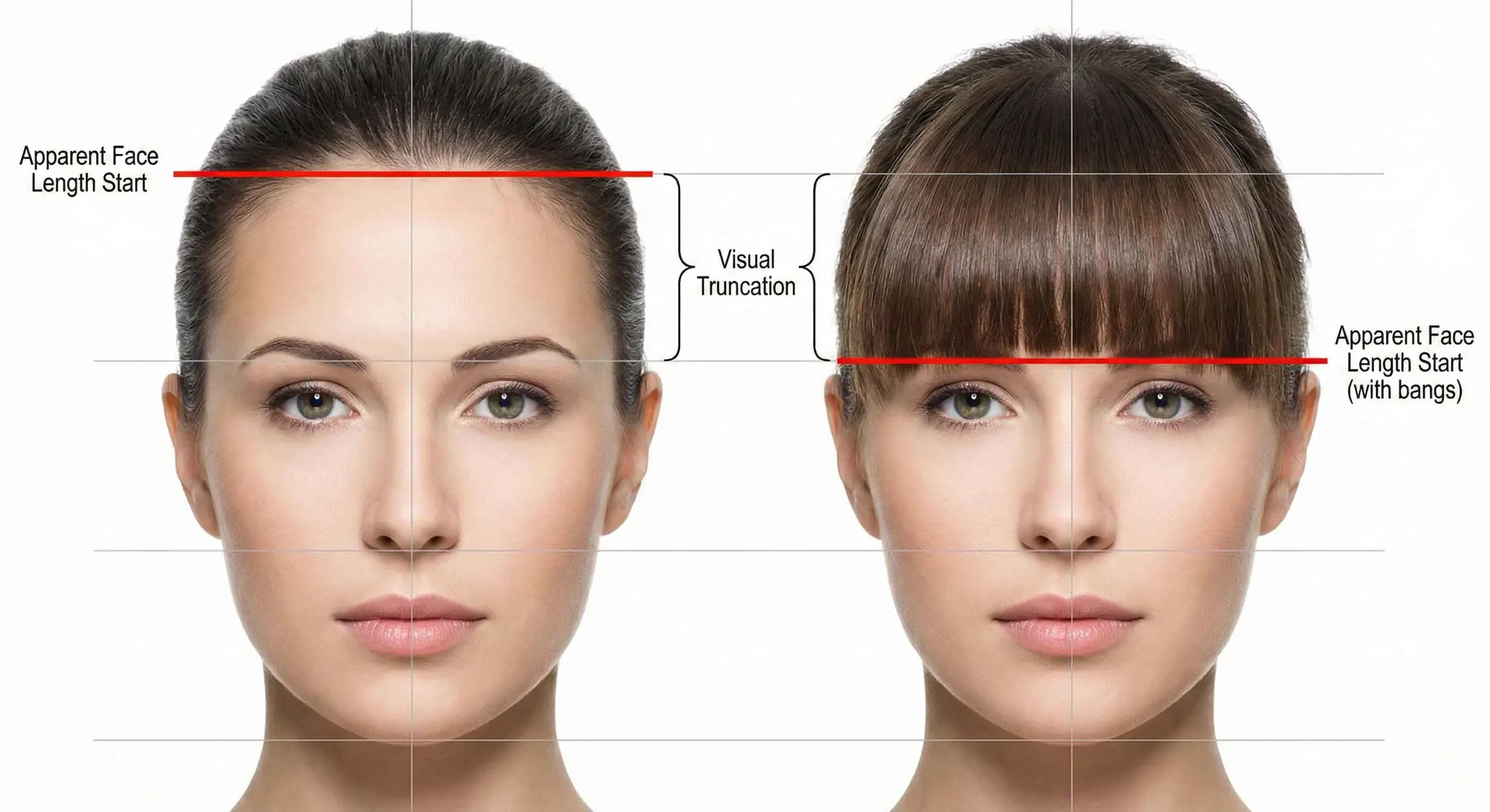
The human eye naturally scans a face vertically, from the hairline down to the chin.
When you introduce bangs, you create a distinct horizontal line that abruptly interrupts this vertical scan. By concealing the forehead, the visible length of the face is truncated. The face now appears to begin at the brow line rather than the hairline.
This structural shift condenses the facial geometry, making the face appear inherently shorter and, by default, proportionately wider. If you are trying to understand how this horizontal interruption compares to vertical framing, reviewing how hair length changes face proportions will clarify the broader mechanics of facial framing.
Shifting the Focal Point
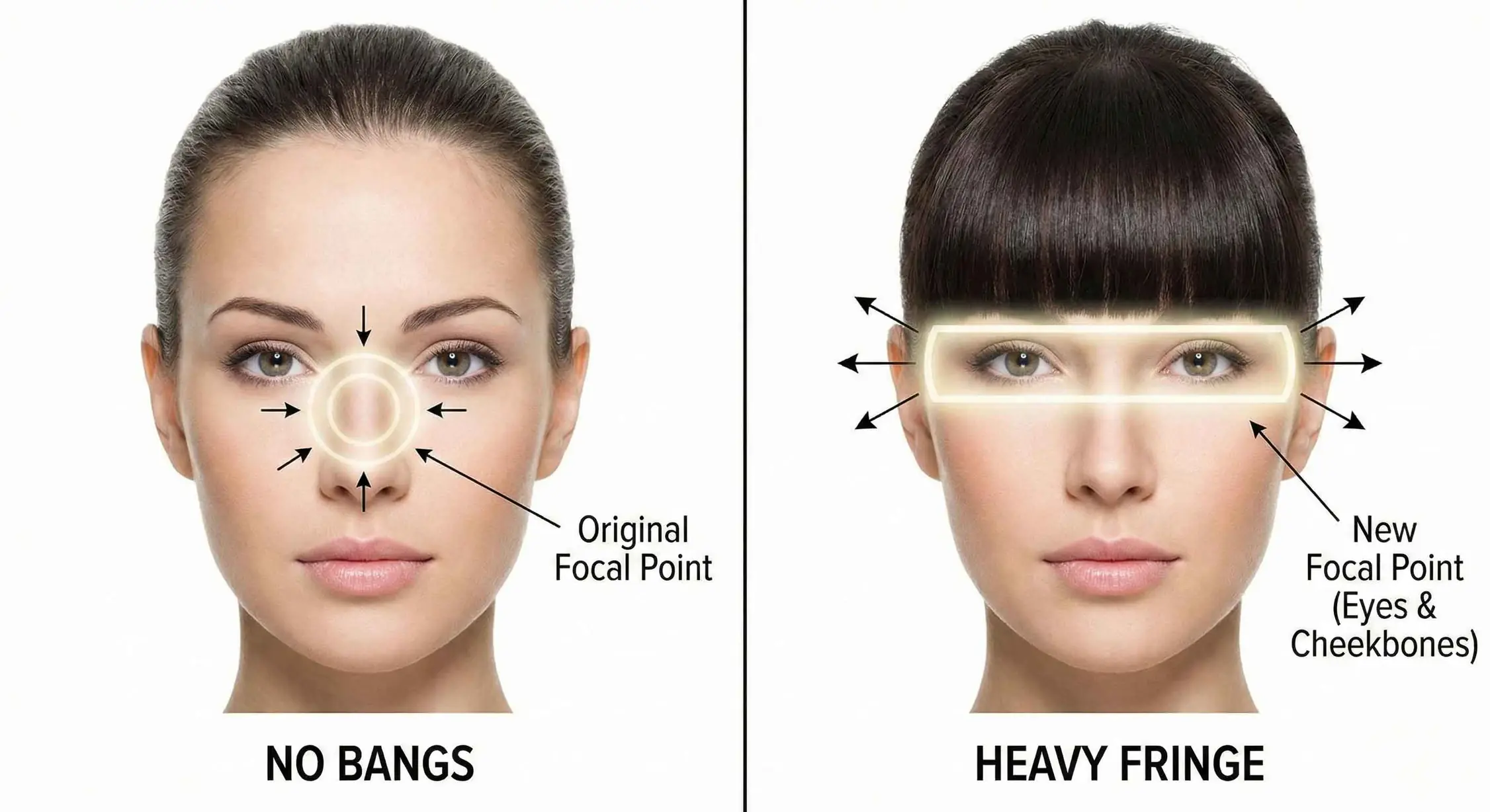
Hair structure dictates where an observer’s eye will rest. Without bangs, the focal point of the face typically lands on the center of the face, near the nose.
Bangs force a radical shift in this focal point. Because the strong horizontal boundary rests directly above or on the brow bone, the viewer’s attention is immediately anchored to the eyes and the upper cheekbones. The density of the hair acts as a frame, compressing the viewing area. If the cheekbones are naturally wide, bangs will amplify this width by creating a heavy canopy directly above them.
Width Expansion and Temple Termination
The structural impact of bangs is largely determined by where the horizontal line ends on the sides of the face.
If the bangs are cut straight across and terminate past the outer corners of the eyes—extending into the temples—they create a visual widening effect. The horizontal line stretches the upper half of the face outward. Conversely, if the fringe is curved downward at the temples, bridging into the side lengths of the hair, it creates a contained, narrowing frame.
Understanding this interaction is critical when analyzing how face shape affects haircut choices. A horizontal expansion is highly disruptive on a structurally wide face but creates necessary balance on a narrow structure.
Density and Opacity
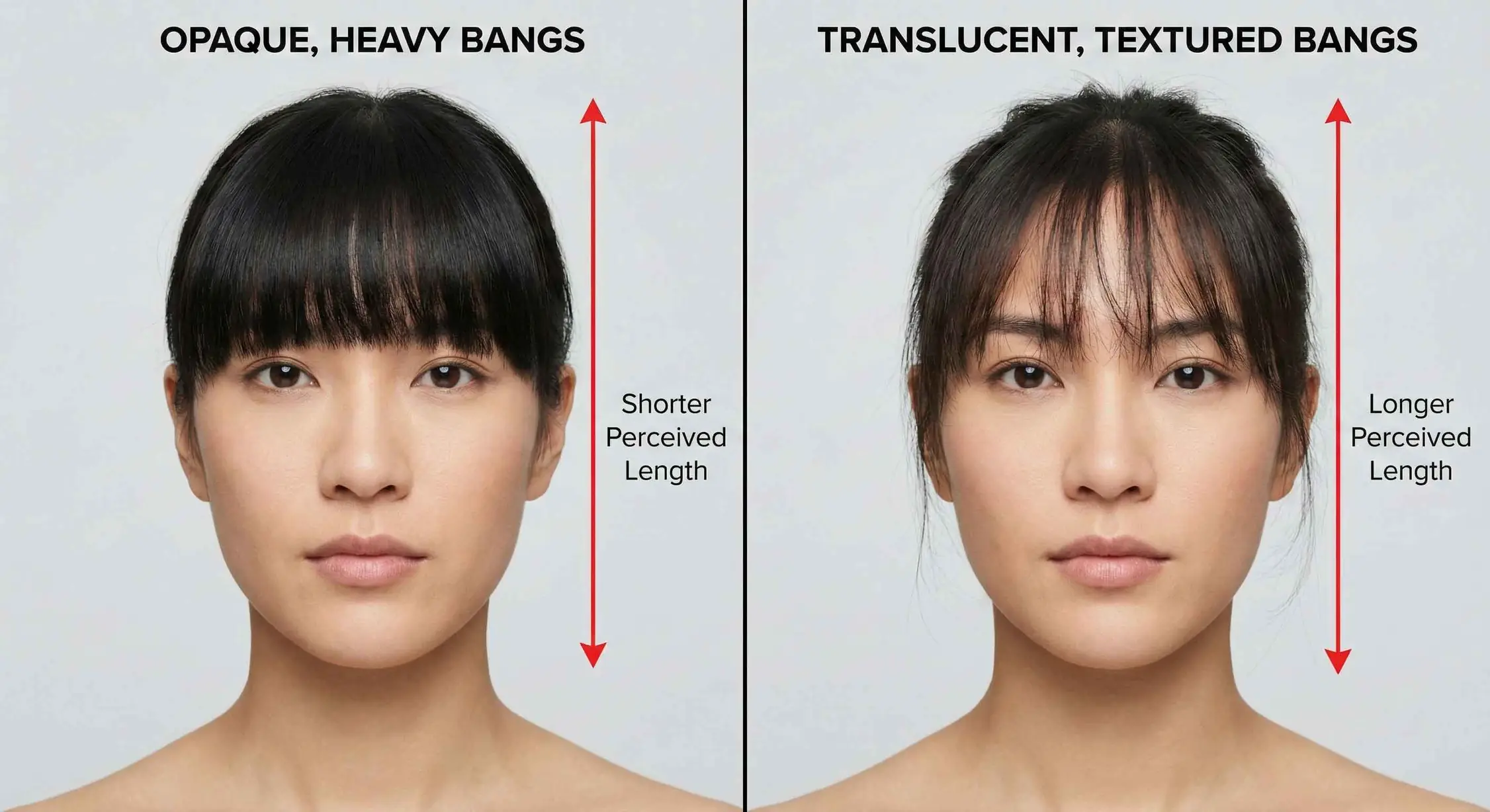
Not all bangs manipulate proportions with the same intensity. The severity of the geometric shift depends entirely on the opacity of the hair.
A solid, heavy fringe creates an impenetrable boundary. The visual truncation of the face is absolute. However, if the bangs are textured, point-cut, or thinly layered, they become translucent. The forehead remains partially visible through the hair, allowing the eye to continue its vertical scan up to the natural hairline. This softens the horizontal interruption and reduces the widening effect.
FAQ
Why do bangs make my face look rounder?
Bangs conceal the upper third of your face, reducing its visible vertical length. When you subtract vertical length without subtracting horizontal width, the face mathematically appears wider and rounder. This effect is amplified if the bangs are cut straight across the temples.
Do bangs work on a short forehead?
Structurally, adding bangs to a short forehead compresses an already limited vertical space, which can overwhelm the face. However, starting the bangs further back on the crown can create the illusion of a longer forehead, altering the perceived proportion.
How do I know if bangs will unbalance my specific face shape?
You must first understand your baseline facial geometry. Before committing to a structural alteration like bangs, you should identify your face shape at home to determine whether your face requires vertical elongation or horizontal widening.
Conclusion
Bangs are an exercise in spatial geometry. They are not merely a stylistic addition; they are a calculated method of altering the perceived length, width, and focal point of the face.
When deciding to incorporate bangs into a haircut structure, the decision must be based on an objective analysis of facial proportions. By understanding how horizontal lines and hair density manipulate visual perception, you can predict the exact structural outcome of the cut before the scissors ever close.