


Haircut longevity is rarely determined by how fast hair grows. In technical reality, haircut longevity is the result of structural engineering. A shape that collapses within weeks typically fails due to poor internal weight distribution rather than biological growth. Understanding haircut longevity requires analyzing geometry, gravity, density, and the evolutionary shift of mass as hair length increases.
When a haircut loses its integrity quickly, the issue is not growth itself — it is structural miscalculation. Growth merely exposes imbalance that was already present within the design.
In This Guide
Haircut Longevity and the Mechanics of Weight Distribution
Every haircut possesses a center of gravity. As hair grows — averaging half an inch per month — this center gradually shifts downward. Haircut longevity depends on whether the internal structure anticipates this displacement.
Through controlled elevation and intentional over-direction, a stylist builds a framework that maintains equilibrium over time. Without this internal engineering, the hair becomes bottom-heavy, visually dense, and resistant to natural movement.
It is important to distinguish between a temporary style and structural longevity. Styling products can disguise imbalance temporarily, but they cannot preserve haircut longevity if the foundation is compromised. For deeper analysis, see the structural differences between a haircut and a hairstyle.
Perimeter Stability as the Anchor of Haircut Longevity
The perimeter acts as the architectural boundary of the design. Strong haircut longevity requires a stable baseline capable of supporting internal weight as growth progresses.
Over-thinning or premature texturizing weakens this perimeter. As new length accumulates, compromised ends fail to hold tension, leading to visual collapse and fraying.
In structured designs — including layered haircuts — the relationship between sectioning and density becomes critical. If density removal exceeds structural necessity, haircut longevity is reduced dramatically.
Hair Density and Growth Evolution
Haircut longevity must align with the client’s natural density. Removing internal weight without respecting growth patterns introduces structural friction. As shorter internal strands grow, they begin pushing against longer surface layers, distorting the silhouette from within.
Fine hair and coarse hair respond differently to growth evolution. A structure that preserves haircut longevity in fine hair may collapse in high-density textures. Predicting this evolution requires understanding how hair type changes the visual outcome of a haircut.
For broader insight into hair growth cycles and biological factors, consult resources from the American Academy of Dermatology.
Visual Framework of Haircut Longevity
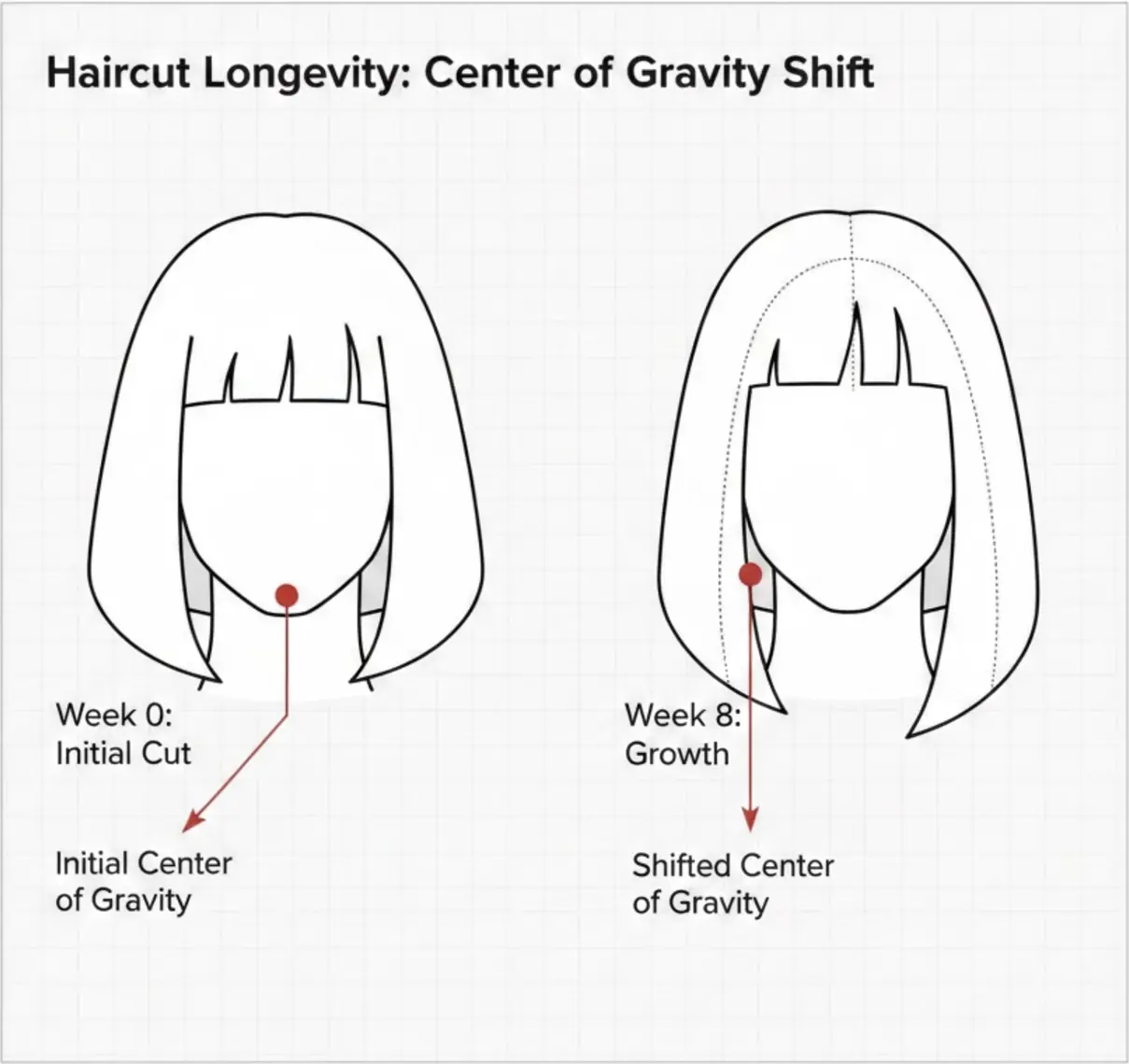
The diagram above illustrates how structural balance shifts as length increases. A haircut engineered for longevity anticipates this downward migration of mass and redistributes weight accordingly.
FAQ About Haircut Longevity
Q: Why does my haircut feel heavy only two weeks after cutting?
A: This often indicates insufficient graduation within the interior. As growth shifts weight into the jawline and ear zone, the haircut loses vertical lift — reducing haircut longevity.
Q: Can texturizing shears extend haircut longevity?
A: Excessive texturizing frequently shortens longevity. Removing structural support within sections destabilizes uniform growth progression.
Q: How do I identify a haircut designed for longevity?
A: True haircut longevity is visible during air-drying. If the shape settles naturally without heavy styling intervention, its geometric framework is sound.
Ultimately, haircut longevity is not trend-dependent. It is governed by structural physics — weight distribution, perimeter integrity, density compatibility, and growth anticipation. When these variables align, the haircut evolves instead of collapsing.