
Easy to maintain haircuts are not defined by how short the hair is cut. True low maintenance emerges from structural alignment — the harmony between haircut geometry and natural hair behavior.
A shape that demands minimal daily effort is engineered to cooperate with gravity, natural fall, and internal weight distribution. It does not depend on heat tools, tension, or product control to function.
This is the underlying principle of easy to maintain haircuts: structure replaces daily styling.
Achieving this compatibility requires evaluating density, growth patterns, and how geometric lines gradually evolve as the hair lengthens. A haircut may appear flawless in the salon, but daily life exposes whether its foundation is structurally sound.
When a cut becomes difficult to manage within weeks, the issue is rarely user error. More often, it reflects a misalignment between the haircut’s geometry and the hair’s natural physics.
In This Guide
Weight Distribution and Natural Fall
Every haircut has a center of gravity. In low-maintenance structures, that center is calculated to fall naturally into place without directional tension.
A salon blow-dry produces a temporary finish. Gravity reveals the permanent architecture.
Without calibrated internal support — balanced density removal and strategic layering — a haircut cannot sustain its own weight as it grows. Roots collapse, ends expand, and shape distortion accelerates.
A structurally aligned haircut evolves gradually rather than deteriorating abruptly.
For a deeper explanation of how geometry determines longevity, review the structural logic behind haircut longevity.
Perimeter Stability and Growth Trajectory
The perimeter defines the architectural boundary of a haircut. It establishes visual stability and anchors proportion.
When the baseline is excessively blunt and rigid, growth quickly exposes inconsistencies. Because individual strands cycle through phases of the human hair growth cycle, a perfectly sharp line loses precision faster than expected.
Subtle perimeter softening allows the haircut to grow without dramatic distortion. Instead of visible structural breakdown, the shape transitions smoothly over time.
A design that requires trimming every few weeks simply to appear intentional is not aligned with low-maintenance principles.
For a practical breakdown of this issue, see why blunt haircuts can fail structurally.
Hair Density Compatibility
Internal structure determines movement and manageability. When a haircut contradicts natural density, structural friction occurs.
Fine hair lacks sufficient structural mass — primarily composed of keratin protein — to support aggressive layering. It benefits from perimeter preservation and subtle internal support.
Coarse or highly dense hair, by contrast, requires internal space creation. Without it, the hair expands outward into a rigid mass that demands constant control.
A cut that ignores density forces mechanical intervention — flat irons to suppress volume or round brushes to artificially create it. This contradicts the purpose of a truly easy-to-maintain haircut.
To better understand this relationship, explore layered haircuts and density compatibility.
From Salon Precision to Daily Wear
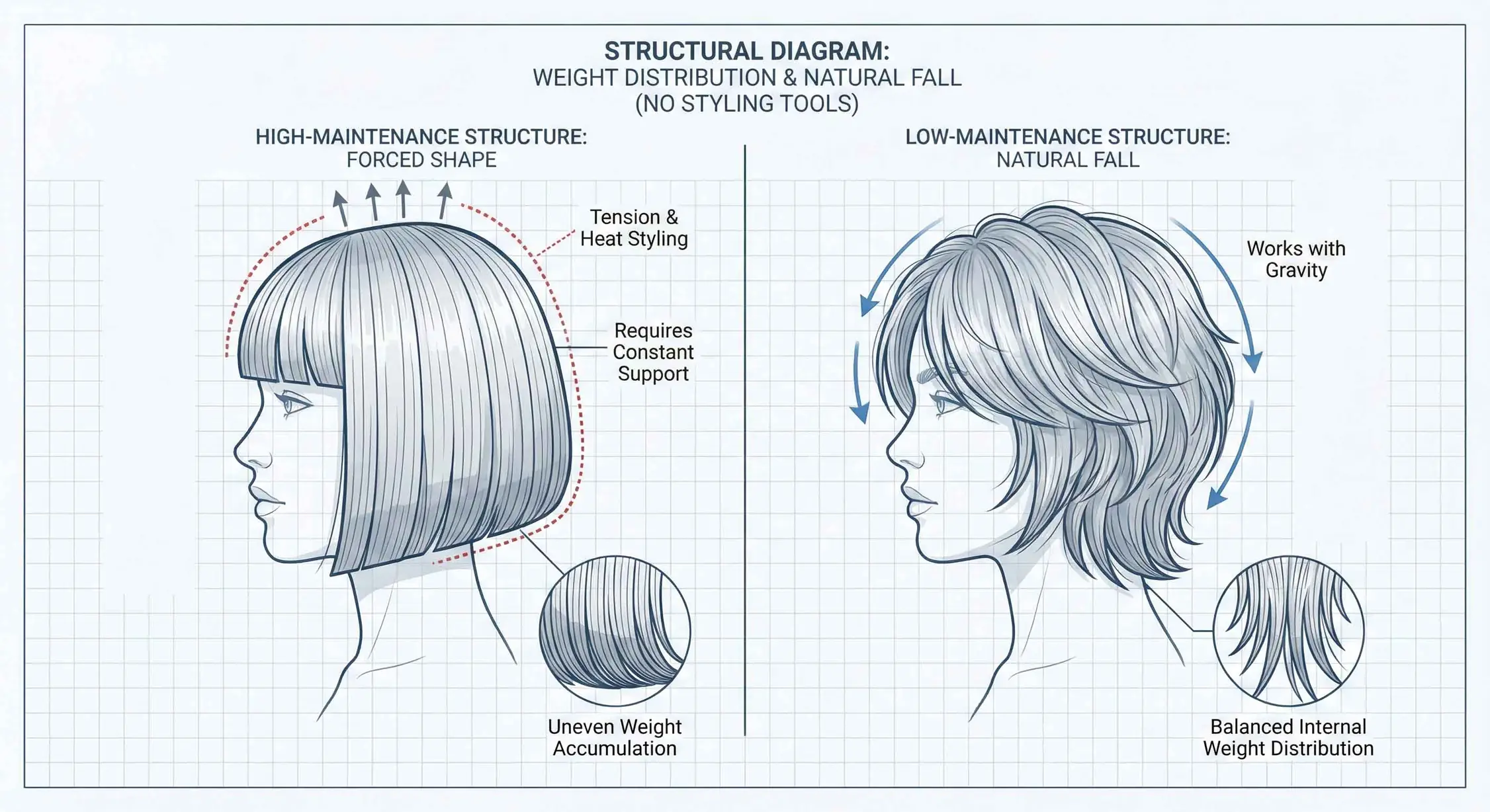
The diagram illustrates how a balanced structure relies on downward natural fall rather than upward artificial lift.
A low-maintenance haircut anticipates growth and redistributes internal weight accordingly. It minimizes reliance on tools and maximizes structural cooperation with natural physics.
Before choosing a new style, evaluate how the haircut behaves without professional intervention. Structural suitability must align with daily routine and personal habits.
For guidance, read how to choose a haircut that fits your lifestyle.
FAQ: The Mechanics of Low-Maintenance Hair
Does cutting hair shorter automatically make it easier to maintain?
No. Short hair exposes geometric precision and natural growth patterns more visibly. Small amounts of growth significantly alter proportion, often requiring more frequent trims.
Can thick hair support a low-maintenance structure?
Yes. The solution is controlled internal weight management — not random thinning. Strategic layering creates internal space while preserving structural integrity.
How should I communicate this to my stylist?
Shift the conversation from “style” to “structure.” Ask for a haircut designed around natural fall and density, one that sits correctly without heat styling.
Conclusion: Structure Determines Effort
Low-maintenance haircuts are governed by physics — gravity, weight distribution, density compatibility, and predictable growth trajectory.
When these structural variables align, the haircut functions effortlessly in daily motion, not just under salon lighting.