


Does short hair reduce bulk in thick hair is not simply a question of length, but a question of how structure redistributes volume.
Thick hair is defined by high density and strong internal mass. This creates expansion, resistance, and outward movement that can be difficult to control.
Cutting the hair shorter changes how this mass behaves. It alters weight distribution, reduces leverage, and limits how far the hair can expand away from the head.
This article explains does short hair reduce bulk in thick hair from a structural perspective. Rather than recommending styles, it focuses on the mechanics of density, length, and volume control.
In This Guide
Does Short Hair Reduce Bulk in Thick Hair: The Core Mechanism
Thick hair contains a large number of strands. This creates internal pressure that pushes the hair outward.
When hair is long, this mass spreads across a larger surface area. The weight pulls downward, but the density still creates expansion at the sides and ends.
When hair is cut shorter, two structural changes occur:
- The total weight is reduced
- The expansion radius becomes smaller
This limits how far the hair can push outward, making the overall shape appear more controlled.
However, this does not automatically mean less volume. In some cases, shorter hair can increase visible fullness due to reduced collapse.
This relationship is further explained in how hair type changes the way a haircut looks.
Why Thick Hair Feels Bulky in the First Place
Bulk is not just about density. It is about how density interacts with shape.
Thick hair creates bulk when:
- Internal weight is not properly distributed
- The perimeter becomes too wide
- The hair expands horizontally instead of falling vertically
Long thick hair often feels heavy but controlled due to gravity. Short thick hair can feel lighter, but visually wider if structure is not managed.
This is why bulk is a structural issue, not just a length issue.
For a broader breakdown, see haircuts for thick hair: why structure matters more.
How Short Hair Changes Volume Distribution
Short hair reduces leverage.
Leverage refers to how length allows weight to pull the hair downward. When length is removed:
- Gravity has less influence
- Hair springs outward more easily
- Volume shifts from vertical to horizontal
This is why short thick hair can appear wider, even if it feels lighter.
Reducing bulk is not about removing length alone. It requires controlling how the remaining mass is distributed.
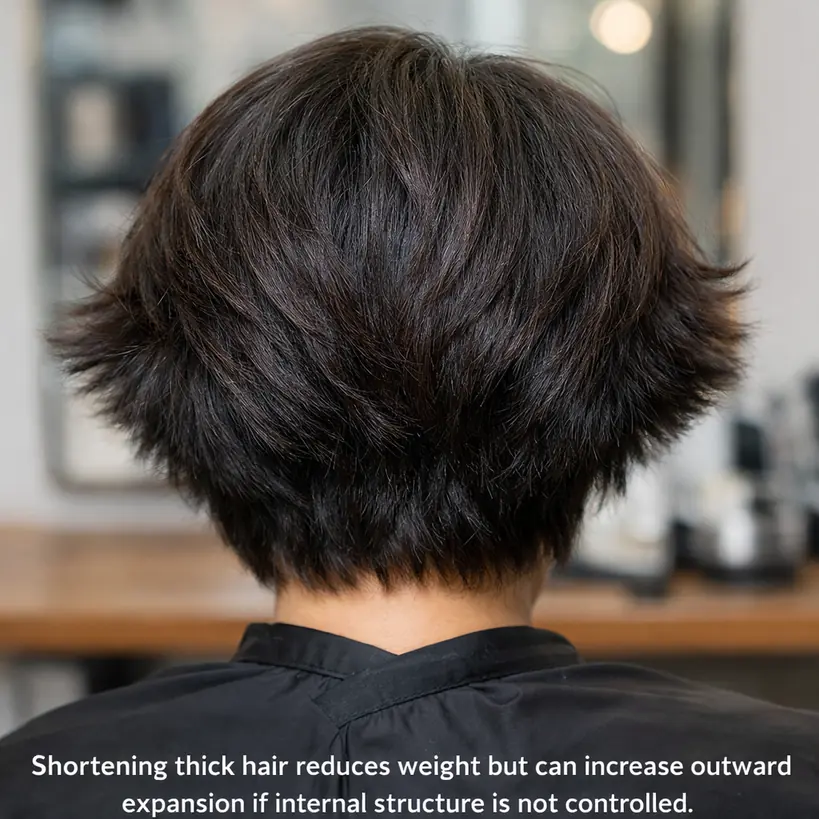
Why Cutting Short Does Not Automatically Reduce Bulk
A common misunderstanding is that shorter hair equals less bulk.
In reality, cutting thick hair short without adjusting internal structure can increase visual bulk:
- The shape becomes wider
- Edges appear heavier
- Expansion becomes more noticeable
This happens because density remains unchanged. Only the length is reduced.
Without internal weight control, the hair compresses vertically but expands horizontally.
This is closely related to the structural principles explained in layered haircuts structural logic.
The Role of Internal Weight Removal
To actually reduce bulk in thick hair, internal weight must be adjusted.
This involves selectively removing mass inside the haircut while maintaining perimeter control.
Key structural effects include:
- Reducing internal pressure
- Allowing the hair to fall closer to the head
- Preventing excessive outward expansion
However, over-removal creates instability. The hair may lose cohesion and become difficult to manage.
This balance is critical in shorter hair, where structural mistakes are more visible.
When Short Hair Effectively Reduces Bulk
Short hair reduces bulk only when structure is aligned with density.
This typically requires:
- Controlled internal weight removal
- A stable perimeter to anchor the shape
- Length that does not exceed the hair’s ability to stay compact
In this context, short hair becomes a compression system rather than a volume amplifier.
Understanding this balance is part of long vs short hair structure.
FAQ: Short Hair and Thick Hair Bulk
Does cutting thick hair short always make it less bulky?
No. Shortening the hair reduces weight but can increase outward expansion if internal structure is not controlled.
Why does my thick hair look wider after cutting it short?
Because shorter length reduces downward pull, allowing the hair to expand horizontally.
What actually reduces bulk in thick hair?
Proper internal weight removal combined with a balanced shape. Length alone is not sufficient.
Closing Perspective: Bulk Is a Structural Problem, Not a Length Problem
Ultimately, does short hair reduce bulk in thick hair depends on how structure is managed.
Length changes weight, but density controls behavior. Without structural adjustment, reducing length may shift bulk rather than eliminate it.
Haircut design is not about making hair shorter. It is about redistributing mass so that density, shape, and movement remain balanced.
Scientific observations on hair structure variability also support this complexity, as noted in studies of human hair growth.