
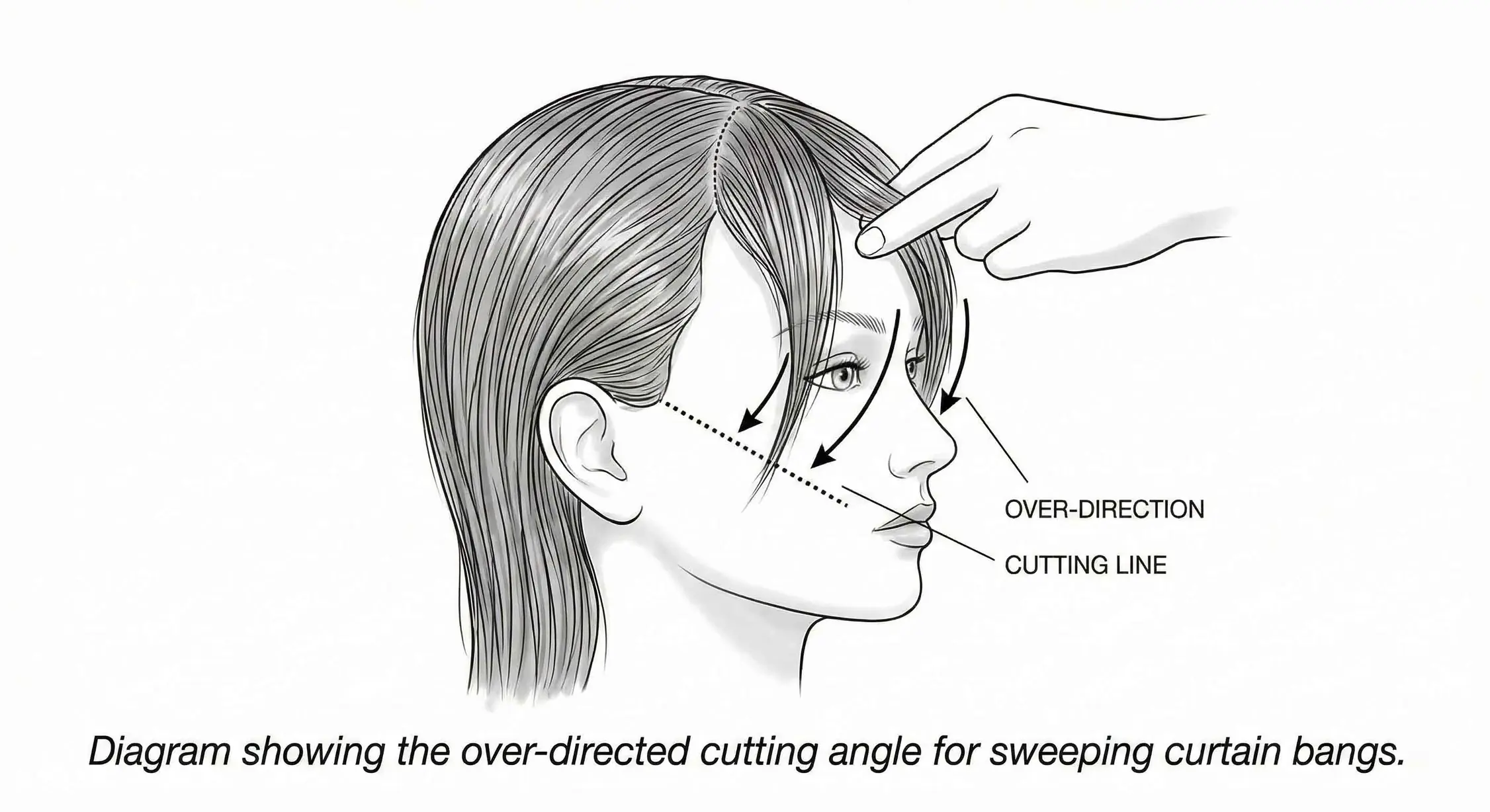
In This Guide
How Front Hairline Growth Dictates the Drape
Curtain bangs require the hair to part cleanly down the middle and flow symmetrically to either side. However, the front hairline is rarely perfectly symmetrical.
The Impact of Cowlicks
A cowlick is a section of hair that grows in a strong directional spiral. If you have a prominent cowlick at the front hairline, the hair will naturally fight the intended drape of the curtain bang.
Instead of sweeping gently backward, the hair will lift vertically at the root or split forcefully to one side, completely breaking the symmetrical “curtain” effect. While heat styling can temporarily alter this direction, the hair will eventually revert to its natural growth pattern as the day progresses, leading to structural collapse.
To understand how bone structure and hairline placement influence your results, see how face shape and head structure affect haircut choices.
Why Hair Density Alters the Silhouette
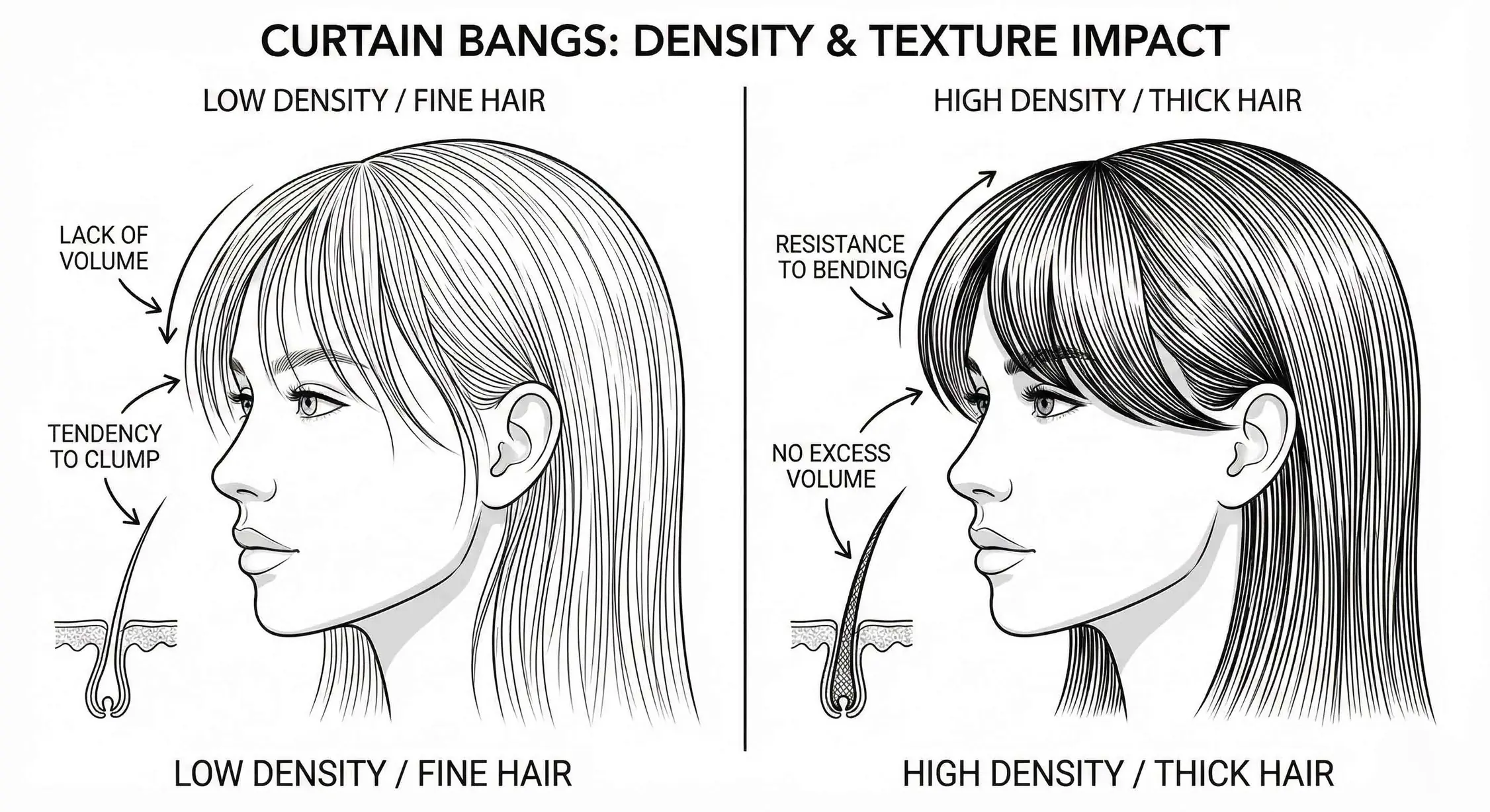
The sweeping drape of a curtain bang requires a specific weight balance. If there is too much mass, the hair cannot bend; if there is too little, the shape fragments.
Excessive Density and Coarse Textures
In highly dense or coarse hair, the individual strands possess a strong structural memory that resists bending. When cut into curtain bangs, the hair often creates a heavy, blunt shelf on the cheekbones rather than a soft taper.
Because the lateral volume is too high, the bangs project outward from the face, requiring aggressive texturizing to remove internal weight. For alternative shaping strategies, read haircuts for thick hair structure.
Low Density and Fine Textures
Curtain bangs require sufficient strand density to create a solid, visual frame. In fine or low-density hair, slicing out a front section for bangs reduces the overall density of the perimeter.
Without enough weight, the bangs cannot hold a cohesive shape. They quickly become stringy, absorbing facial oils and flattening against the skin within hours. For better structural integrity, review best haircuts for thin hair.
The Styling Reality of Face-Framing Layers
A curtain bang is rarely a wash-and-wear design. Hair naturally falls straight down due to gravity. The signature “swoop” associated with this look is entirely created through thermal styling—typically using a round brush and a blow dryer to apply heat and tension, followed by cooling the hair to lock in the bend.
If you do not manually manipulate the structure every time you wash it, the haircut simply looks like shorter pieces of hair hanging around your face.
Before committing to this cut, it is critical to separate the geometry of the cut from the daily requirement of the style. For further clarification, read haircut vs. hairstyle: the structural difference. You may also want to identify your hair type at home to anticipate your styling demands.
Who Should Reconsider Curtain Bangs?
Curtain bangs face structural failure if:
- You have a strong front cowlick that forces the hair in opposing directions.
- Your hair is extremely fine and lacks the density to hold a solid, sweeping shape.
- Your hair is highly coarse and resists taking on a curved bend without intense heat.
- You require a strictly low-maintenance routine and do not intend to blow-dry your front sections daily.
Frequently Asked Questions
Why won’t my curtain bangs stay swept away from my face?
Answer: Hair falls according to gravity and natural growth direction. The swept-back look is a temporarily styled state. If they fall forward, it means the thermal memory (the heat-styled bend) has worn off, or the structural weight of the hair is overpowering the styling product used.
Can curly hair support the structure of curtain bangs?
Answer: Structurally, yes, but visually the result is entirely different. On curly textures, curtain bangs will not form a smooth, sweeping drape. Instead, they act as short, volumetric face-framing coils. They require a specific cutting technique that accounts for shrinkage rather than over-direction. See realistic maintenance for curly hair haircuts.
Final Consideration
Curtain bangs require a specific alignment of hair density, growth patterns, and styling dedication to succeed.
Before altering your front perimeter, evaluate:
- Your front hairline and parting habits
- Your natural strand density
- Your styling frequency and tool usage
When executed on the correct hair type and styled consistently, they offer a dynamic, framing shape. If your structural reality does not support them, opting for longer, standard face-framing layers often provides a more reliable and stable alternative.
To align your haircut with your daily reality, review how to choose a haircut that fits your lifestyle.