


Curly hair is often treated as a styling problem.
In reality, it is a structural one.
Most disappointing curly haircuts don’t fail because the curls are unpredictable. They fail because the haircut assumes behavior that curly hair simply does not have—uniform length, stable shape, and predictable fall. Curly hair shrinks, expands, and redistributes weight every time it dries. Any haircut that ignores this will look fine once and drift out of shape quickly.
This article explains how haircuts for curly hair actually work, what determines whether a cut is sustainable, and how to judge a haircut by its maintenance reality, not its first-day appearance.
In This Guide
Why Curly Haircuts Age Faster Than Straight Haircuts
Straight hair changes gradually as it grows.
Curly hair changes nonlinearly.
A few millimeters of growth can shift curl grouping, expose uneven layers, or exaggerate bulk in one area. This is why curly haircuts often look “off” weeks earlier than expected.
Three factors control this behavior:
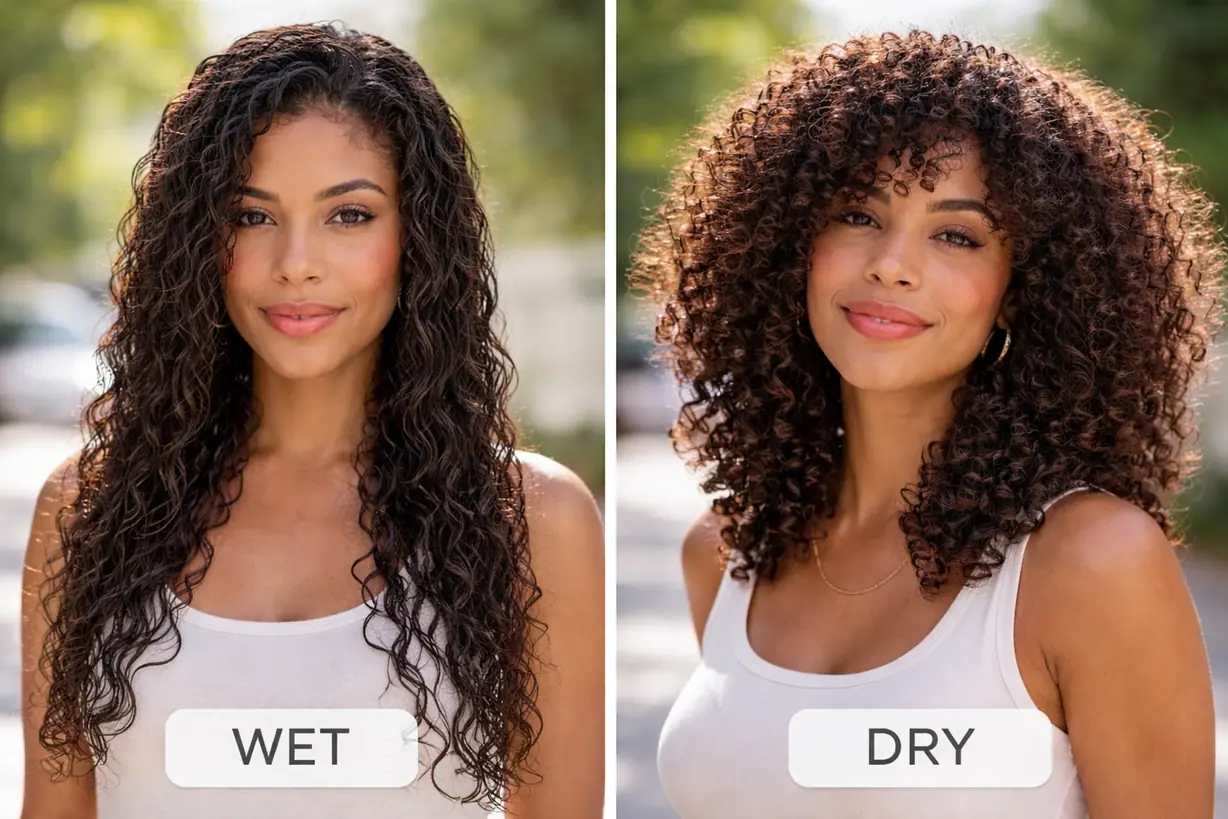
Shrinkage
Wet length is not usable information for curly hair. Depending on curl pattern and elasticity, dry length may rebound anywhere from 10% to over 40%. A haircut planned in wet length alone is incomplete.
Density distribution
Curly hair does not distribute weight evenly. Bulk accumulates where curls cluster, not where hair is longest. Removing length without managing density often increases width.
Curl grouping
Curls form families. Cutting through a curl group breaks visual continuity and creates frizz-prone edges, even if the line looks clean when wet.
A sustainable haircut works with these forces instead of fighting them.
Length Is Less Important Than Shape Control
Many people search for “short curly haircuts” or “long curly haircuts,” assuming length determines ease. Length matters—but not as much as where shape is controlled.
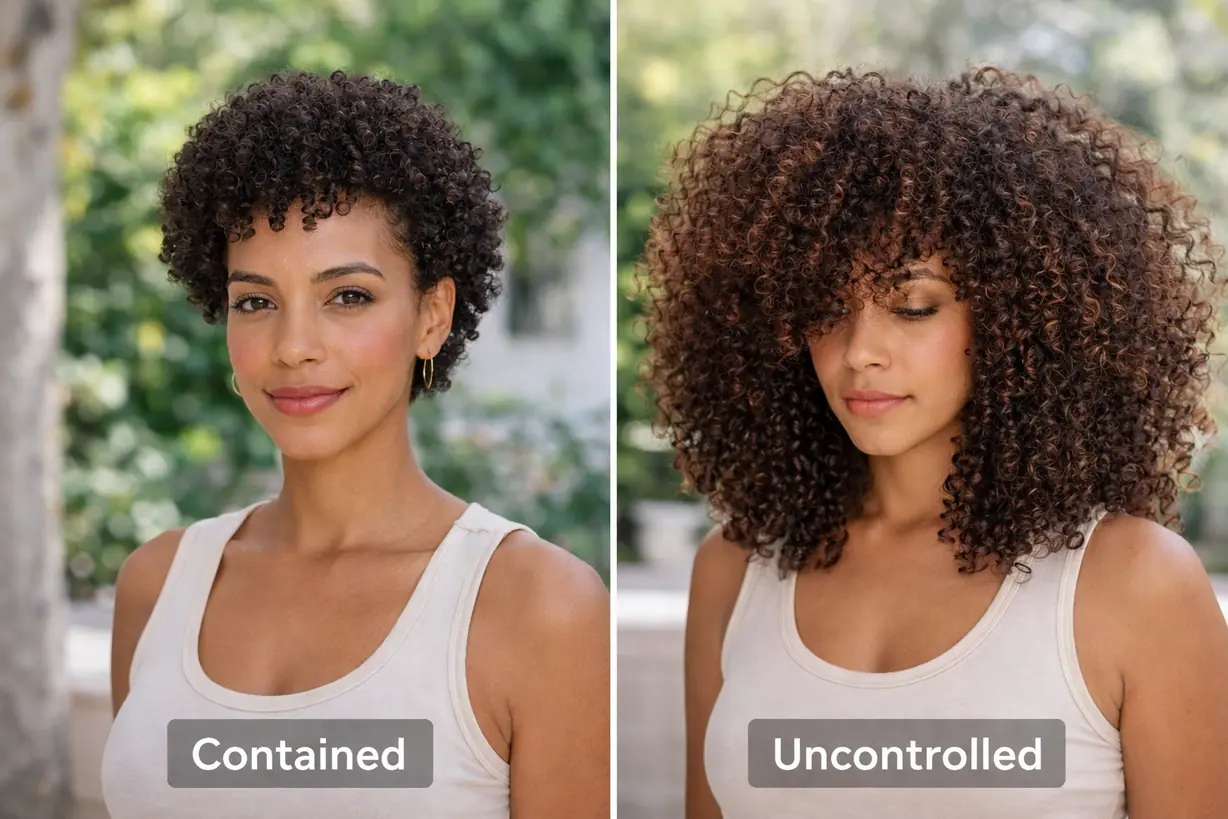
Short curly cuts demand frequent shape correction. As curls grow, volume expands outward quickly, and small imbalances become obvious. These cuts look intentional only when refreshed often.
Longer curly hair carries more weight, which can help curls fall downward—but excess length can also stretch curl definition and create flat roots.
Mid-length cuts tend to be the most forgiving, but only when layers are placed to manage expansion zones rather than chase symmetry.
A helpful way to think about curly haircuts is not short versus long, but contained versus uncontrolled.
Dry Cutting vs Wet Cutting: What Actually Matters
The dry-versus-wet debate is often overstated.
Dry cutting helps when shrinkage is extreme or curl patterns vary significantly across the head. It allows shape to be judged in its final state. Wet cutting works well for looser curl patterns or when the stylist understands how the hair will rebound.
What matters more than the method is whether the haircut accounts for:
- Final dry shape
- Curl grouping boundaries
- Growth pattern over time
A precise wet cut that anticipates shrinkage will outperform a dry cut that focuses only on individual curls. Technique is a tool, not a guarantee.
Layers: Function Before Style
Layers are often treated as a volume trick. For curly hair, they are a load-balancing system.
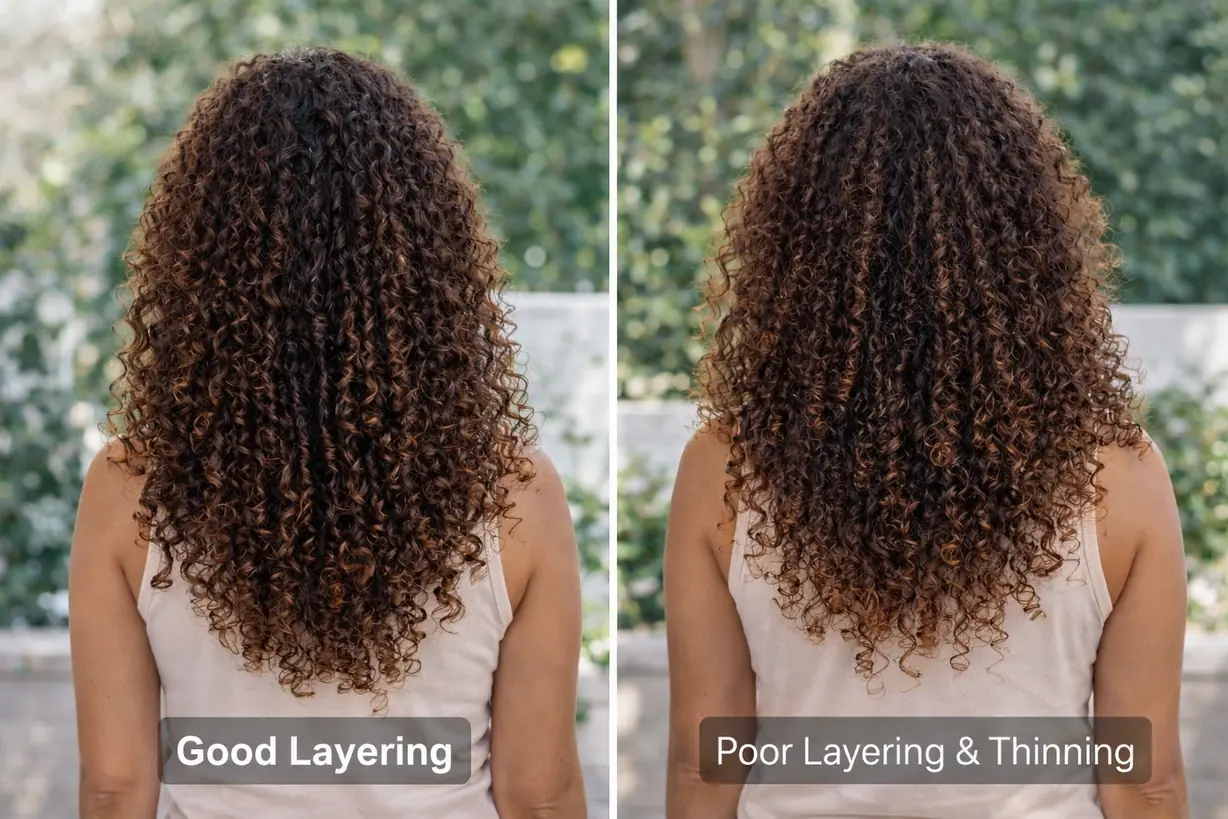
Poor layering creates the familiar triangle shape: flat at the crown, wide at the ends. Effective layering redistributes weight upward without collapsing curl structure.
Key principles that hold across curl types:
- Layers should follow curl groupings, not slice through them
- The shortest layer determines maintenance frequency
- Over-thinning increases frizz and accelerates shape loss
If a haircut relies on thinning shears to “remove bulk,” it is compensating for a shape problem rather than solving it.
Maintenance Reality: The Question Most Haircuts Avoid
A haircut is not successful because it looks good today.
It is successful if it stays understandable as it grows.
Before choosing a curly haircut, it helps to know:
- How often shape must be refreshed
- Whether the cut depends on daily styling
- How it behaves when air-dried
Shorter curly cuts often require more frequent washing and reshaping. Longer cuts may tolerate air-drying better but need density management to avoid heaviness. There is no universally “low maintenance” curly haircut—only cuts whose maintenance matches real life.
FAQ
Does curly hair always need layers?
No. Layers are useful when they solve a shape or density problem. Blunt or minimally layered cuts can work for some curl patterns, but only when weight distribution remains balanced.
Is cutting curly hair dry always better?
Not always. Dry cutting helps visualize final shape, but informed wet cutting can be equally effective. Understanding shrinkage matters more than the cutting state.
Why does my curly haircut look good once and then fall apart?
Because the cut was designed for day-one styling, not growth behavior. If shape collapses quickly, the structure was not sustainable.
Final Perspective
Curly hair does not need correction.
It needs accurate assumptions.
The most reliable curly haircuts are not defined by trend or technique, but by how honestly they account for shrinkage, density, and time. When a haircut respects how curly hair actually behaves, styling becomes optional instead of mandatory—and maintenance becomes predictable instead of frustrating.
That is the real difference between a haircut that looks good and one that lasts.