


This guide explains when a blunt haircut fails, why it fails, and how to determine whether this geometric design will actually work for your head shape and hair type.
In This Guide
Why Blunt Haircuts Fail on Certain Head Shapes
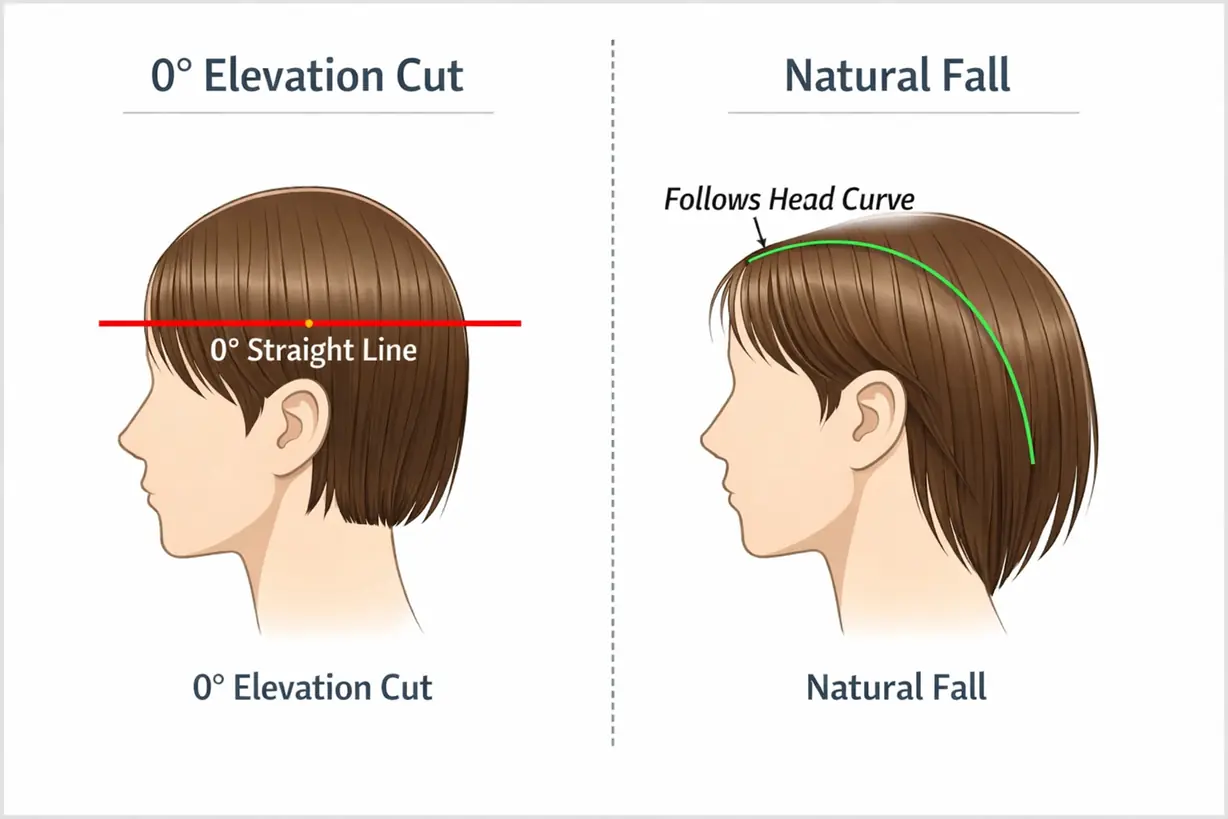
A blunt haircut attempts to impose a perfectly straight line onto a curved, three-dimensional surface — the human head. That geometric conflict is where many structural failures begin.
The Occipital Bone Effect
The most common problem area is the occipital bone — the rounded curve at the back of the head.
If the back of the head is relatively flat, the perimeter line hangs evenly. However, when the occipital bone protrudes, the hair covering that curve must travel a longer surface distance than the hair at the nape.
This creates uneven tension and movement. When the head shifts, the perimeter can separate, forming a visible gap or an inverted V shape.
This is not a cutting mistake. It is a geometric limitation — straight lines do not naturally wrap cleanly around convex structures.
To better understand how bone structure influences haircut outcomes, see how face shape and head structure affect haircut choices.
Why Hair Density and Texture Matter in a Blunt Cut
A blunt cut depends almost entirely on gravity to maintain its shape. When internal expansion forces — such as density or curl pattern — overpower gravity, the structure destabilizes.
1. Very Thick or High-Density Hair
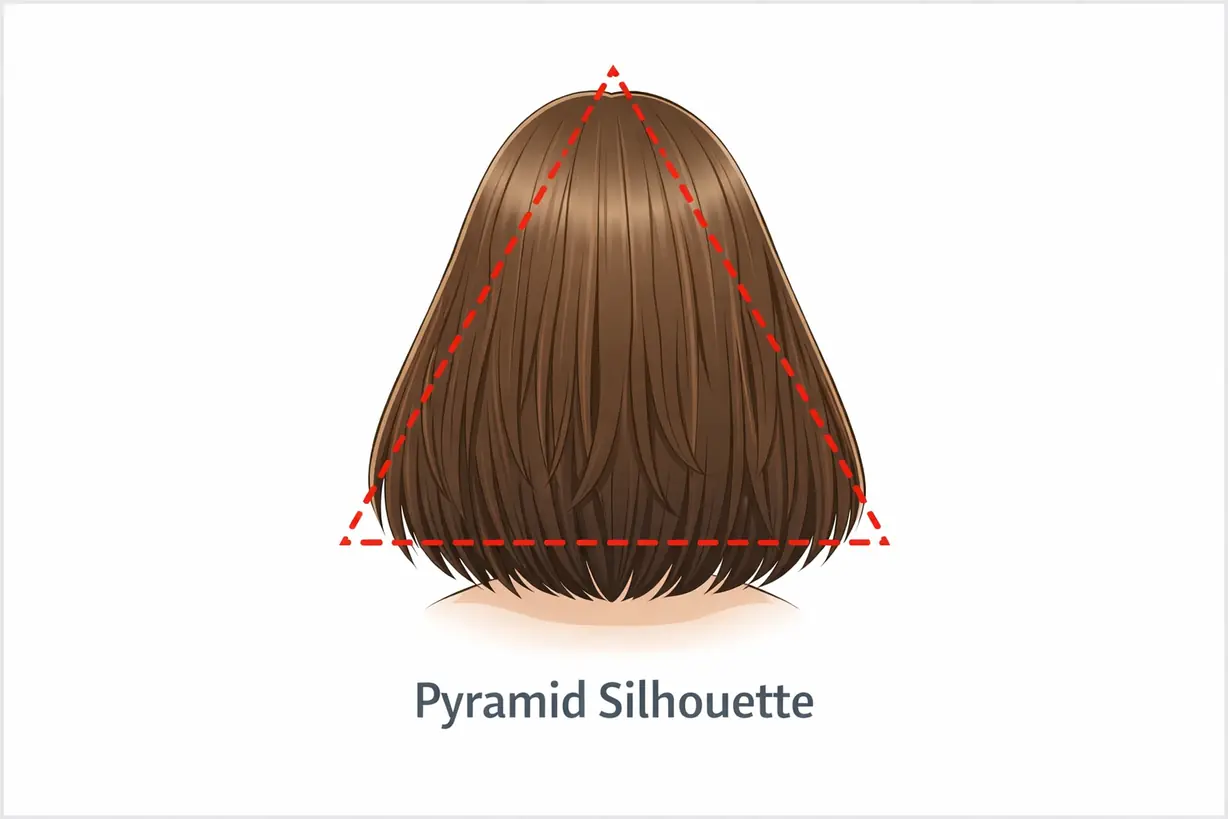
In extremely dense hair, weight accumulates at the perimeter. Without internal layering to redistribute mass, the lower section expands outward.
This creates the well-known “pyramid effect” — narrow near the roots, wider at the ends.
Structurally, lateral volume exceeds downward pull. Instead of falling vertically, the shape spreads horizontally.
Correcting this often requires internal weight removal, which technically alters the haircut from being a true blunt cut.
For management strategies, read haircuts for thick hair structure.
2. Low-Density or Very Fine Hair
Blunt cuts are often recommended to “create thickness.” This works only if there is enough hair density to build a solid perimeter line.
If density is too low — especially around the hairline — the blunt edge appears transparent or fragmented rather than bold and graphic.
A blunt line is a visual illusion. It requires sufficient strand concentration to appear solid.
For structural alternatives, see best haircuts for thin hair.
The Styling Reality Most People Overlook
A blunt haircut only appears sharply geometric when the hair is fully straight.
If your hair has natural wave or curl, the perimeter visually breaks apart. The sharp edge disappears unless you heat-style it smooth.
This is why blunt haircuts often look perfect in photos but disappointing at home. Most reference images show a styled finish — not the natural state of the cut.
If your goal is wash-and-go practicality, a blunt haircut may conflict with your natural texture.
For further clarification, read haircut vs. hairstyle: the structural difference.
You may also want to identify your hair type at home before requesting this design.
Who Should Avoid a Blunt Haircut?
A blunt haircut may not be ideal if:
- You have a pronounced occipital curve that creates separation at the back.
- Your hair is extremely dense and expands outward without internal layering.
- Your hair is very fine with limited perimeter density.
- You prefer low-maintenance styling and do not plan to heat-style regularly.
Blunt haircuts succeed only when head shape, density, texture, and lifestyle are aligned.
Frequently Asked Questions
Why does my blunt cut flip out at the ends?
Answer: The most common cause is the “shoulder barrier.” When the perimeter rests directly on the shoulders, physical obstruction forces the ends outward. It may also occur if the hair was cut with high tension; as the hair relaxes, it retracts and flips.
Can curly hair have a blunt cut?
Answer: Technically yes — visually no. On curly textures, a blunt cut does not appear as a straight line. Instead, it forms a heavy shelf or triangular expansion. Most curly hair benefits from strategic layering to balance volume. See realistic maintenance for curly hair haircuts.
Final Consideration
A blunt haircut is not a trend. It is a structural commitment.
Before choosing it, evaluate:
- Your head curvature
- Your hair density
- Your natural texture
- Your willingness to style daily
If these factors align, a blunt cut can look precise and powerful. If they do not, subtle internal layering often produces a more balanced and sustainable result.
To align your haircut with your routine, review how to choose a haircut that fits your lifestyle.