
A common piece of advice in haircutting is that round faces should avoid bangs entirely.
Like most blanket statements in hair design, this is fundamentally incorrect. The issue is never the bangs themselves; it is the structural geometry they introduce to the face.
Bangs do not inherently widen a face. What they do is alter the visual starting point of the forehead and manipulate where the eye travels. This concept is deeply tied to how bangs change face proportions on a structural level.
This guide breaks down the structural mechanics of bangs on a round face, explaining how to build angles and what geometric mistakes to avoid.
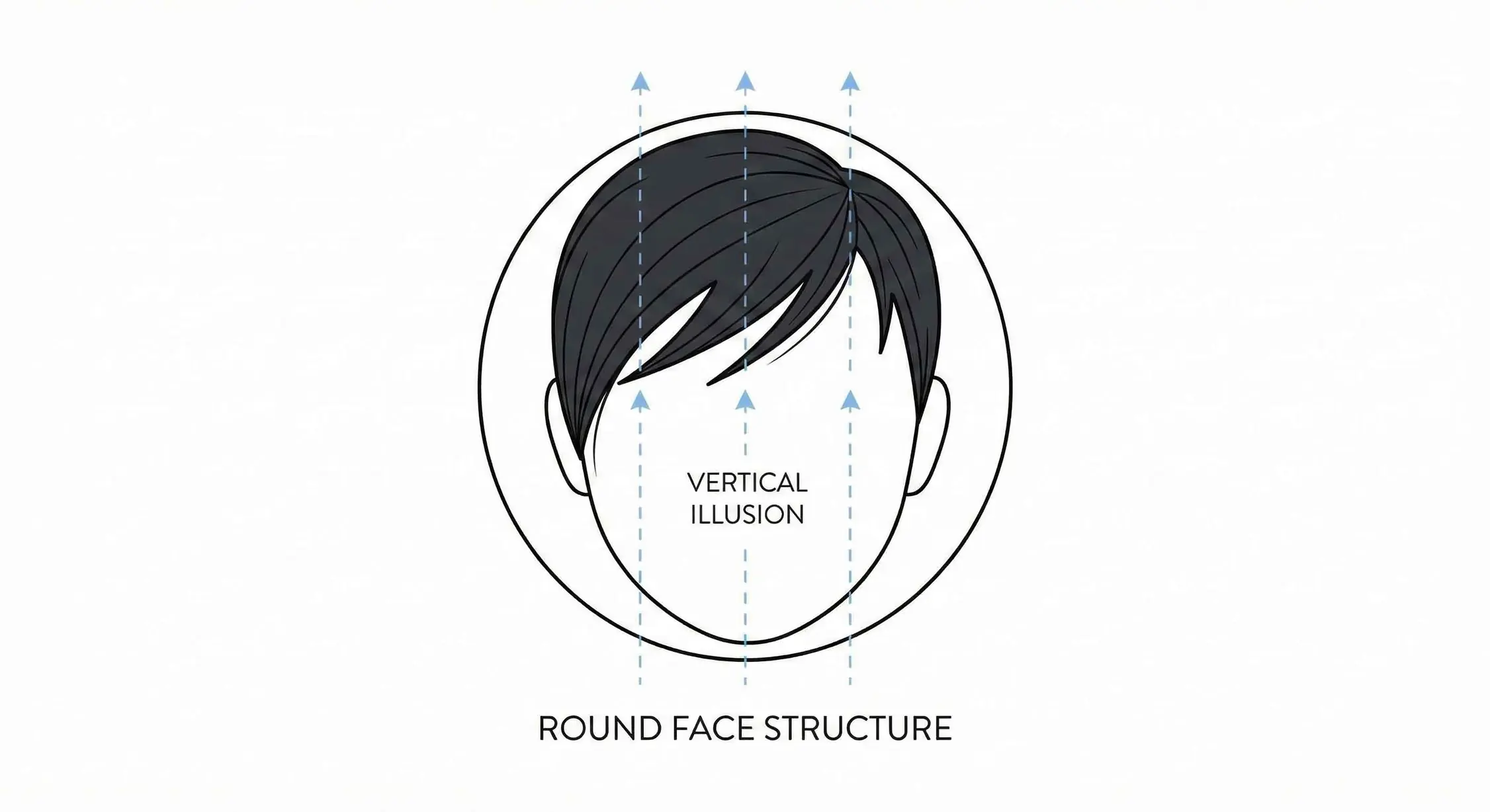
Notice how introducing a diagonal line across the forehead immediately breaks the circular symmetry, shifting the visual focus vertically.
In This Guide
The Structural Logic of a Round Face
A round face is characterized by nearly equal width and length, with softer jawlines and less pronounced angularity.
Before committing to a fringe, it is crucial to ensure this is your actual baseline. Many people mistake a slightly softer jawline for a round face when they actually have square or oval proportions. You can verify this using a systematic at-home face shape identification process.
When designing for a round face, the structural objective is elongation and angularity:
- Breaking up the horizontal width at the cheekbones
- Creating vertical visual pathways
- Introducing sharp or textured lines to contrast the face’s natural curves
The right fringe achieves this by drawing the eye up and down, rather than side to side.
What Fails: The Horizontal Block
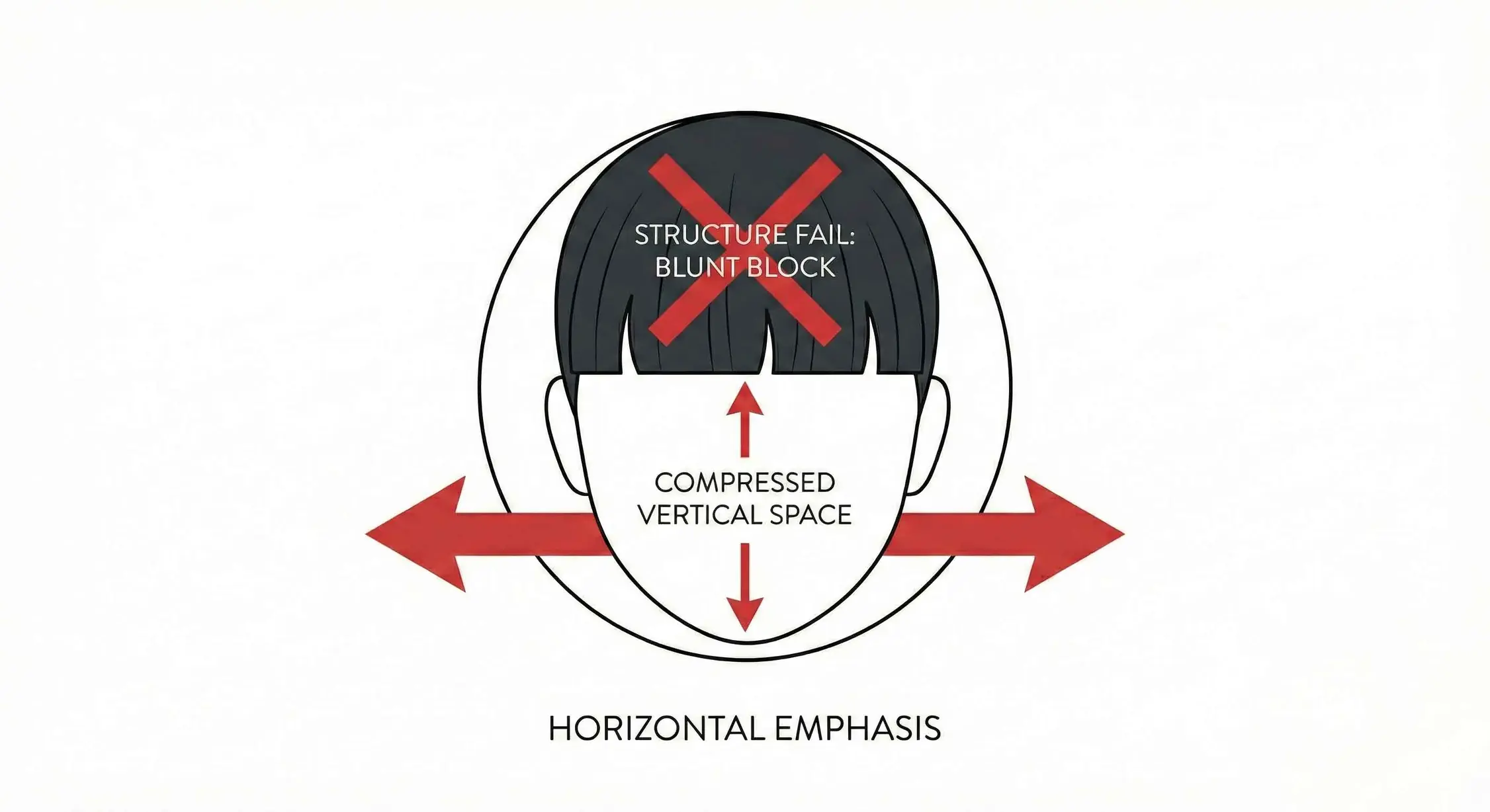
The reason bangs have a poor reputation for round faces usually comes down to one specific cut: the heavy, blunt fringe.
When hair is cut straight across the forehead in a solid, unbroken line, it creates a horizontal block. This structural choice essentially cuts off the top third of the face. By eliminating the forehead from the visual equation, the remaining visible area of the face (the cheeks and jaw) appears wider and more compressed.
If you understand the structural differences between blunt and wispy bangs, it becomes clear why a blunt horizontal line works against the geometry of a round face. It reinforces the width instead of breaking it.
The Solution: Angles, Texture, and Asymmetry
To balance a round face, bangs must interrupt the circular outline. This is achieved through specific structural placements.
The Diagonal Interruption (Side-Swept)
By parting the fringe to one side and allowing it to sweep across the forehead, you create a strong diagonal line. Diagonals trick the eye into seeing length. The hair should ideally taper and blend near the cheekbone, cutting off the widest part of the face.
The Vertical Channel (Curtain Bangs)
Curtain bangs can work exceptionally well, provided they are structured correctly. They must carry enough length to hit below the cheekbone and be styled with volume at the root. This parts the hair in the center or slightly off-center, creating a narrow, vertical sliver of forehead that elongates the face. However, this structure requires specific maintenance; understanding when curtain bangs work and when they collapse is vital before choosing this cut.
Textured Vertical Breaks (Wispy Fringe)
If a forward-falling fringe is desired, it must be deeply point-cut and wispy. By allowing parts of the forehead to show through the hair, you maintain vertical continuity from the chin to the hairline, avoiding the horizontal compression of a blunt cut.
How to Communicate This to a Stylist
Do not simply ask for “bangs.” Focus on the structural elements you need the haircut to perform:
- “I need to keep the center of the fringe soft and textured so my forehead isn’t completely hidden.”
- “Please ensure the longest pieces of the fringe fall right below my cheekbones to break up the width.”
- “I want to avoid any harsh, straight lines across my face; let’s keep it angled and asymmetrical.”
This instructs the stylist on the mechanics of the cut, ensuring the final result serves your proportions.
FAQ
Do curtain bangs make a round face look wider?
They can, if cut too short. If curtain bangs end exactly at the widest part of the cheeks, they will highlight that width. They must be structured to fall below the cheekbone to create an elongating effect.
Can I wear micro bangs if my face is round?
Yes, but they must be highly textured and asymmetrical. A blunt micro bang will widen the face, but a choppy, piecey micro bang opens up the forehead entirely, which can actually elongate the face by maximizing visible vertical space.
Why do my side-swept bangs keep falling flat?
Side-swept bangs require a structural foundation to maintain their diagonal line. If they fall flat, it is usually a density issue or a lack of proper root direction during blow-drying. The cut must remove enough interior weight so the hair can sweep without collapsing under its own mass.