
A common misconception in haircutting is that an oval face shape can wear absolutely any fringe.
While it is true that an oval face has inherently balanced proportions, introducing a fringe drastically alters the visual geometry of the head. A poorly engineered fringe will override the face’s natural symmetry, artificially compressing or elongating the features.
Before altering the front perimeter of your hair, you must understand the baseline rules of foundational haircuts for an oval face. The objective is not to “fix” the shape, but to introduce new lines without destroying the existing equilibrium. This requires a deep understanding of how bangs change face proportions.
This guide breaks down the structural mechanics of adding a fringe to an oval face, explaining how to control weight, length, and geometric angles.
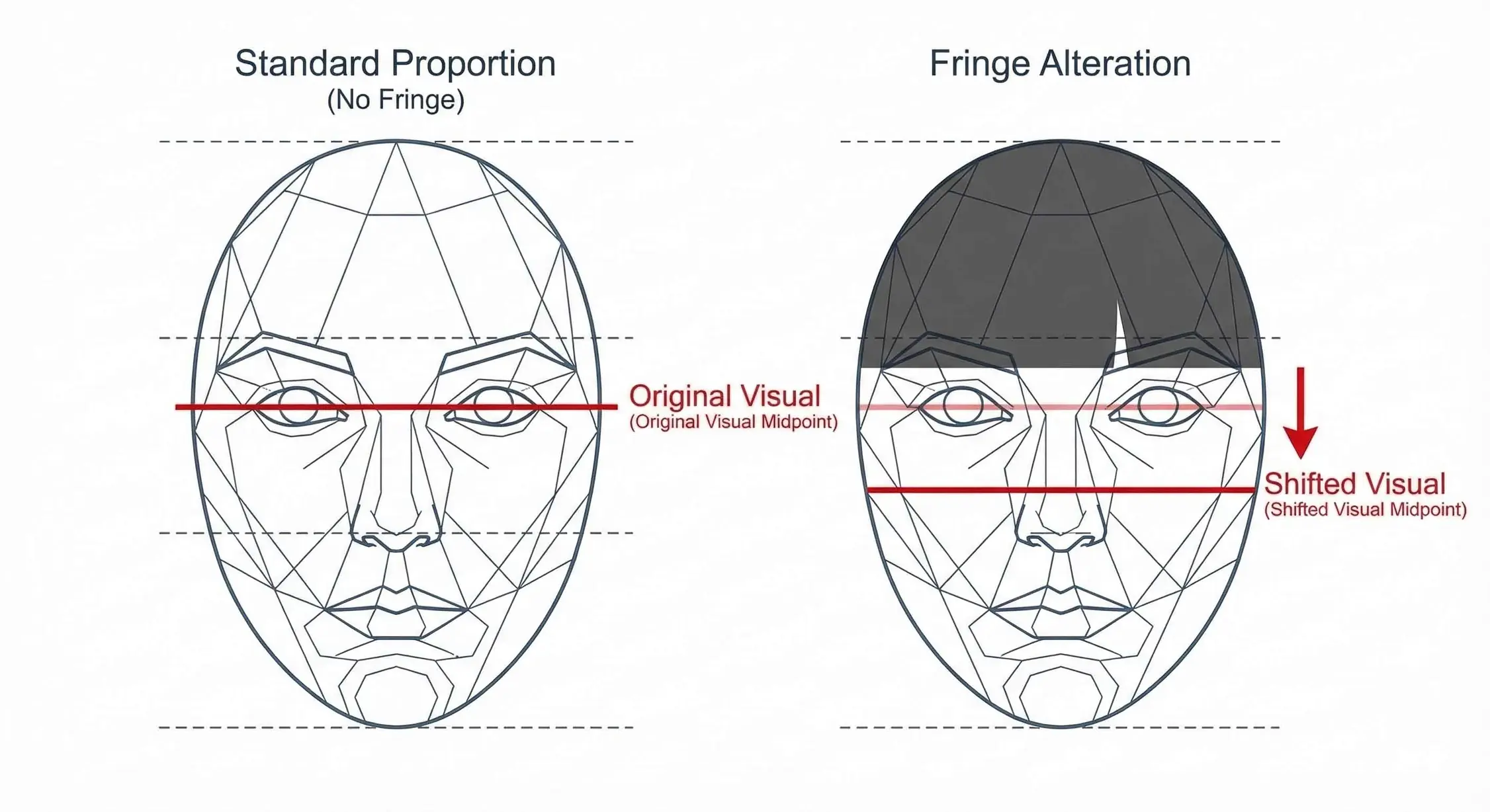
Notice how the natural midpoint of the face sits at the eyes. Introducing a fringe lowers the visual ceiling, forcing the eye to re-measure the remaining visible space from the brow to the chin.
In This Guide
The Structural Logic of an Oval Face
An oval face is defined by a length that is roughly one and a half times its width, with a gently rounded hairline and jaw. There are no harsh corners or extreme widths to camouflage.
Because the structural baseline is already balanced, the mechanical goal of a fringe changes. You are no longer trying to widen a narrow face or lengthen a round one. Instead, the objective is proportion preservation:
- Maintaining the equal ratio between the forehead, mid-face, and lower face
- Avoiding heavy horizontal lines that artificially shorten the face
- Ensuring the fringe’s density does not overpower the softness of the jawline
If you disrupt these ratios, an oval face will visually collapse into a round face or stretch into a long face.
The Geometric Risk: Over-Compression
The most frequent structural failure on an oval face is over-compression, usually caused by an excessively deep, heavy fringe.
When hair is pulled from too far back on the crown to create a thick, solid line across the eyebrows, it entirely erases the top third of the face. By mathematically removing the forehead from the observer’s view, the remaining visible face (from the brows down) appears suddenly wider and shorter.
Understanding the structural differences between blunt and wispy bangs is critical here. A heavy blunt line creates a hard horizontal barrier. If the goal is to maintain the oval’s natural vertical flow, the density of the fringe must be reduced.
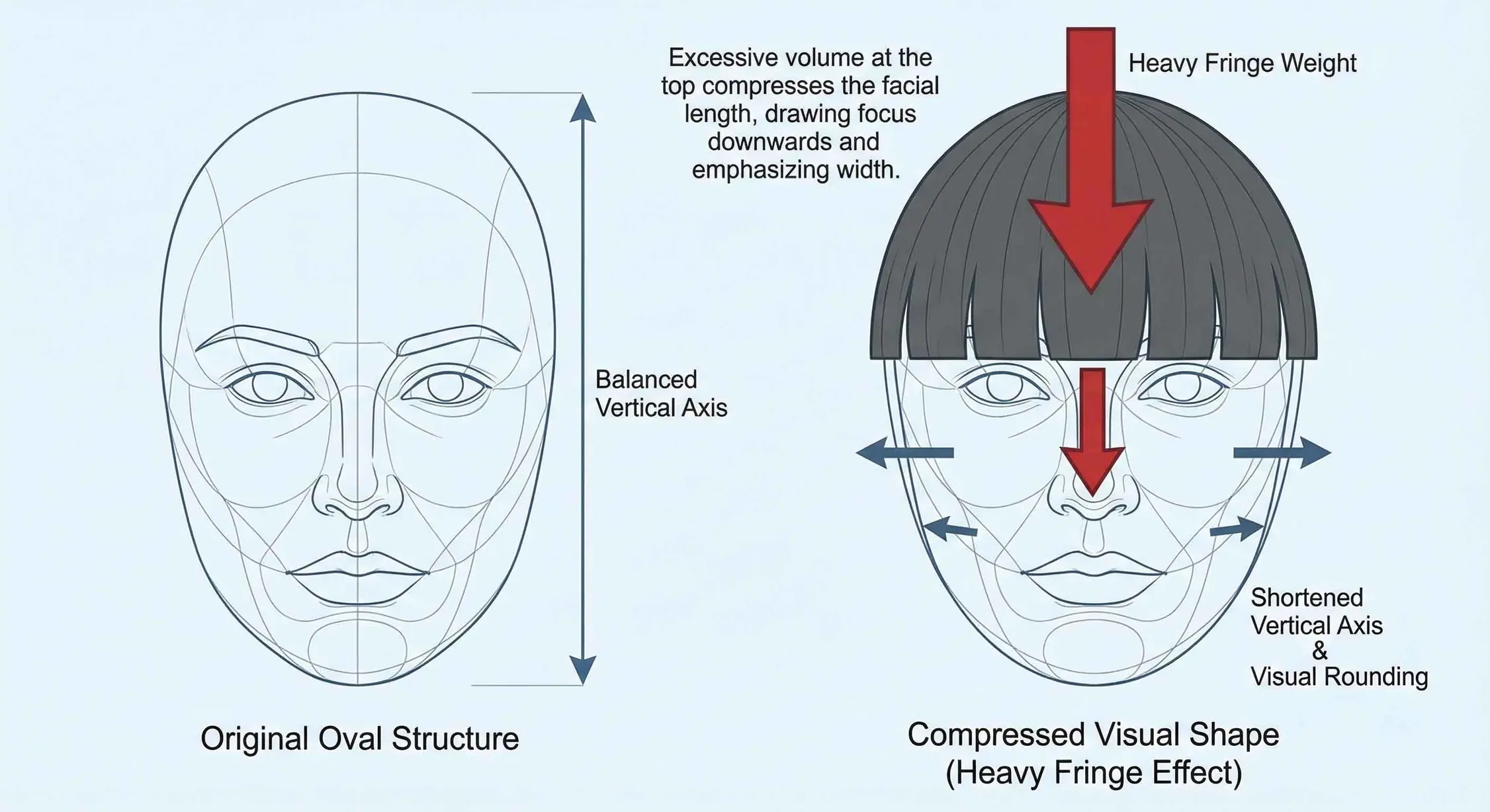
Maintaining Proportion: Density and The Horizontal Break
To successfully integrate a fringe into an oval face, the horizontal line must be broken, or the density must be adjusted so the forehead is not entirely obscured.
The Textured Break (Wispy Fringe)
By point-cutting the ends and removing interior bulk, you create vertical gaps within the fringe. This allows the skin of the forehead to show through. Visually, the brain connects the skin of the forehead to the rest of the face, maintaining the perception of length while still enjoying the framing effects of the hair.
The Soft Diagonal (Curtain Bangs)
Parting the fringe in the center and sweeping it outward creates an inverted “V” shape. This exposes the center of the forehead, preserving the vertical axis of the face, while adding soft volume at the cheekbones. However, the sweeping motion relies heavily on the hair’s texture and root lift; you must understand when curtain bangs work and when they collapse to maintain this specific geometry.
The Curved Perimeter (Crescent Bangs)
Instead of a straight horizontal line, the fringe is cut shorter in the center and smoothly curved downward to blend into the sides. This mimics the natural curvature of the oval face itself, harmonizing with the bone structure rather than fighting it with rigid straight lines.
How to Communicate This to a Stylist
Avoid bringing in trend-based buzzwords. Focus on the structural weight and the precise landing points of the hair:
- “I want to maintain the length of my face, so the fringe needs to have enough texture to see my forehead through it.”
- “Please do not start the fringe too far back on my head; keep the section shallow so it isn’t too heavy.”
- “If we are doing a sweep, the shortest piece should sit exactly at the bridge of my nose, tapering down to my cheekbones.”
These directions provide the stylist with a geometric blueprint rather than a vague aesthetic wish.
FAQ
Will a blunt fringe make an oval face look round?
Yes, it can. If the blunt fringe is cut very thick and completely opaque, it shortens the visible vertical length of the face. Without that length to balance the width, the remaining exposed face takes on a circular appearance.
Do long, face-framing pieces ruin the oval shape?
Only if they lack structural integration. If heavy pieces of hair hang straight down past the jawline without any layering, they draw the eye downward, which can stretch the visual perception of the face, making an oval look like a long face shape. They must be layered to curve toward the collarbone or jaw.
Why does my fringe separate awkwardly in the middle?
This is usually a result of fighting natural growth patterns (cowlicks) or improper blow-drying mechanics. A fringe must be structurally forced into its resting position while wet. If it separates, the cut may also be too blunt, lacking the interior texture needed for the strands to interlock and lay flat.