
A standard recommendation for an elongated facial structure is to cut a fringe to “hide the forehead.”
However, simply covering skin does not automatically balance proportions. The success of a fringe relies entirely on the structural geometry it introduces to the face.
Bangs do not inherently shorten a face. What they do is truncate the continuous vertical plane and manipulate the viewer’s focal point. This mechanism relies on how bangs change face proportions by establishing new horizontal or diagonal axes.
This guide breaks down the structural mechanics of a fringe on an elongated face, explaining how to build lateral width and what geometric mistakes will inadvertently drag the face downward.
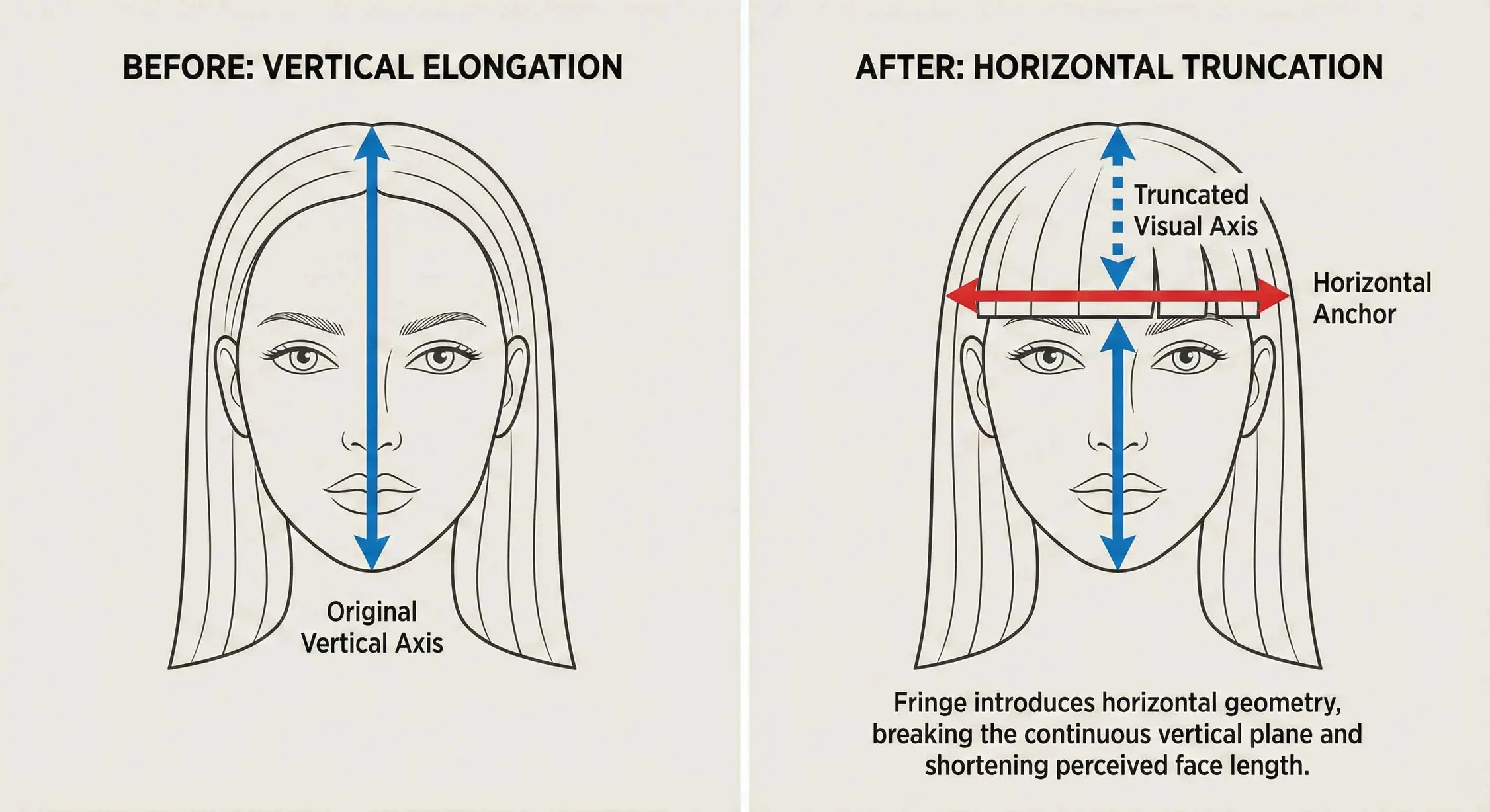
Notice how introducing a solid horizontal line across the brow ridge immediately breaks the vertical symmetry, forcing the visual focus to move side-to-side rather than up-and-down.
In This Guide
The Structural Logic of a Long Face
An elongated face is characterized by a vertical axis that is significantly longer than its horizontal width. The forehead, cheeks, and jawline typically share a similar, narrow width.
Before altering your haircut, you must ensure you are designing for the correct baseline. Many people confuse a narrow oval with a true elongated structure. You can verify your exact geometric baseline by reviewing balance, structure, and common mistakes for long faces.
When designing for this structure, the objective is truncation and lateral expansion:
- Breaking up the continuous vertical line from the hairline to the chin
- Creating horizontal visual pathways across the eyes and cheekbones
- Introducing volume at the sides to contrast the narrow skeletal structure
A properly engineered fringe achieves this by stopping the eye at the brow bone and redirecting it outward.
What Fails: The Vertical Drag
The reason some fringes fail to balance an elongated face usually comes down to a lack of horizontal weight or incorrect parting.
When hair is cut into long, flat, face-framing pieces that fall vertically past the cheekbones, it creates a vertical drag. This structural choice essentially frames the face with two parallel, descending lines. By drawing the eye straight down the cheeks without any lateral interruption, the face appears even longer and narrower.
Additionally, a highly parted, sparse fringe fails to establish a strong horizontal boundary. The vertical continuous plane of the forehead remains visible, defeating the structural purpose of the cut.
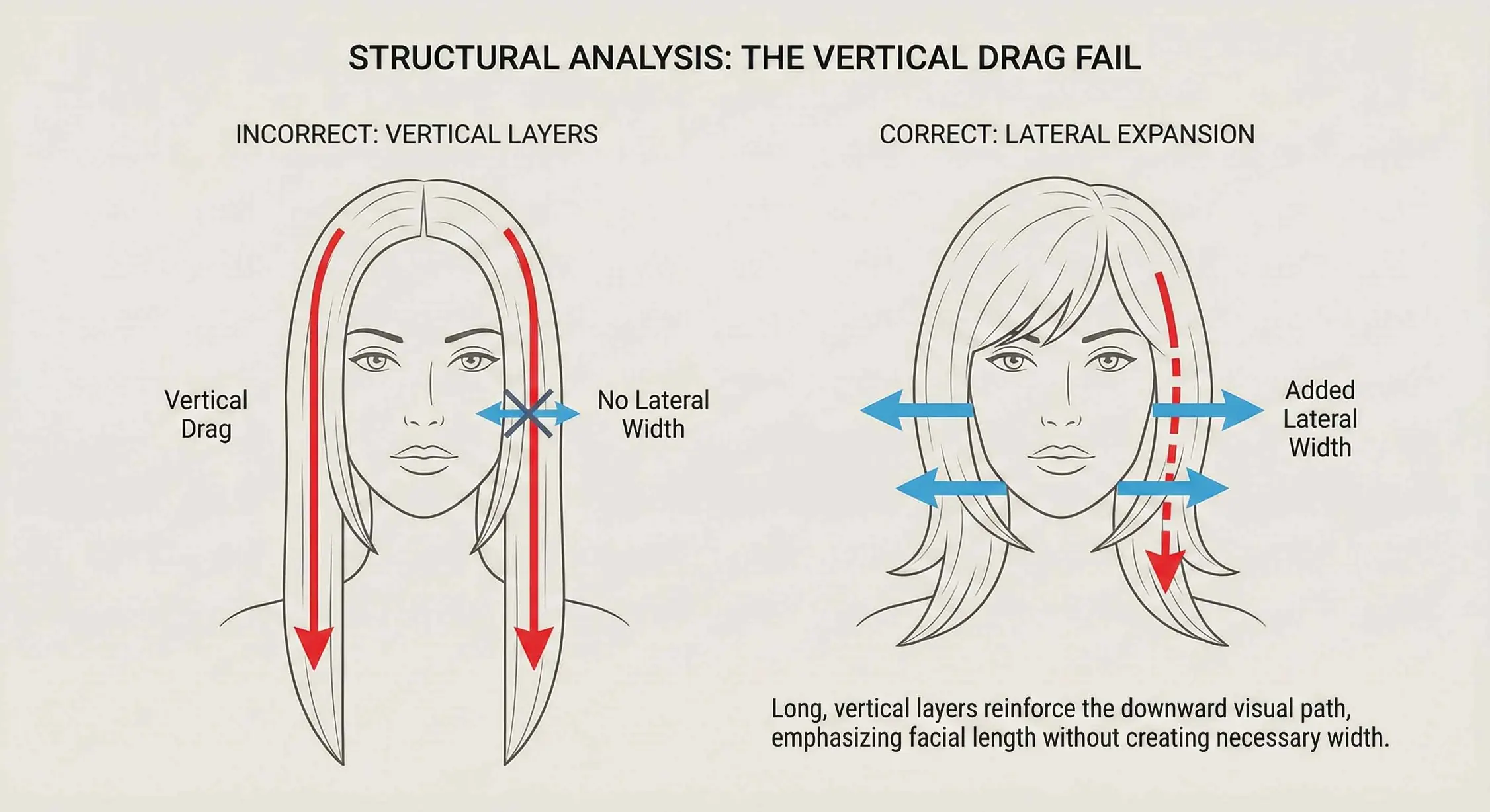
The Solution: Horizontal Anchors and Width
To balance an elongated face, the fringe must interrupt the vertical descent. This is achieved through specific structural placements that force the eye outward.
The Horizontal Anchor (Solid Fringe)
A fringe cut cleanly across the brow ridge creates a definitive horizontal block. This effectively removes the top third of the face from the visual equation, shortening the overall perceived length. Understanding the structural differences between blunt and wispy bangs is critical here: a denser, blunt line provides a stronger horizontal anchor than a highly texturized, transparent fringe.
The Lateral Sweep (Wide Curtain Fringe)
If a solid fringe is too heavy for your hair density, a center-parted fringe can work—provided it expands outward. The hair must be cut to sweep sharply away from the center, hitting the peak of the cheekbones. This horizontal flaring adds lateral volume, widening the center of the face.
The Diagonal Break (Deep Side-Swept)
A deep, heavy side part that sweeps across the forehead cuts the vertical plane at an angle. This diagonal break disrupts the length and draws attention to the eyes and cheekbones, adding necessary width to the upper half of the facial structure.
How to Communicate This to a Stylist
Do not simply ask for “bangs to shorten my face.” Focus on the structural mechanics you need the haircut to execute:
- “I need a strong, horizontal line at my brow ridge to break up the length of my face.”
- “Please ensure the fringe connects to the sides with enough volume to widen my cheekbone area.”
- “I want to avoid long, vertical pieces that drag downward; let’s keep the movement pushing outward and horizontal.”
This instructs the stylist on the geometry of the cut, ensuring the final shape directly alters your proportions.
FAQ
Will a fringe work if my forehead is naturally short, even though my face is long?
If your elongated face is due to a long chin and jawline rather than a high hairline, a solid horizontal fringe may compress the upper face too much, throwing off your overall balance. In this case, a sweeping diagonal fringe is structurally safer, as it creates width without entirely erasing the forehead.
Why does my fringe separate into vertical sections throughout the day?
Separation is usually caused by cowlicks or incorrect root direction during styling. If the fringe splits, it loses its horizontal blocking power and reverts to vertical lines. Controlling the root direction while the hair is wet is mandatory; reviewing how blow-drying changes hair shape will help you lock the horizontal structure in place.
Can a long face wear a micro fringe?
A micro fringe leaves a significant portion of the forehead exposed, which maintains a long vertical visual pathway. While it can be an intentional avant-garde choice, from a strict proportional balancing standpoint, it fails to truncate the face and often emphasizes length.