


In This Guide
The Logic of Weight Distribution
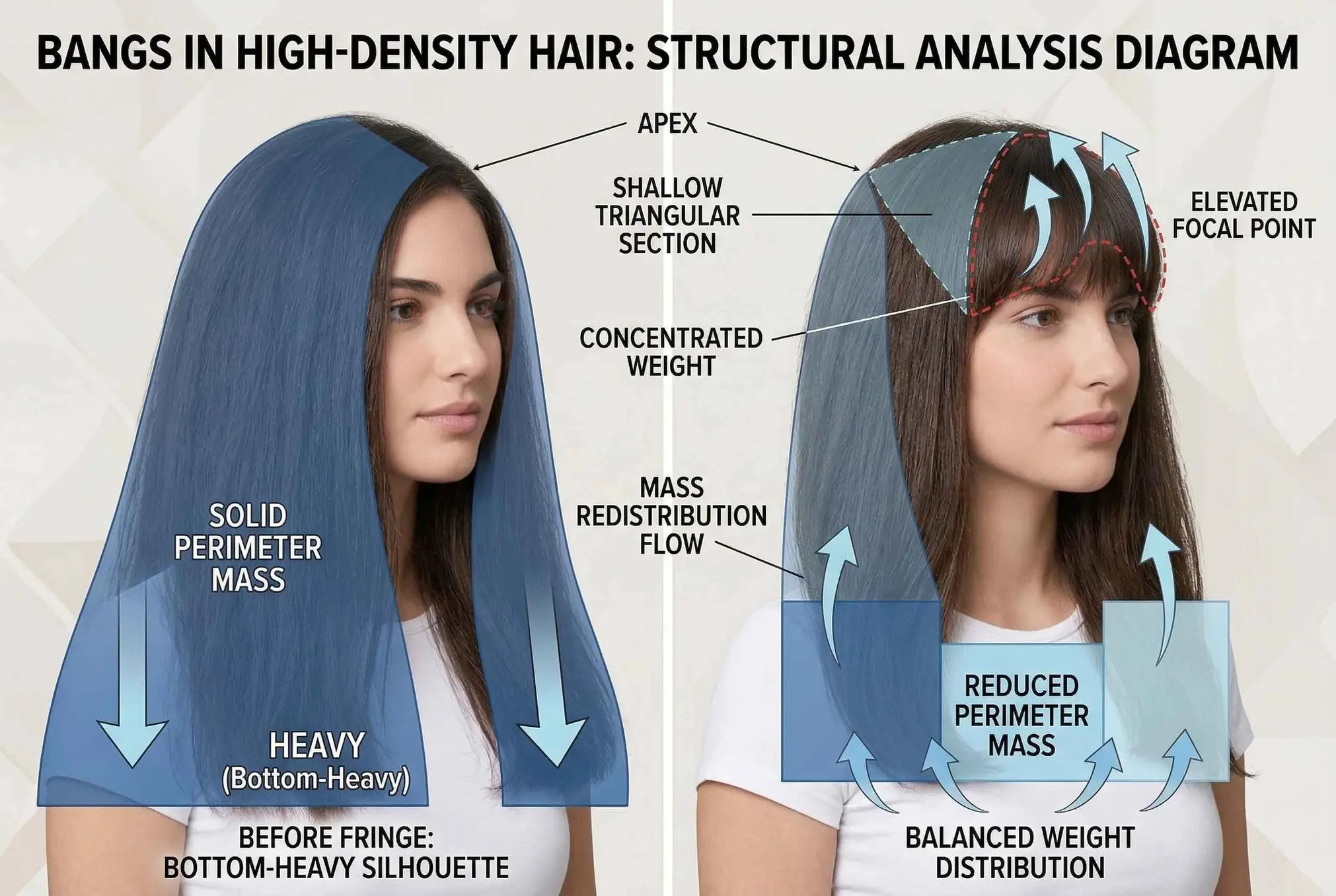
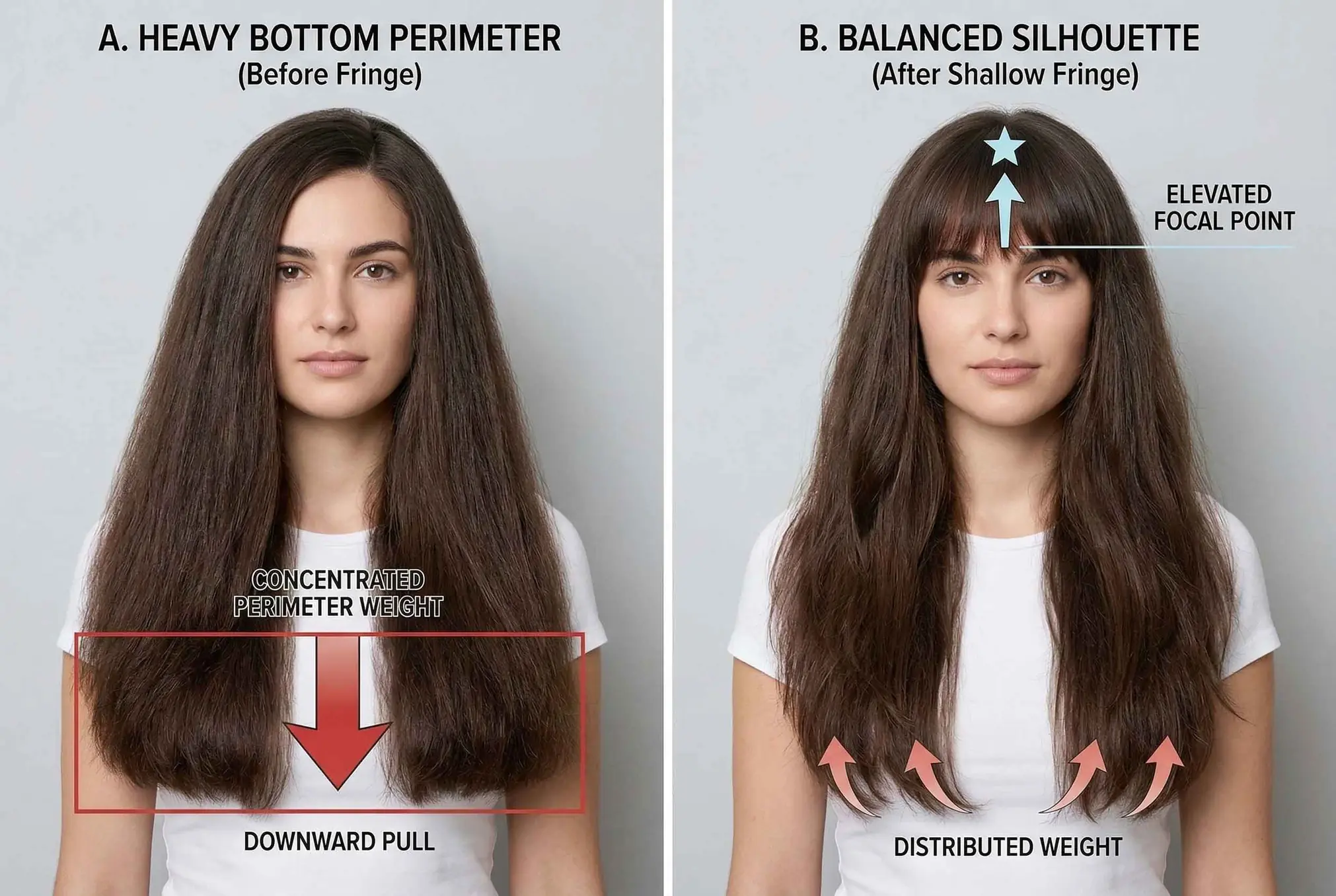
High-density hair is subject to intense gravitational pull. When thick hair is left at a uniform length, the bulk accumulates entirely at the perimeter. This concentration of mass forces the hair to expand horizontally, creating a heavy, triangular shape at the bottom.
By incorporating bangs, you isolate a specific percentage of the hair’s overall density—usually from the apex (top of the head) forward to the front hairline. You are structurally removing this hair from the bottom perimeter. The result is an immediate reduction in lower bulk and a redistribution of volume toward the upper half of the head.
Understanding this mass-to-weight ratio is crucial. For a deeper breakdown of how to manage high-density mass, refer to our guide on why structure matters more in haircuts for thick hair.
Silhouette Alteration and Proportion Control
A haircut is essentially a frame. In thick hair, a solid, heavy frame can overpower the facial features.
When bangs are introduced, they establish a new geometric line across the upper quadrant of the face. This horizontal break immediately alters the vertical length illusion of the hair and shifts the visual center of gravity upward. Instead of the eye being drawn to a heavy baseline at the collarbone or chest, the focal point moves to the cheekbones and eyes.
This architectural shift prevents high-density hair from dominating the wearer. To see how these horizontal lines interact with your specific bone structure, read how bangs change face proportions.
Texture Compatibility and Sectioning Depth
Not all thick hair behaves the same way when cut short. The structural success of bangs in dense hair relies entirely on the sectioning depth and the hair’s natural growth pattern.
The Depth of the Section
In low-density hair, a stylist must take a deep section (starting further back on the head) to create enough weight for the bangs to lay flat. In high-density hair, taking a deep section is a structural failure. It forces too much mass forward, resulting in a heavy “helmet” effect that completely obscures the face.
For thick hair, the section must be shallow. A shallow section allows the natural weight of the hair to provide coverage without overpowering the forehead.
The Influence of Texture
Straight, thick hair will fall forcefully downward, requiring internal texturizing (weight removal at the ends) to soften the line. Wavy or curly thick hair will immediately contract and expand outward when cut. If you are unsure how your specific strands will react to a shorter length, identify your hair type at home before making a structural change.
Frequently Asked Questions
Why do my bangs feel too heavy when cut into thick hair?
Answer: This is a sectioning error. The stylist likely took too deep of a triangular section, bringing too much hair forward from the apex. In thick hair, bangs require a shallow section to prevent overwhelming density at the front hairline.
Will bangs make my thick hair look wider?
Answer: Only if they are cut bluntly straight across without any internal weight removal. A purely blunt line creates horizontal expansion. To prevent this, the interior of the bangs must be point-cut or slide-cut to collapse the excess bulk and encourage the hair to lay flat.
Final Consideration
Adding bangs to thick hair is a highly effective way to remove perimeter weight and balance a heavy silhouette. It is not about adding more hair to the face; it is about reorganizing the mass you already have.
Before committing to this structural change, evaluate:
- The depth of the section required for your specific density
- Your natural wave pattern and how it will expand when cut short
- Your willingness to control the frontal section with styling tools
If you are evaluating whether this geometric change suits your daily maintenance reality, review how to choose a haircut that fits your lifestyle.