


thick hair square face structural strategy is not about reducing volume randomly, but about controlling how excessive density interacts with angular facial structure.
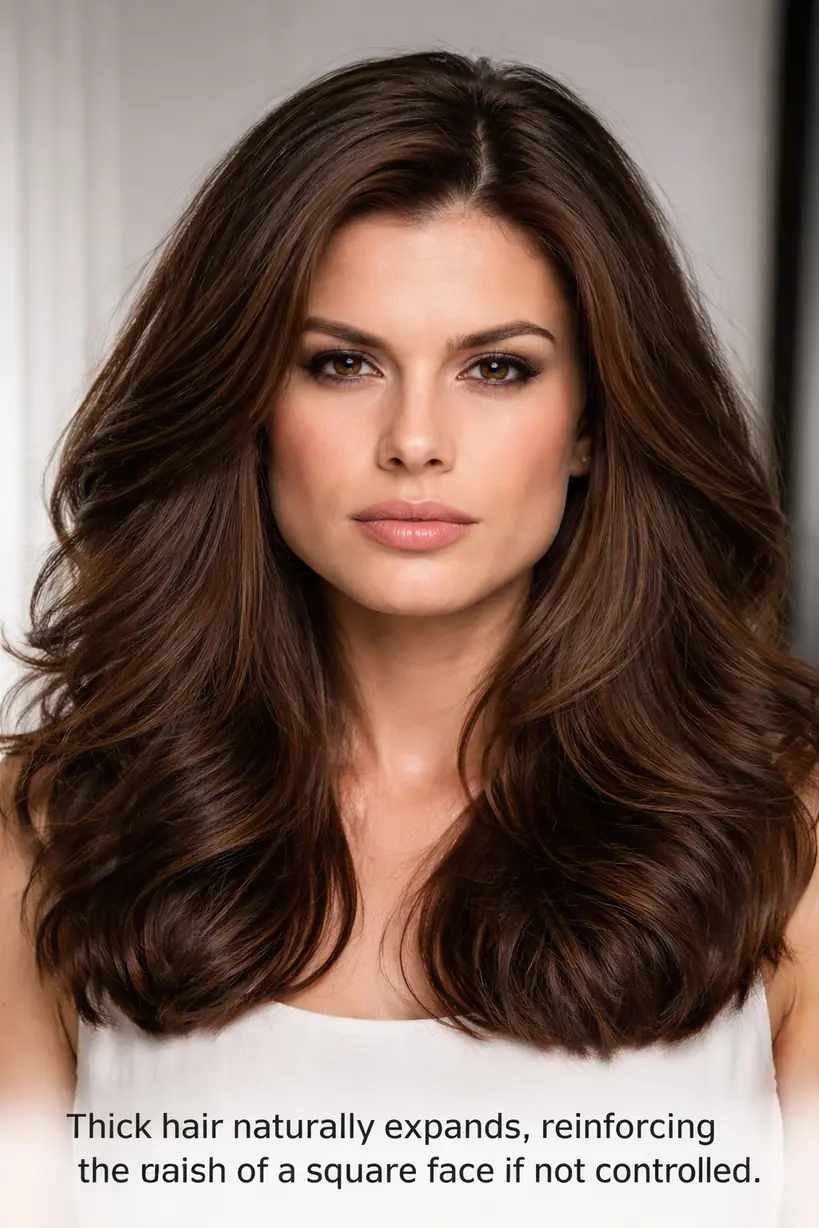
Thick hair naturally expands outward and creates visual width. A square face is defined by strong horizontal lines, particularly at the jaw. When these two elements combine without structure, the result is an overly wide and heavy appearance.
This article explains thick hair square face structural strategy from a structural perspective. Instead of suggesting styles, it focuses on how hair density and face shape interact to influence balance.
In This Guide
Thick Hair Square Face Structural Strategy: The Core Conflict
A square face is characterized by:
- Strong jawline width
- Relatively straight vertical sides
- Reduced softness in contour transitions
Thick hair behaves differently from thin hair. It expands naturally and resists collapse, creating a wide silhouette.
When combined, this creates two structural effects:
- Horizontal width is visually exaggerated
- Facial angles become more pronounced
This explains why thick hair often makes square faces appear heavier and more rigid.
This interaction is part of a broader principle explained in how hair type changes the way a haircut looks.
Why Reducing Volume Alone Does Not Solve the Problem
For thick hair, the common advice is to “remove bulk.” Structurally, this is incomplete.
Volume reduction without direction control can create imbalance rather than fix it.
If bulk is removed randomly:
- The shape becomes unstable
- The silhouette loses structure
- Width may still remain in the wrong areas
For square faces, the goal is not minimal volume, but controlled redistribution.
Effective adjustments include:
- Reducing density at the jawline area
- Allowing vertical softness to break horizontal edges
- Shifting volume away from the widest points
This connects to how proportions shift with length, as explained in how hair length changes face proportions.
The Role of Vertical Movement: Softening Angular Structure
The primary structural goal for thick hair square face structural strategy is to reduce horizontal dominance.
This is achieved by introducing vertical and diagonal movement.
Balance occurs when:
- The outline is no longer box-like
- Edges appear softened rather than rigid
- The silhouette shifts toward an oval proportion
Without vertical interruption, the face appears wider. With directional flow, structure becomes balanced.
Why Blunt Cuts Often Reinforce Square Face Width
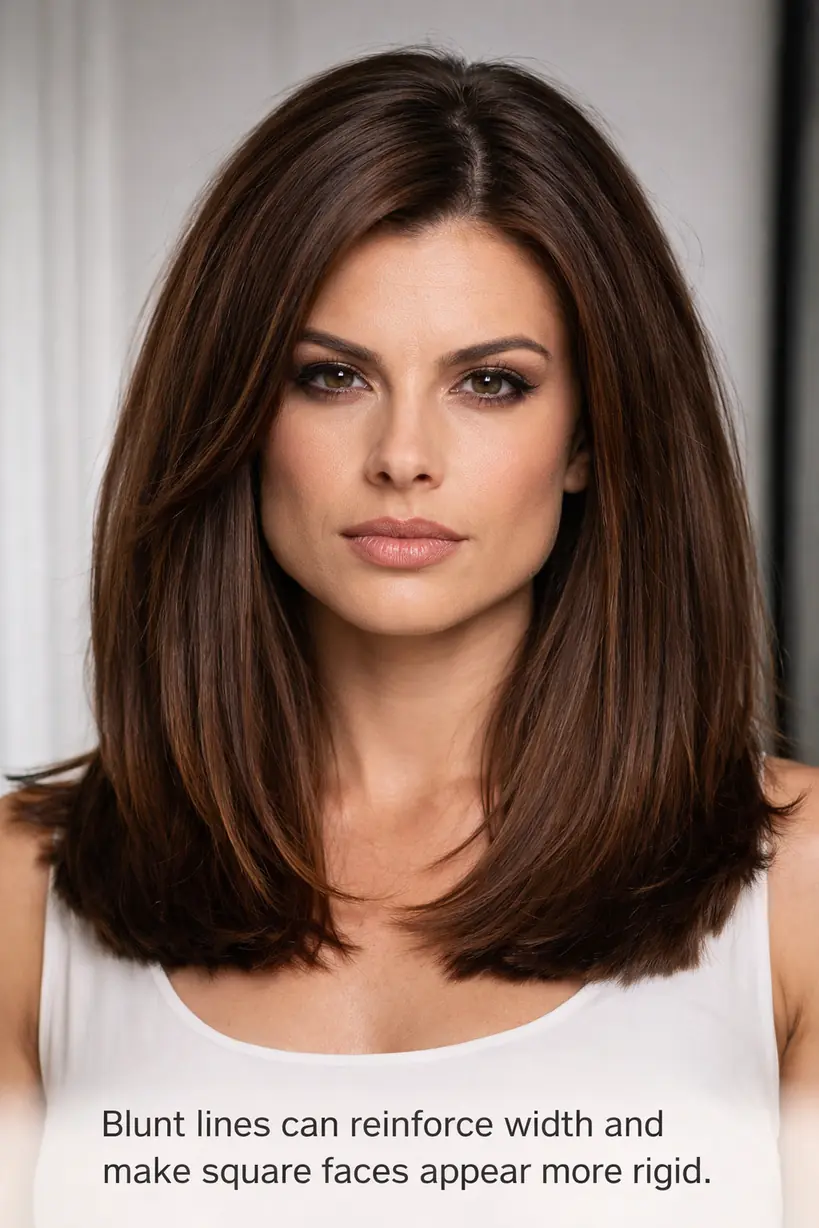
Blunt cuts maintain density, which is often beneficial for thin hair.
However, for thick hair and square faces, they can amplify structural problems.
This leads to:
- Strong horizontal lines at the ends
- Reinforced jaw width
- A heavier overall silhouette
The structural limitation of blunt shapes is explained in blunt haircuts structural failure.
Layering: Controlling Expansion Instead of Removing Density
Layering in thick hair is often misunderstood as simply “thinning out.”
Structurally, its purpose is to control how volume distributes in space.
Incorrect layering results in:
- Uncontrolled expansion
- Frizz-like silhouette instead of structure
- Loss of directional flow
Correct layering:
- Breaks horizontal weight lines
- Introduces vertical movement
- Maintains internal support while reducing external bulk
This structural logic is explained in layered haircuts structural logic.
Where Balance Comes From: Width vs Direction
The most critical factor is not how much hair is removed, but where visual weight is placed.
For square faces:
- Width must be reduced at the jawline
- Movement should redirect the eye vertically or diagonally
- The silhouette should avoid flat horizontal endpoints
This aligns with broader proportion rules explained in haircuts for square face balance logic.
When Thick Hair Works Well with Square Face
Thick hair is not a disadvantage for square faces.
It works when:
- Volume is controlled, not eliminated
- Horizontal weight is reduced at key points
- Movement softens angular structure
In this context, thick hair becomes an advantage, providing enough density to shape balance intentionally.
FAQ: Thick Hair and Square Face Structure
Does thick hair always make a square face look wider?
No. It depends on distribution. If width is concentrated at the jaw, the face appears wider. If volume is redirected, balance improves.
Should thick hair be thinned out aggressively?
No. Excessive thinning removes structure. The goal is controlled distribution, not maximum reduction.
Is shorter hair better for square faces with thick hair?
Not necessarily. Short hair can increase width if not structured properly. Length matters less than directional balance.
Closing Perspective: Control Expansion, Not Just Volume
Ultimately, thick hair square face structural strategy is about direction, not reduction.
Thick hair naturally expands. Square faces already emphasize width. The solution is not removing volume entirely, but controlling how it expands.
When horizontal weight dominates, the face appears wider. When movement redirects that weight, balance emerges.
Haircut design, therefore, is not about reducing bulk, but about shaping how density interacts with facial structure.
This structural relationship between density and form is also explained in haircuts for thick hair structure.