


Curly hair round face structural strategy is not about choosing a flattering style, but about controlling how volume is distributed around facial proportions.
Curly hair naturally expands outward. A round face already has horizontal width. When these two factors combine without control, the result is an amplified width effect that reduces definition.
This article explains curly hair round face structural strategy from a structural perspective. Instead of listing styles, it focuses on how curl behavior interacts with face shape geometry.
In This Guide
Curly Hair + Round Face: The Structural Conflict
A round face is defined by relatively equal width and height, with soft transitions and minimal angular structure.
Curly hair introduces volume through expansion. Unlike straight hair, which falls downward, curls create lateral movement and occupy horizontal space.
When uncontrolled, this creates two structural effects:
- Width is visually increased
- Vertical length appears reduced
This interaction explains why curly hair often makes round faces appear fuller rather than more defined.
This relationship is part of a broader principle explained in how hair type changes the way a haircut looks.
Why Volume Placement Matters More Than Length
In curly hair, length does not control shape in the same way as straight hair.
Even long curly hair can expand outward if internal weight is not managed. This means volume placement becomes the primary structural variable.
For round faces, uncontrolled side volume creates a circular silhouette. To counter this, structure must shift emphasis vertically.
Key structural adjustments include:
- Reducing width at cheek level
- Maintaining controlled volume above or below the widest point
- Allowing vertical elongation to visually extend the face
This is also connected to how length interacts with proportions, as explained in how hair length changes face proportions.
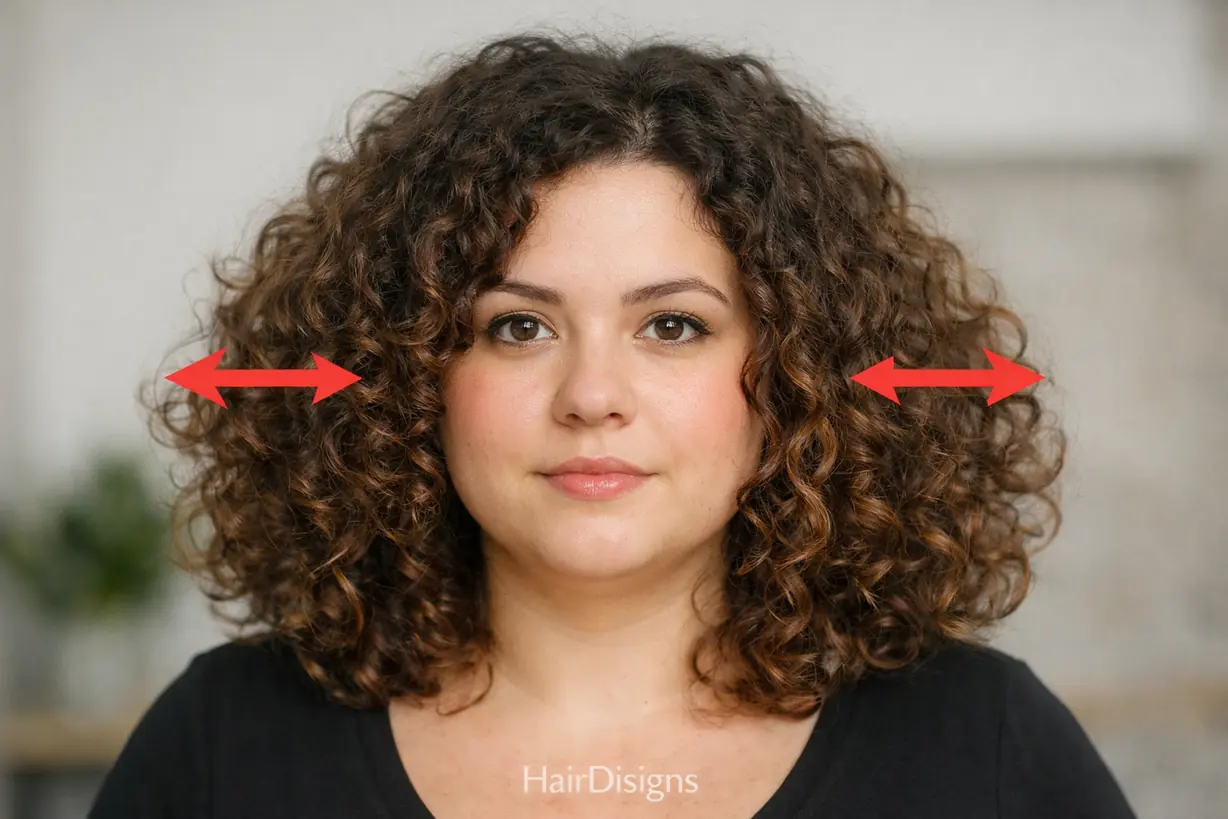
The Illusion of Slimming: Vertical vs Horizontal Balance
Facial slimming is not achieved by removing volume entirely, but by redistributing it.
Curly hair can create a slimming effect only when it introduces vertical direction.
This occurs when:
- The silhouette is taller than it is wide
- Volume is shifted away from the mid-face
- The eye is guided upward or downward rather than sideways
Without this redistribution, curls form a rounded outline that mirrors the face shape.
The goal is not less volume, but controlled direction of volume.
Why Layering Can Either Help or Fail
Layering is often used in curly hair to manage weight, but its effect depends on placement.
Incorrect layering increases expansion. By removing internal weight unevenly, curls separate and push outward more aggressively.
This leads to:
- Increased width at the sides
- Loss of vertical structure
- A fragmented overall shape
Correct layering, however, can reduce bulk at the widest points while preserving shape integrity.
The structural logic behind this is explained in layered haircuts structural logic.
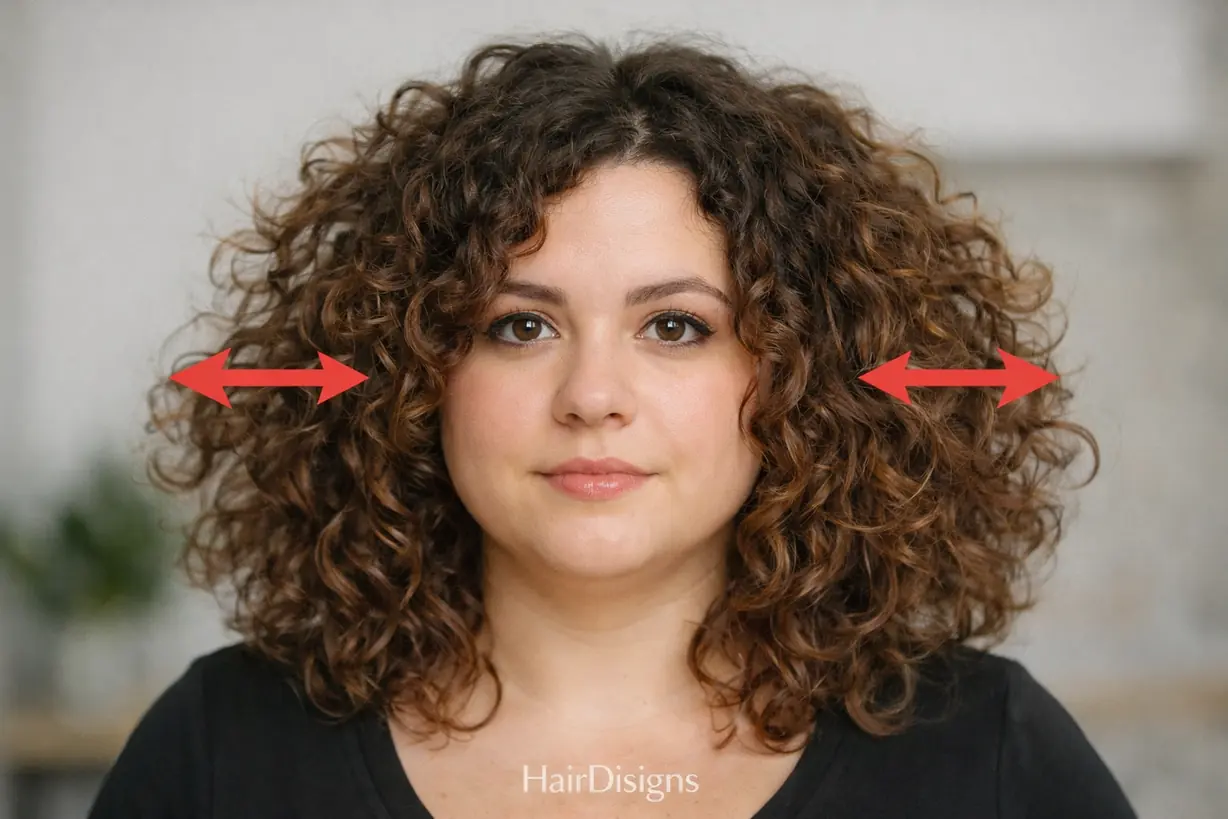
Where Balance Comes From: Controlling the Widest Point
The most critical factor in curly hair round face structural strategy is controlling where the hair appears widest.
For round faces, the widest point should not align with the cheeks.
Instead, structure should:
- Shift width slightly below the jaw or above the temple
- Reduce expansion at mid-face level
- Create a more oval visual outline
This aligns with the general principles of proportion discussed in haircuts for round face based on proportions.
When Curly Hair Works Well with Round Face
Curly hair is not inherently unsuitable for round faces. The outcome depends on structural control.
It works when:
- Volume is vertically oriented
- The silhouette avoids circular symmetry
- The widest point is repositioned away from the cheeks
In this context, curls add texture and movement without reinforcing facial width.
FAQ: Curly Hair and Round Face Structure
Does curly hair always make a round face look wider?
No. It depends on how the volume is distributed. Uncontrolled side expansion increases width, while vertical shaping can create balance.
Is short curly hair better for round faces?
Not necessarily. Short length can increase width if volume is concentrated at the sides. Structure matters more than length.
Should curly hair avoid layers for round faces?
No. Layers can work if they control bulk at the sides. Poorly placed layers increase width and reduce shape stability.
Closing Perspective: Control Direction, Not Just Volume
Ultimately, curly hair round face structural strategy is about direction rather than reduction.
Curly hair naturally creates volume. The goal is not to eliminate it, but to guide it.
When volume expands horizontally, it reinforces roundness. When it is directed vertically, it creates balance and definition.
Haircut design, therefore, is not about minimizing curls, but about structuring how they occupy space.
Scientific understanding of hair fiber behavior and curl formation also supports the variability in how curls expand and interact with face shape, as explained in studies of human hair structure.