


Does long hair make thin hair look thinner is not a question of style preference, but a question of structure.
Hair length directly changes how weight is distributed along the hair shaft. When density is low, this shift in weight can significantly affect how full or flat the hair appears.
Long hair introduces gravitational pull, reduces internal support, and exposes the limitations of low-density hair. As a result, thin hair often appears more compressed, less voluminous, and visually weaker when grown too long.
This article explains does long hair make thin hair look thinner from a structural perspective. Rather than recommending styles, it focuses on the mechanics of length, density, and weight.
In This Guide
Does Long Hair Make Thin Hair Look Thinner: The Core Mechanism
Thin hair typically lacks internal density. This means there are fewer strands available to create volume or support a shape.
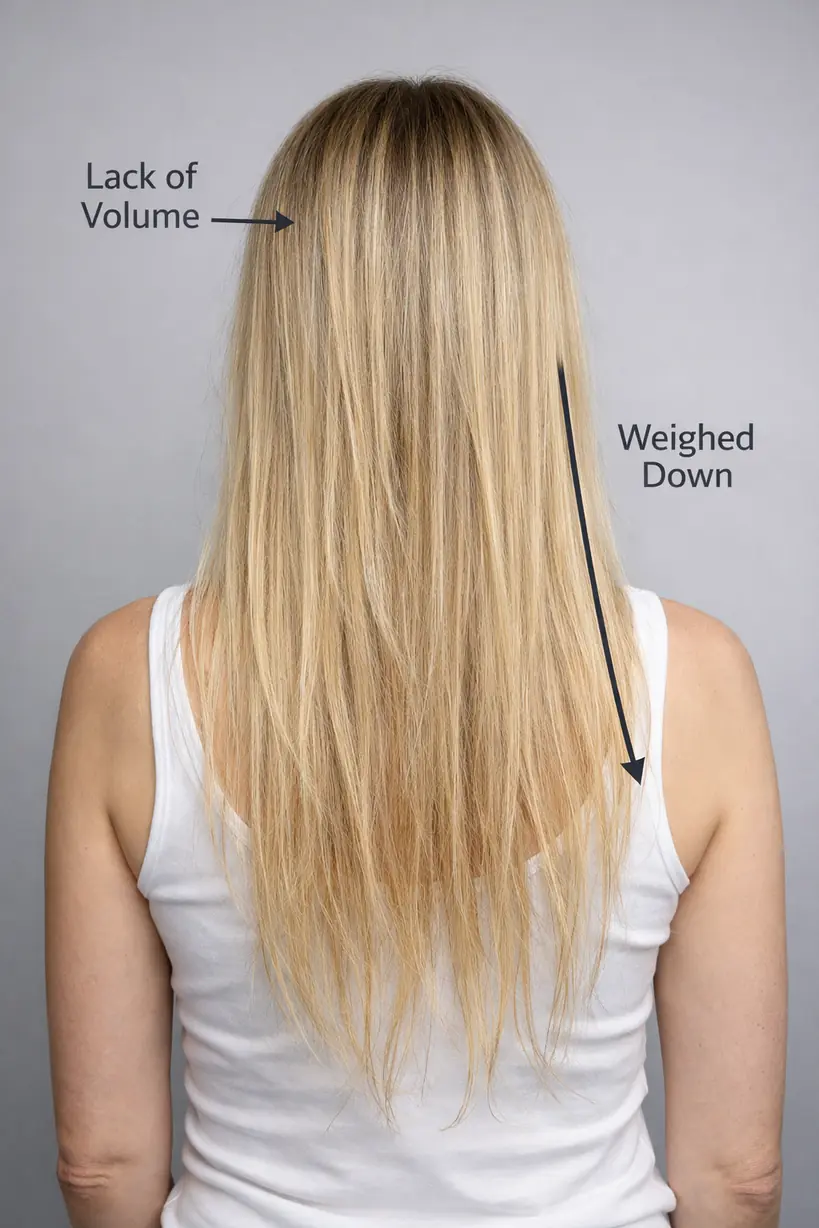
As hair grows longer, its total weight increases. This weight pulls the hair downward, reducing lift at the roots and compressing the overall silhouette.
On dense hair, this downward force is partially resisted by internal mass. On thin hair, there is not enough structure to counterbalance gravity.
The result is a flatter appearance, where the hair sits closer to the scalp and loses dimensional shape.
This relationship between structure and appearance is explained further in how hair type changes the way a haircut looks.
Why Length Amplifies the Weakness of Thin Hair
Hair length acts as a multiplier of structural weaknesses.
When hair is short or medium, the reduced length limits how much weight can accumulate. This allows even thin hair to maintain some lift and visible body.
When hair becomes long, three structural effects occur simultaneously:
- Weight increases along the entire strand
- Root lift decreases due to gravitational pull
- Ends become visually sparse and separated
This combination creates a stretched appearance. Instead of forming a cohesive shape, the hair disperses into thinner visual sections.
This is also why long hair requires careful structural control, as discussed in long hair structural balance.
The Illusion of Thickness and Why It Fails in Long Hair
Hair thickness is largely a visual illusion created by how strands group together.
In shorter or structured cuts, strands overlap and stack, creating the appearance of fullness. In long thin hair, strands separate more easily, exposing gaps between them.
This separation reduces visual density.
Even if the total number of hairs remains the same, the distribution changes. The hair occupies more vertical space but less horizontal density, making it appear thinner.
This effect is closely related to how perimeter strength works in haircuts for thin hair, where maintaining edge density is critical.
Why Layering Often Makes Long Thin Hair Worse
Layering is frequently misunderstood as a solution for adding volume.
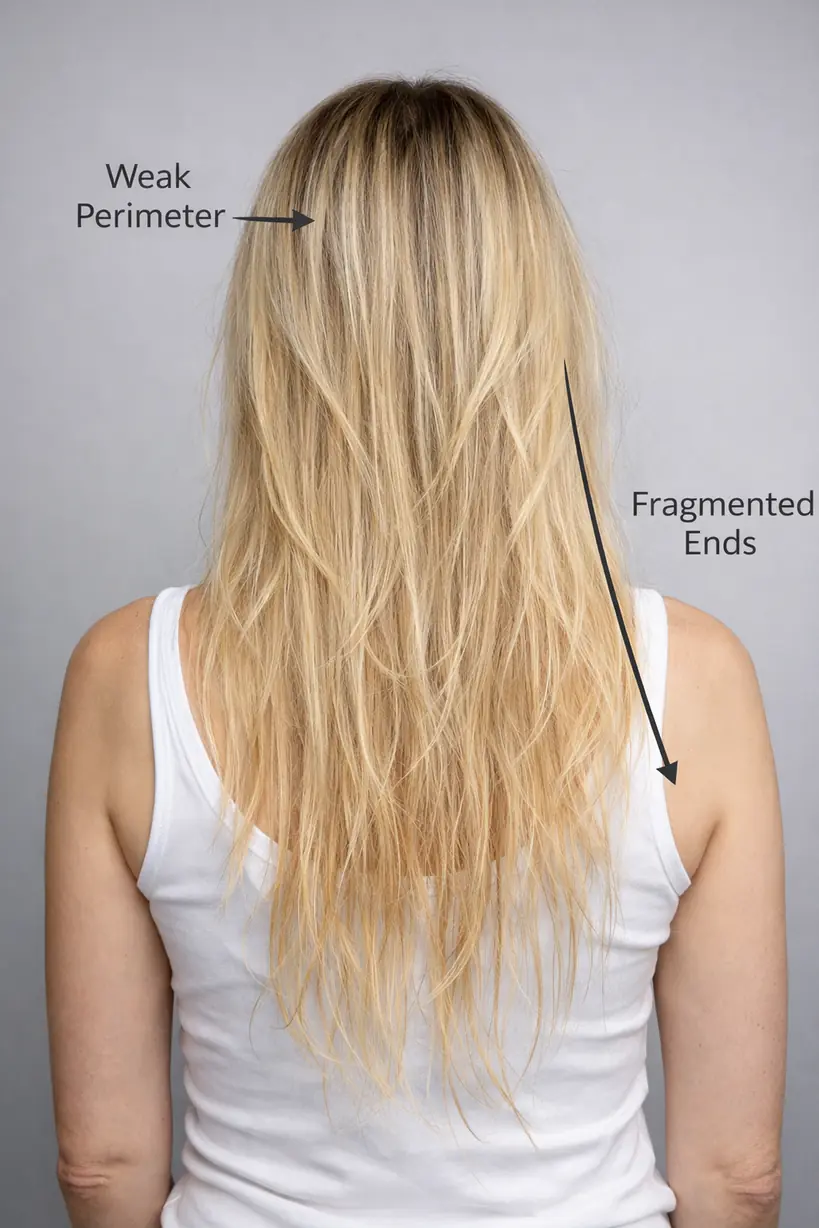
In thin hair, layering removes mass from the interior. This reduces the already limited structural support.
On long hair, this effect becomes more severe:
- The perimeter becomes weaker
- The ends appear fragmented
- The overall shape loses cohesion
Instead of creating movement, layering can exaggerate thinness by increasing separation between strands.
The structural logic behind this is explained in layered haircuts structural logic.
When Long Hair Can Still Work on Thin Hair
Long hair is not universally unsuitable for thin hair, but it requires strict structural control.
Key conditions include:
- Maintaining a strong, blunt perimeter
- Minimizing internal layering
- Controlling overall length to prevent excessive weight
In this context, long hair becomes a controlled extension of structure rather than an uncontrolled collapse.
Understanding where that limit exists is part of choosing between long and short hair structurally.
FAQ: Long Hair and Thin Hair Structure
Does long hair always make thin hair look thinner?
Not always, but it often does when structural limits are exceeded. Without enough density, long hair loses lift and appears flatter.
Is blunt cutting better for long thin hair?
Yes. A blunt perimeter preserves edge density and prevents the ends from appearing too sparse.
How long is too long for thin hair?
There is no fixed length. The limit is reached when the hair can no longer maintain volume at the roots and begins to collapse under its own weight.
Closing Perspective: Length Must Respect Structural Limits
Ultimately, does long hair make thin hair look thinner depends on whether the structure can support the length.
When length exceeds the hair’s internal capacity, the shape collapses, volume disappears, and thinness becomes more visible.
Haircut design is not about achieving maximum length. It is about maintaining structural balance between density, weight, and form.
Scientific observations on hair growth patterns also support the variability in density and behavior across individuals, as noted in studies of human hair growth.