


Long hair structural balance explains when length begins to reduce the effectiveness of a haircut rather than improve it.
Long hair is often associated with versatility and softness.
However, beyond a certain point, increasing length does not improve the haircut. Instead, it begins to reduce structural clarity. The hair becomes heavier, the internal shape weakens, and the overall silhouette may lose definition.
This article explains long hair structural balance from a technical perspective. Rather than focusing on trends, it examines when long hair stops functioning as a stable structure and why this happens.
In This Guide
Long Hair Structural Balance: Why Length Changes Behavior
Hair behaves differently as it grows longer because of accumulated weight.
Each additional centimeter adds mass. This mass is pulled downward by gravity, reducing the hair’s ability to hold internal shape or volume.
At moderate lengths, hair can still maintain structure through layering and internal balance. At excessive lengths, gravity begins to dominate completely.
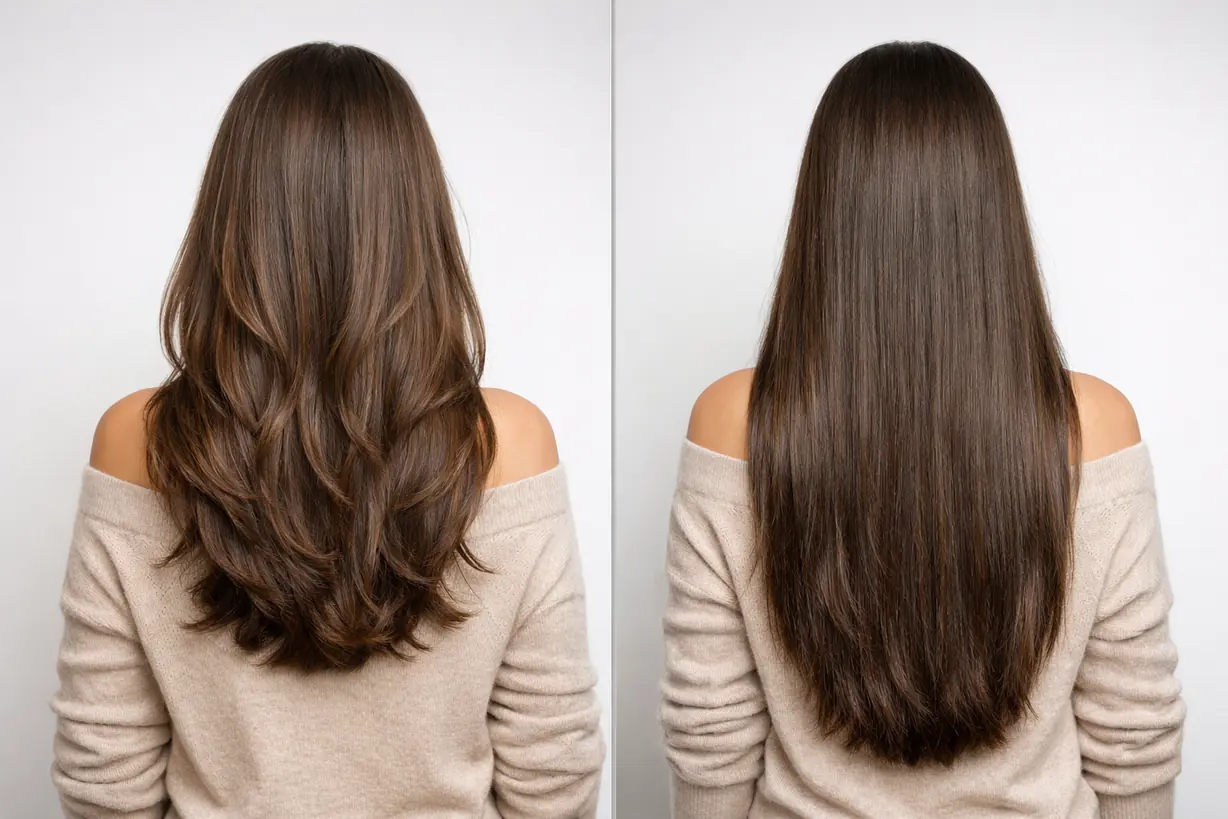
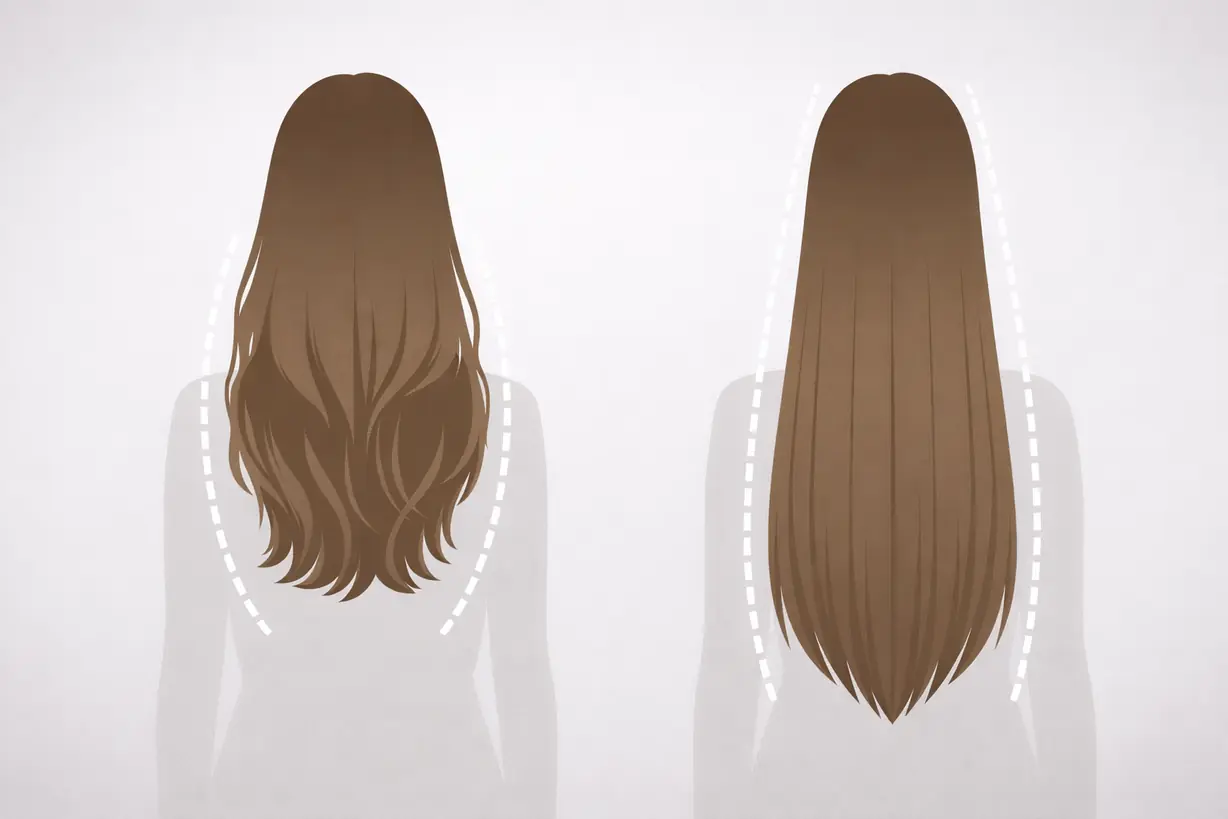
This is why very long hair often appears flat at the top and heavy at the bottom. The structure is no longer self-supporting.
This relationship between length and proportion is further explained in
how hair length changes face proportions.
When Long Hair Stops Holding Shape
Long hair stops working structurally when weight exceeds the hair’s ability to maintain internal lift.
This usually appears in three ways:
– The top collapses and lacks volume
– The mid-lengths lose movement
– The ends become dense and undefined
At this stage, the haircut no longer distributes weight effectively. The structure becomes vertical and compressed rather than balanced.
Unlike medium-length designs, long hair cannot rely on internal layering alone to correct this. The mass becomes too dominant.
This transition point varies depending on density and texture, which is why similar lengths behave differently across individuals.
The Role of Density in Long Hair Stability
Hair density determines how long hair behaves under extended length.
High-density hair can carry more weight before collapsing, but when it does, the effect is more dramatic. The shape may become excessively heavy and visually dense.
Low-density hair reaches its structural limit earlier. The ends may appear thin while the overall shape lacks presence.
This explains why long hair structural balance cannot be defined by length alone. Density determines how much mass the structure can support.
This principle is closely related to how different hair types behave, as explained in
how hair type changes the way a haircut looks.
Why Layering Becomes Less Effective Over Length
Layering is often used to introduce movement and reduce weight.
However, in very long hair, layering becomes less effective as a structural tool.
The reason is simple: layering redistributes weight, but it does not remove total mass. When the overall length is excessive, redistribution alone cannot counteract gravity.
This leads to a common misconception that more layering will fix heavy long hair. In reality, excessive layering can weaken the perimeter without solving the core problem.
At extreme lengths, structure is determined more by total mass than by internal design.
The structural logic behind layering is explained in
layered haircuts structural logic.
The Visual Illusion of Length vs Structure
Long hair is often valued for its visual length rather than its structural quality.
However, when structure is lost, length no longer contributes positively to appearance.
Instead of creating elegance, excessive length can produce:
– A stretched silhouette
– Reduced volume contrast
– Lack of defined shape
In structured haircut design, length must serve the shape. When it begins to override structure, it stops being functional.
This is why some shorter or medium-length haircuts appear fuller and more controlled than very long hair.
FAQ: Long Hair Structural Balance
How do I know if my long hair is too heavy?
If your roots collapse easily, your mid-lengths lack movement, and your ends feel dense or undefined, the structure is likely overloaded by weight.
Can layering fix overly long heavy hair?
Layering can redistribute weight but cannot eliminate excessive mass. If length is the main issue, reducing length is often more effective than adding layers.
Does long hair always lose structure?
Not always. With the right density and controlled length, long hair can maintain balance. However, every hair type has a structural limit.
Closing Perspective: Length Must Serve Structure
Ultimately, long hair structural balance is not about how long the hair can grow, but how long it can remain structurally functional.
When length exceeds the hair’s ability to support shape, the haircut loses clarity and stability.
Haircut design is a process of balancing weight, density, and form. Length is only one variable within that system.
For a broader comparison of structural behavior across lengths, see
long vs short hair structure.
Research on hair growth behavior also supports these structural differences, as explained in
human hair growth.