


Growing out bangs often creates one of the most frustrating stages in a haircut. What once sat neatly above the brow suddenly begins collapsing, separating, or pushing outward in unpredictable ways.
This period is commonly called the awkward stage. Many people assume it happens simply because the hair is “between lengths.” In reality, the cause is structural. As bangs grow longer, the haircut undergoes a gradual shift in weight distribution, center of gravity, and perimeter geometry.
Understanding these mechanical changes transforms the grow-out process from passive waiting into a controlled transition.
The key principle is simple: structure dictates function during regrowth.
In This Guide
Why Growing Out Bangs Creates an Awkward Stage
Short bangs function as a lightweight frontal structure. Because the hair sits above the brow line, gravity has minimal influence and the roots remain naturally lifted.
As the hair grows past the brow, the situation changes. Additional length increases mass, and gravity begins pulling the hair downward. This downward tension gradually compresses root lift.
At the same time, the growing fringe no longer fits cleanly into the original geometry of the haircut. It becomes too long to behave like bangs, but too short to integrate with the side sections.
This structural mismatch is what creates the awkward stage.
How Long Does It Take to Grow Out Bangs?
Human hair grows on average about 1–1.25 cm per month. Because most bangs begin around eyebrow length, it typically takes several months before they can fully merge into the rest of the haircut.
Most transitions follow a rough timeline:
Month 1–2: Bangs reach the brow and begin losing structural support.
Month 3–4: The fringe enters the awkward stage as it approaches the cheekbones.
Month 5–6: Length becomes sufficient to blend into the side panels or front layers.
Individual results vary depending on hair density, growth speed, and the original haircut design.
Gravitational Shift and Weight Accumulation
As bangs lengthen, the haircut’s center of gravity gradually shifts downward.
Short hair relies on its own brevity for support. Longer hair carries more mass, which increases gravitational pull on the root.
When the fringe approaches cheekbone length, accumulated weight can push outward at the mid-face. This creates the common “winging” effect where bangs separate or flare away from the face.
This change is not random styling behavior—it is the mechanical response of hair mass interacting with gravity.
Understanding how bangs alter facial balance provides additional context. See how bangs change face proportions through structural analysis.
How Bangs Integrate Into the Side Sections
For a smooth transition, growing bangs must eventually merge with the side panels of the haircut.
If the fringe grows independently without adjustment, a visible geometric disconnect appears between the front hairline and the rest of the shape.
Professional stylists often guide this process through subtle corner adjustments. The sharp edges of the fringe are softened so the hair naturally redirects toward the sides instead of falling forward.
This creates mechanical compatibility between the front perimeter and the longer side sections.
A similar structural behavior appears in curtain bangs and their structural collapse points, where weight distribution determines how the hair separates and falls.
The Structural Shift During the Grow-Out Phase
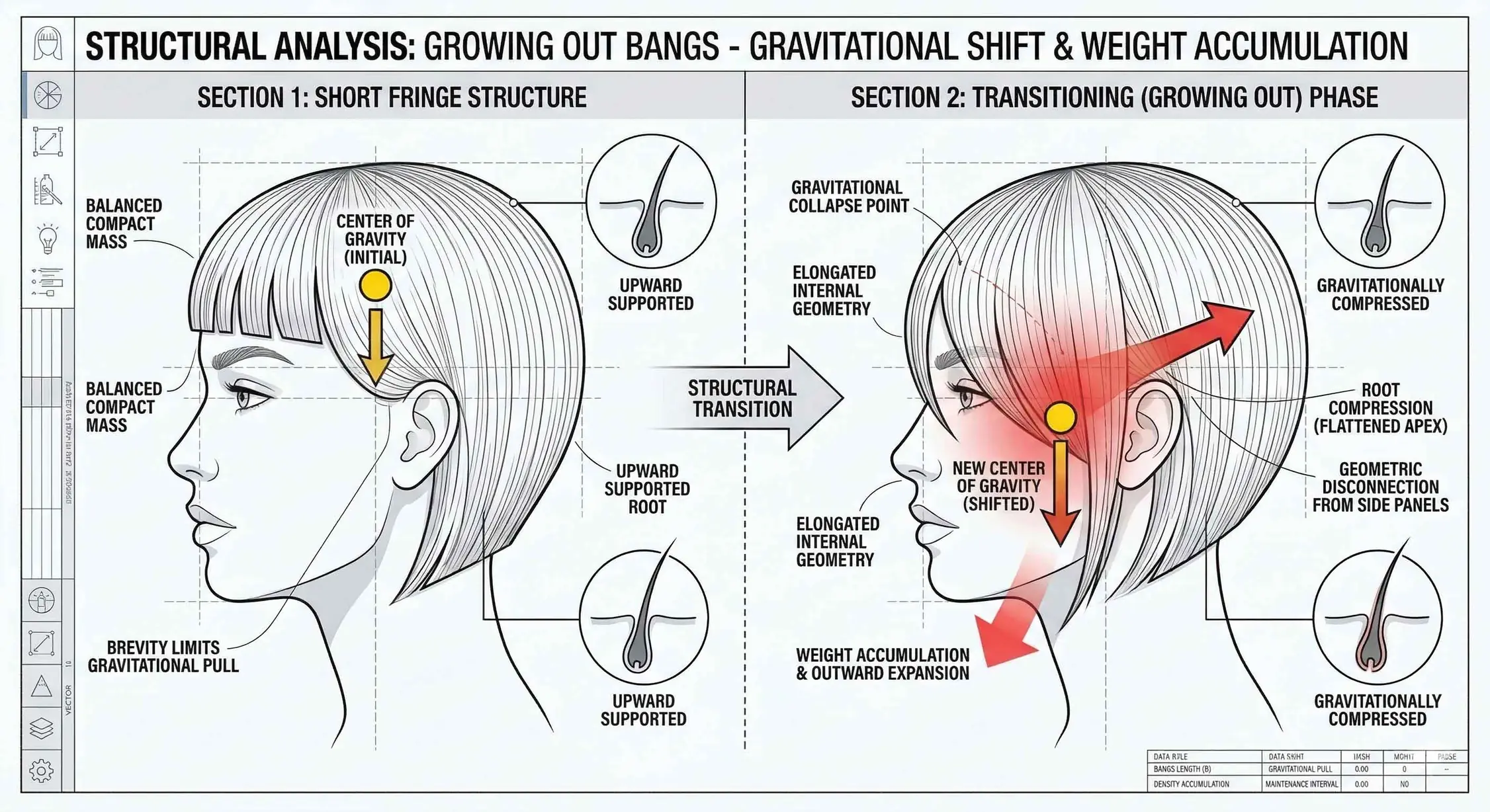
During regrowth, the fringe slowly transforms from a short frontal element into part of the longer front layers.
This shift exposes natural root direction and growth patterns that were previously controlled by the short geometry.
Small structural corrections throughout this phase maintain balance between the growing bangs and the rest of the haircut.
Frequently Asked Questions
Why do my bangs separate in the middle while growing out?
As bangs become longer and heavier, gravity reveals the natural growth direction of the hair. Many people have a slight center parting pattern that becomes visible once the fringe loses its short structural control.
Should I trim my bangs while growing them out?
Yes—but only strategically. Small corner trims help guide the fringe toward the side panels without reducing overall length progress.
Should I thin my bangs during the grow-out phase?
Generally no. Removing too much density can weaken the structure needed to blend the bangs into the rest of the haircut later.
What hairstyles help hide the awkward stage?
Side-swept styling, curtain-style separation, and light layering around the temples often help redirect the growing fringe while maintaining structural balance.
Conclusion: Growing Out Bangs Is a Structural Transition
Growing out bangs is not simply a waiting game. As the fringe length increases, gravity, density distribution, and perimeter geometry constantly evolve.
When these shifts are understood and guided, the haircut transitions naturally with minimal styling effort.
When ignored, the result is the familiar awkward stage that requires daily correction.
By viewing the grow-out process through the lens of physics and geometry, what feels like a frustrating in-between phase becomes a predictable structural transition.