


A frequent oversight in haircutting geometry is the assumption that adding a fringe automatically creates the illusion of volume. For individuals with low hair density, this structural decision often yields the exact opposite result.
As with all haircutting mechanics, hair is a finite resource. The success of a shape relies on how you distribute the available mass. The objective when working with low density is always to preserve the baseline and avoid unnecessary depletion of weight.
Understanding how structure creates volume in thin hair is the first step in recognizing why removing hair from the interior to create a fringe can structurally compromise the rest of the haircut.
This guide breaks down the structural mechanics of why bangs often make thin hair appear thinner, explaining the geometry of density redistribution and how to avoid perimeter collapse.
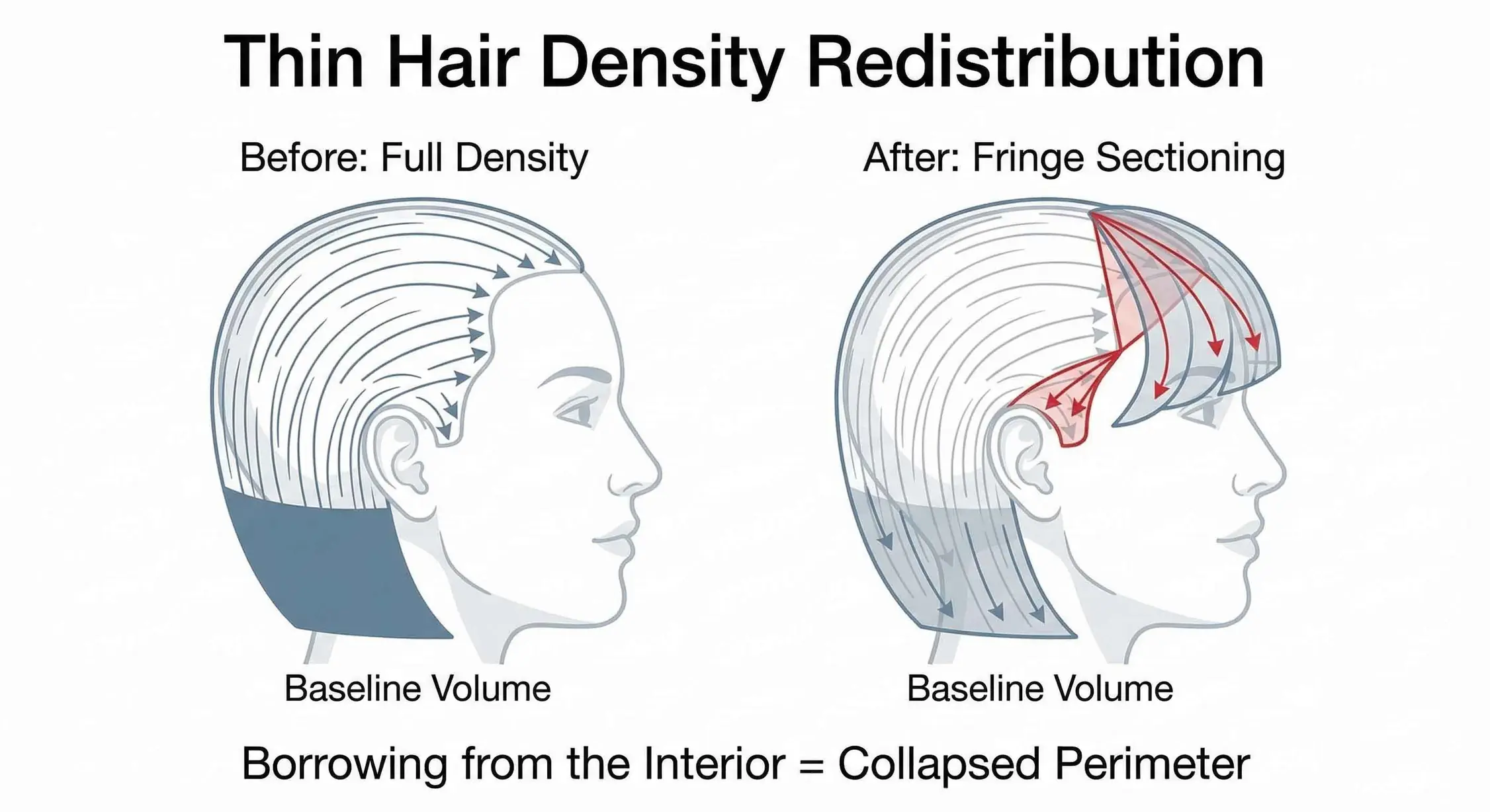
Notice how redirecting hair from the top of the head forward into a fringe subtracts structural weight from the sides, immediately exposing the scalp and weakening the overall outline.
In This Guide
The Mathematics of Density Redistribution
Hair density refers to the number of individual strands per square inch on the scalp. Unlike thick hair, which has surplus mass that must be removed to prevent bulk, thin hair lacks this buffer.
When designing a fringe, you must partition a specific section of hair—usually a triangle originating near the apex of the head—and comb it forward. By doing this, you are actively borrowing hair that would otherwise fall to the sides and back to contribute to the haircut’s overall thickness.
In thin hair, this redistribution is mathematically risky. If you dedicate 20 percent of the total frontal density to a fringe, the sides of the hair instantly lose that 20 percent. The result is a fringe that may look moderately thick, but at the direct expense of the sides, which will now appear stringy, transparent, and structurally weak.
The Perimeter Collapse
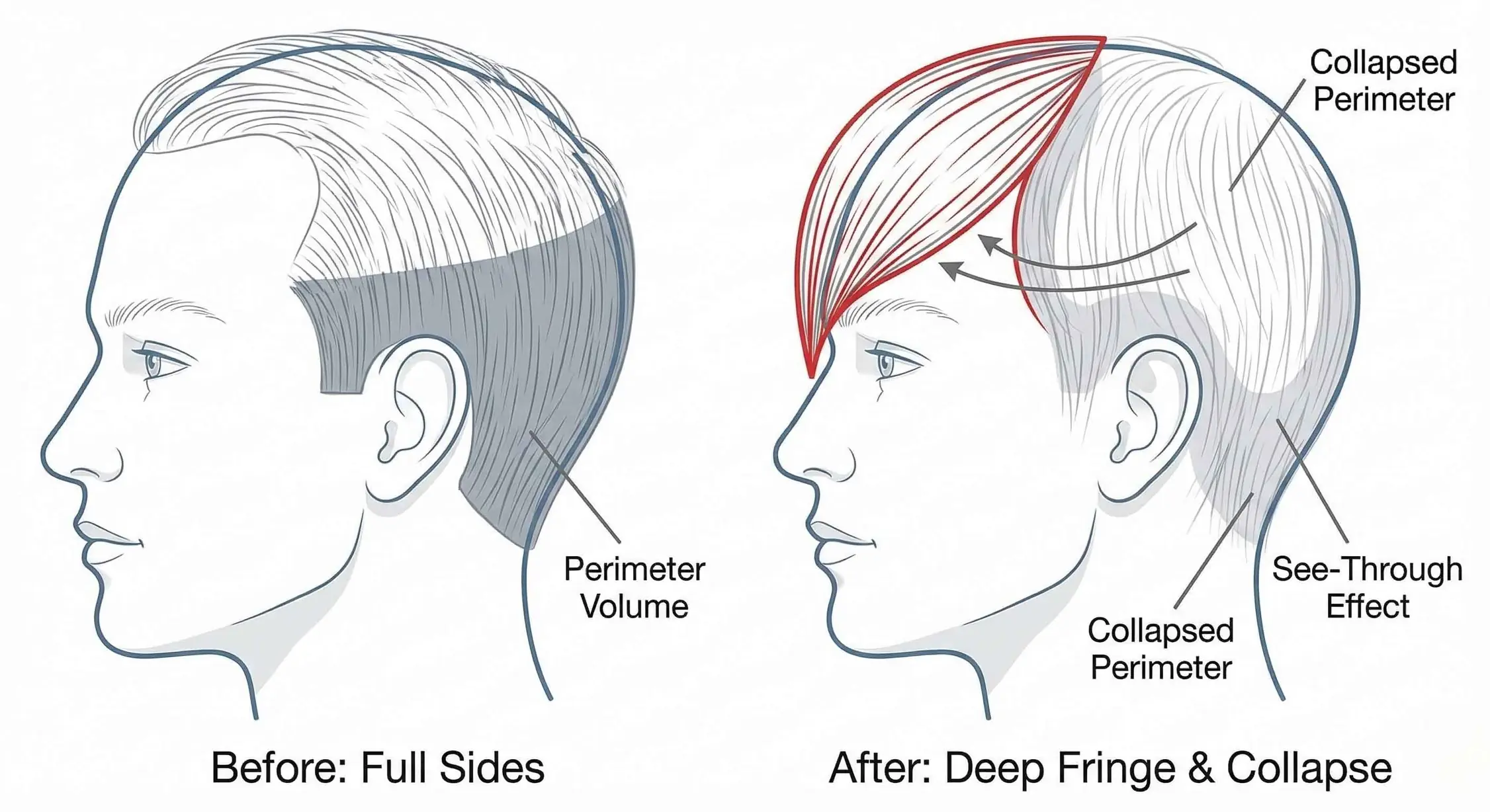
The primary structural failure when adding a fringe to thin hair is the collapse of the perimeter (the bottom edge of the haircut).
A strong perimeter creates a blunt, solid line that visually grounds the haircut, giving the optical illusion of maximum thickness. When hair is diverted forward for bangs, the sides lose their anchor. The remaining hair on the sides is no longer dense enough to maintain a solid line, causing the perimeter to look frayed and broken.
By analyzing hair density compatibility, the structural flaw is clear: fine hair requires its mass to remain consolidated. Splitting the hair’s limited density into two separate zones (the fringe and the lengths) guarantees that neither zone will have enough structural weight to look solid.
Structural Solutions: Shallow Partings and Preservation
If a fringe is absolutely necessary for facial framing, the geometry of the sectioning must be drastically altered to protect the perimeter.
The Shallow Triangle
Instead of taking a deep triangular section that reaches back to the apex of the head, the parting must be kept extremely shallow. By only utilizing the hair immediately at the front hairline, you preserve the interior hair, allowing it to fall to the sides and maintain the structural integrity of the baseline.
Avoiding Vertical Layering in the Fringe
To maximize the visual weight of the fringe itself, it must be cut on a strict horizontal plane with zero elevation. Introducing layers or heavy texturization removes structural mass. The fringe must remain blunt to reflect light evenly and create an unbroken line, mimicking the appearance of density.
Integrating the Sides
The transition between the shallow fringe and the sides must be handled with precise geometry. The sides cannot be heavily face-framed or slide-cut, as this will further deplete the density around the jawline. The fringe should disconnect cleanly or transition with minimal angle to keep the side panels completely intact.
How to Communicate This to a Stylist
When discussing this structural plan, avoid asking for a “full fringe” or “wispy bangs,” as these terms invite subjective interpretation. Instruct the stylist on the exact geometric limitations of your density:
- “My density cannot support a deep section; please take an extremely shallow parting right at the hairline.”
- “We need to preserve the weight on the sides. Do not pull hair from the interior or crown to build the bangs.”
- “Keep the perimeter of the fringe blunt with zero elevation to maximize the structural weight, and avoid point-cutting.”
This guarantees the stylist prioritizes density preservation while adjusting how the bangs change your face proportions.
FAQ
Why do my bangs look piecey and separate immediately after washing?
When thin hair is cut into a fringe, there is insufficient mass to keep the hairs grouped together. Without the physical weight of surrounding hair to anchor it, individual strands easily separate due to scalp oils or minor air movement, creating a transparent, piecey look rather than a solid shape.
Can styling products fix a thin fringe?
No. While certain compounds can temporarily swell the cuticle or add grip, they cannot replace structural mass. If the geometry of the haircut has depleted the density, products will eventually weigh the fine strands down, exacerbating the separation and making the hair look thinner as the day progresses.
If I already have a deep fringe that made my hair look thin, how do I fix it?
The only structural solution is to allow the deeper sections of the fringe to grow out and rejoin the sides and perimeter. You must have a stylist separate the shallow front hairline (to maintain a micro-fringe if desired) and strictly leave the rest of the interior hair untouched until it reaches the baseline.