


A frequent misconception in hair geometry is that strong, angular faces cannot support a fringe.
As with all haircutting principles, the success or failure of a fringe does not depend on the feature itself, but on the structural geometry it creates. For a square face, the objective is never to hide the forehead, but to manipulate the visual pathways and soften existing rigid lines.
Understanding how bangs change face proportions is the first step in recognizing why certain structural choices either compliment or clash with a strong jawline.
This guide breaks down the structural mechanics of cutting a fringe for a square face, explaining how to diffuse hard angles and what geometric traps to avoid.
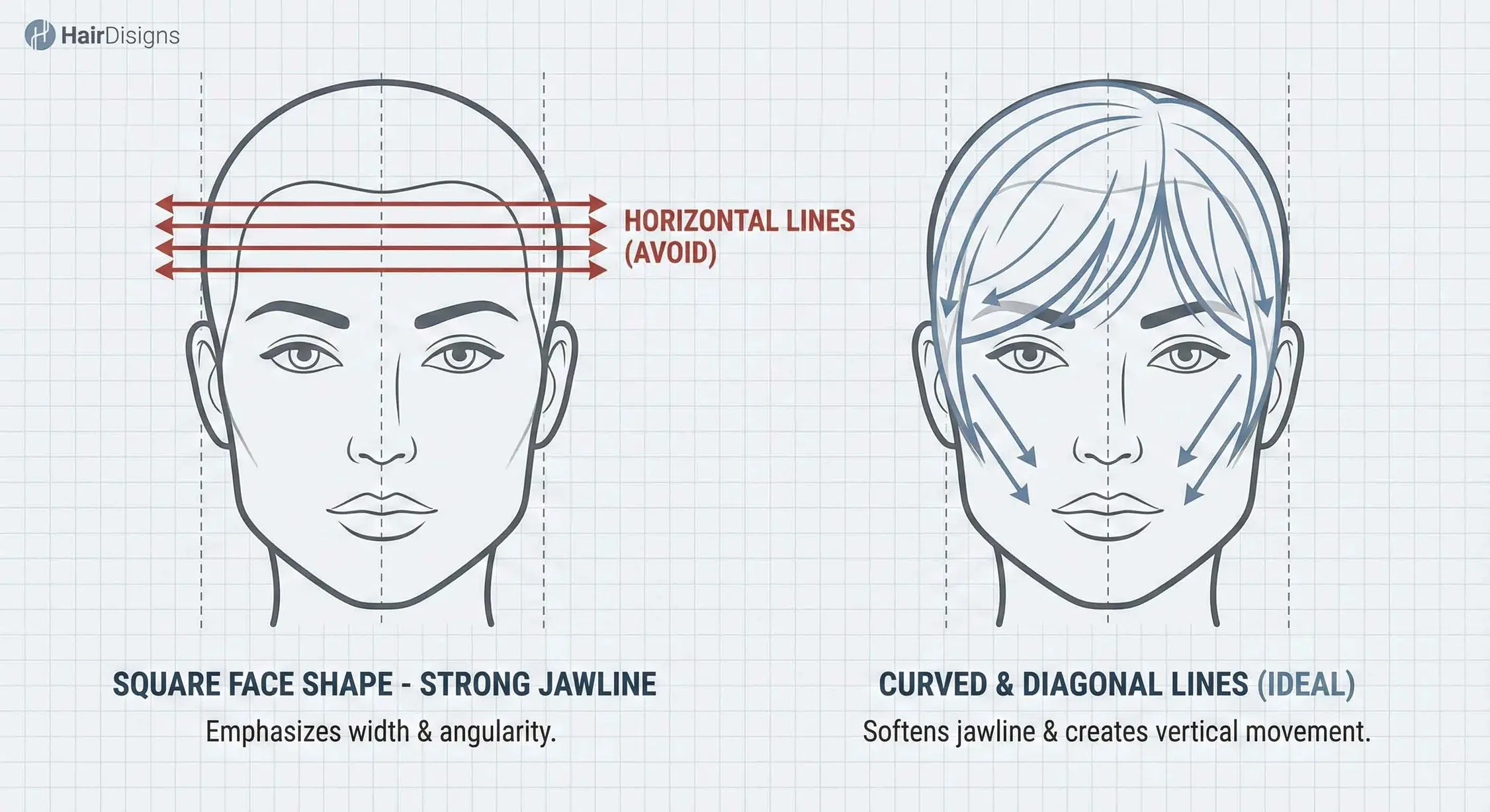
Notice how introducing a curved or sweeping line at the forehead immediately breaks the parallel symmetry of the face, drawing the visual focus away from the sharp corners of the jaw.
In This Guide
The Structural Logic of a Square Face
A square face is defined by a strong, angular jawline that is nearly equal in width to the forehead and cheekbones. The sides of the face follow a relatively straight, vertical line.
When designing a haircut for this geometry, you must first understand the balance logic of a square face. The structural objective is softness and elongation:
- Breaking up the strict horizontal line of the forehead
- Introducing curves and diagonals to contrast the sharp jawline
- Creating vertical length to stretch the square proportion into a faux-oval
The correct fringe achieves this by guiding the eye in a diagonal or curved pathway, entirely avoiding rigid horizontal lines.
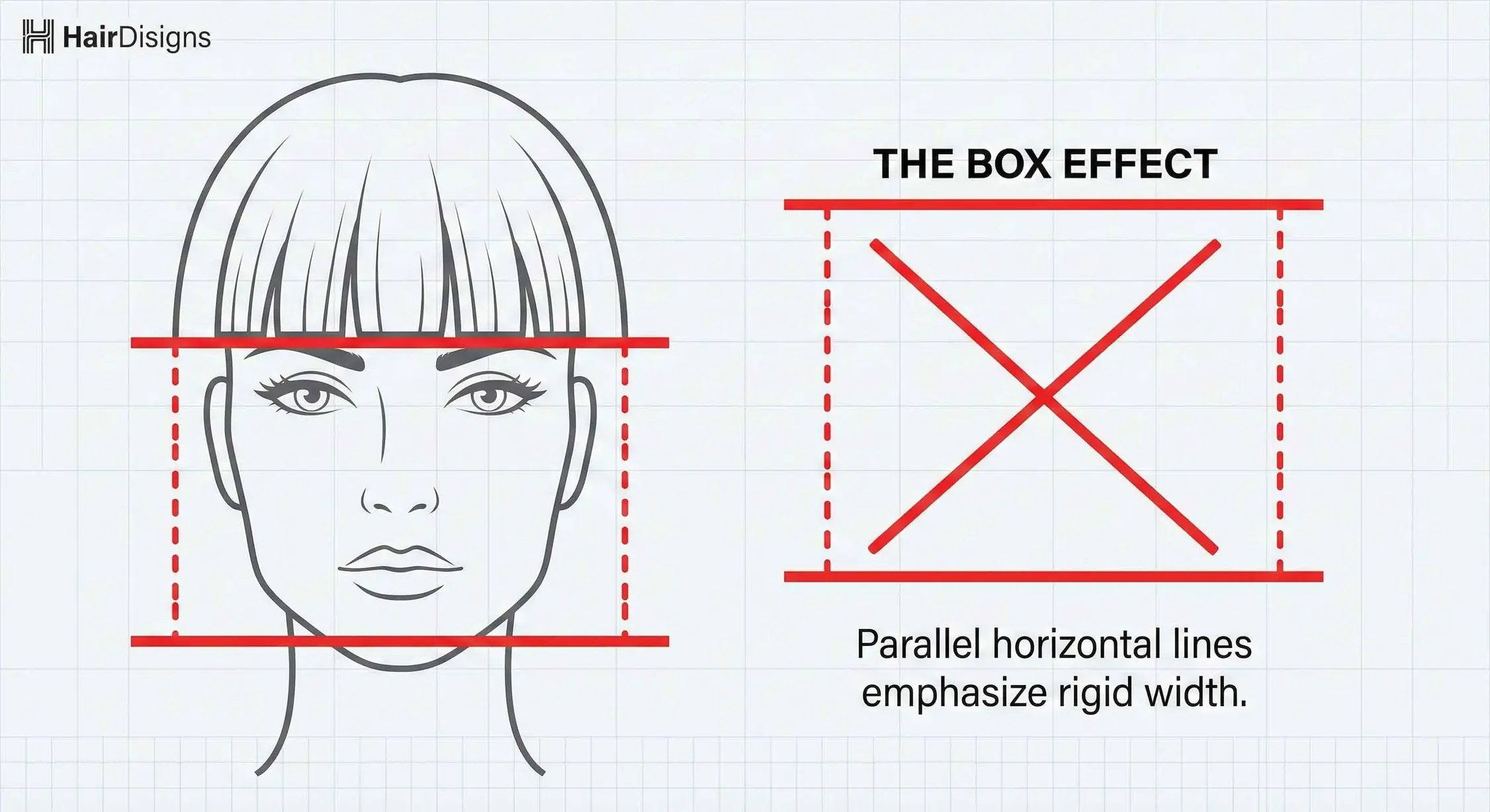
What Fails: The Box Effect
The primary reason people with square faces struggle with bangs is the improper execution of the heavy, blunt fringe.
When hair is cut straight across the forehead in a solid, unbroken horizontal line, it mirrors the exact horizontal line of the jaw. This structural choice creates parallel lines at the top and bottom of the face, effectively framing the face into a perfect, rigid box.
By analyzing the structural differences between blunt and wispy bangs, the flaw becomes evident: a blunt horizontal line reinforces angularity and width. It eliminates the forehead from the vertical proportion, making the remaining visible face appear shorter, wider, and distinctly heavier at the jaw.
The Solution: Diagonals, Diffusion, and Soft Edges
To balance a square face, the fringe must interrupt the hard geometric outlines. This is achieved through specific techniques that remove weight and build movement.
The Diagonal Sweep (Side-Swept Fringe)
A side-swept fringe is structurally ideal for a square face. By parting the hair asymmetrically and creating a sweeping diagonal line across the forehead, you immediately break the box-like symmetry. The diagonal line draws the eye downward at an angle, which softens the jaw and creates an illusion of vertical length. The ends must be textured to blend seamlessly into the sides.
The Softened Center (Textured Curtain Fringe)
A center-parted fringe can work, provided it avoids harsh edges. By parting the hair in the center and allowing it to drape down the sides of the face, you create an inverted “V” shape at the forehead. This elongates the face vertically. However, the edges must be heavily point-cut and hit right at or slightly below the cheekbone to diffuse the jawline. Understanding when curtain bangs work and when they collapse is crucial here, as a curtain fringe that is too short or thick will add unwanted width.
Diffused Horizontal Lines (Wispy Fringe)
If a straight-across look is required, the structural density must be completely altered. The fringe must be wispy and highly textured, allowing the skin of the forehead to remain visible through the hair. This breaks the horizontal line and prevents the “box effect,” maintaining vertical continuity.
How to Communicate This to a Stylist
Avoid vague terminology. Instruct your stylist on the exact structural mechanics required to balance your facial geometry:
- “I need to avoid blunt, heavy lines across my forehead; please heavily point-cut the ends for diffusion.”
- “Let’s create a sweeping diagonal line to soften the squareness of my jaw.”
- “If we do a center part, the face-framing pieces need to fall below my cheekbones and blend seamlessly into the lengths.”
This ensures the stylist understands that the goal is geometric balance, not just a generic shape.
FAQ
Will a thick fringe make my jaw look wider?
Yes. A thick, opaque fringe acts as a solid horizontal block. By covering the forehead entirely, the visual weight of the face shifts downward, making the jawline the primary focal point and emphasizing its width and angularity.
Can a square face pull off short, textured fringes?
It is structurally difficult but possible. A short fringe on a square face must be highly asymmetrical and choppy. The uneven, textured lengths draw the eye upward and break up the horizontal plane, but it requires a very specific density reduction to avoid looking blocky.
Why does my fringe look too heavy at the sides?
If a fringe looks heavy at the sides, the stylist likely did not remove enough interior weight where the fringe transitions into the longer hair. On a square face, this transition area must be heavily texturized so it curves softly inward toward the face, rather than flaring out and adding width.