


Long vs short hair structure determines how gravity, weight distribution, density compatibility, and growth direction influence the performance of a haircut.
Choosing between long and short hair is not merely an aesthetic preference. It is a structural decision governed by mechanical physics: mass, tension, geometric perimeter behavior, and maintenance cycles.
A haircut that functions efficiently cooperates with these forces instead of fighting them. When excessive product, heat, or tension is required to maintain shape, structural alignment is missing.
This is the central principle of length selection: structure dictates function.
In This Guide
Weight Dynamics in Long vs Short Hair Structure
In long hair structures, gravity acts as continuous downward tension, compressing the root and elongating internal geometry. This produces natural control but may cause visual collapse in fine or low-density hair.
Short hair structures remove this gravitational anchor. Without length to pull strands downward, cowlicks, density, and natural growth patterns dominate the silhouette.
Removing significant length without recalibrating internal support can cause outward expansion. Leaving fine hair excessively long without reinforcement results in perimeter thinning and mid-length heaviness.
For a deeper explanation, review the structural logic behind haircut longevity.
Perimeter Stability and Maintenance Cycles
The perimeter forms the architectural boundary of any haircut. Short structures depend on extreme perimeter precision.
Because strands cycle through phases of the human hair growth cycle, even minimal regrowth disrupts short geometry quickly.
Long hair diffuses growth irregularities through accumulated mass, allowing smoother transition and longer maintenance intervals.
If a haircut requires trimming every few weeks simply to preserve proportion, it is structurally high-maintenance.
Density Compatibility and Structural Volume
Length must correspond with natural density. Fine hair—composed primarily of keratin protein—often lacks the structural mass to support excessive length without appearing hollow.
Shorter geometry reduces gravitational elongation and can enhance perceived density.
Coarse or dense hair benefits from gravitational control when left long. Cutting dense hair short requires controlled internal weight redistribution to prevent expansion.
Geometric Transition in Long vs Short Hair Structure
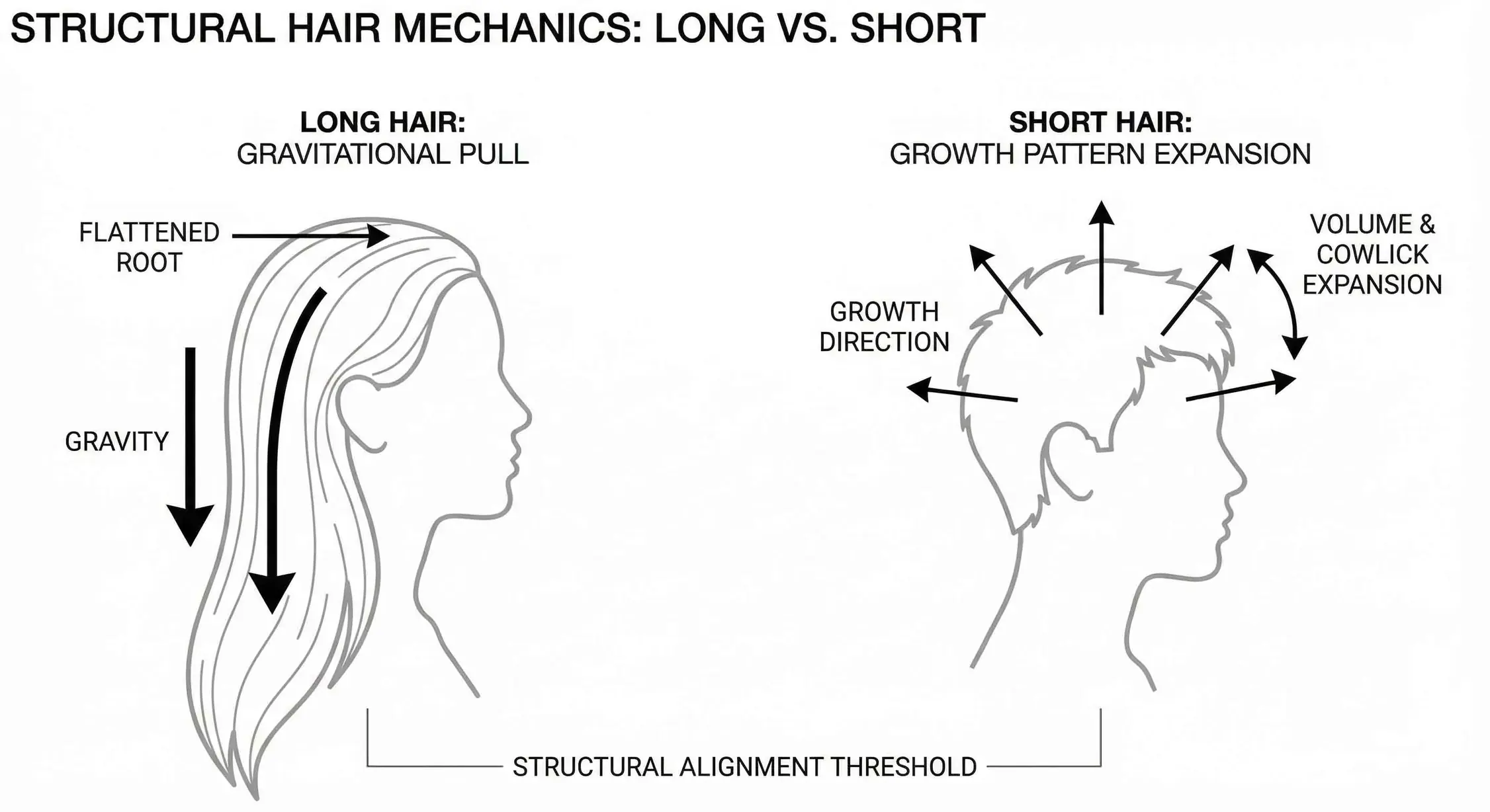
Transitioning from long to short shifts the center of gravity upward. This alters force distribution and exposes natural root direction.
A structurally sound transformation anticipates post-cut behavior without overreliance on tools. Mechanical compatibility determines long-term success.
Conclusion: Mechanical Compatibility Over Trend
The long vs short hair structure decision is fundamentally mechanical. Length changes gravitational force, density expression, perimeter behavior, and maintenance rhythm.
When structure aligns with natural hair physics, the haircut performs with minimal correction. When misaligned, daily intervention becomes necessary.
Choose length based on physics rather than impulse. Sustainable design is engineered, not improvised.