


Haircut Photos vs Reality is rarely a matter of simple miscommunication. In technical terms, the gap is created by the difference between temporary styling and structural engineering.
A shape that appears flawless in a static image often relies on heat manipulation, tension control, and holding products rather than true internal weight distribution.
This is the core issue behind Haircut Photos vs Reality — the conflict between engineered styling and natural structure.
Understanding this discrepancy requires examining geometry, gravity, density, and the predictable breakdown of artificial hold once the hair is washed.
A photograph captures a fraction of a second. Daily life exposes everything that fraction hides.
When a cut fails to match a reference image after the first wash, the issue is usually not scissor technique. It is a structural miscalculation of the hair’s natural baseline — how it falls, expands, compresses, and reacts without intervention.
In This Guide
Static Styling and the Mechanics of Weight Distribution
Every haircut has a natural center of gravity. In controlled studio conditions, heat and directional tension temporarily shift that center upward.
The camera records the lifted version. Reality reveals the resting one.
Through concentrated product application and strategic backcombing, stylists can build a temporary framework that resists gravity. But without internal structural support — balanced layering, preserved perimeter weight, and calibrated density removal — the shape collapses once external support disappears.
Styling can enhance structure. It cannot replace it.
For a deeper structural breakdown, see the structural differences between a haircut and a hairstyle.
Perimeter Stability as the Anchor in Reality
The perimeter forms the architectural boundary of a haircut. It anchors movement and defines visual stability.
When this baseline is weakened through aggressive thinning or premature texturizing — often done to create a “piecey” camera-ready effect — long-term integrity suffers.
Humidity, wind, and natural motion expose compromised ends quickly. Without sufficient perimeter weight, strands separate unpredictably, creating visual collapse rather than intentional separation.
A design that requires an hour of daily styling to resemble its photo reference is not structurally aligned with real life.
Consider how to choose a haircut that fits your lifestyle to prevent this mismatch.
Hair Density, Texture, and Structural Compatibility
Lighting, angles, and controlled blow-drying artificially enhance density in photographs. When that visual illusion is applied to incompatible hair types, structural friction emerges.
Fine hair lacks the internal mass to support excessive layering. Coarse or highly textured hair resists compression and may expand beyond the intended silhouette.
A cut that appears full in an image can collapse — or over-expand — once natural texture reasserts itself. This is another practical expression of Haircut Photos vs Reality.
Predicting these outcomes requires understanding how hair type changes the visual outcome of a haircut.
For broader scientific context, temporary salon volume depends on the manipulation of hydrogen bonds.
These weak physical bonds are easily broken by moisture, returning the hair to its baseline structure.
Haircut Photos vs Reality: From Styled Moment to Daily Movement
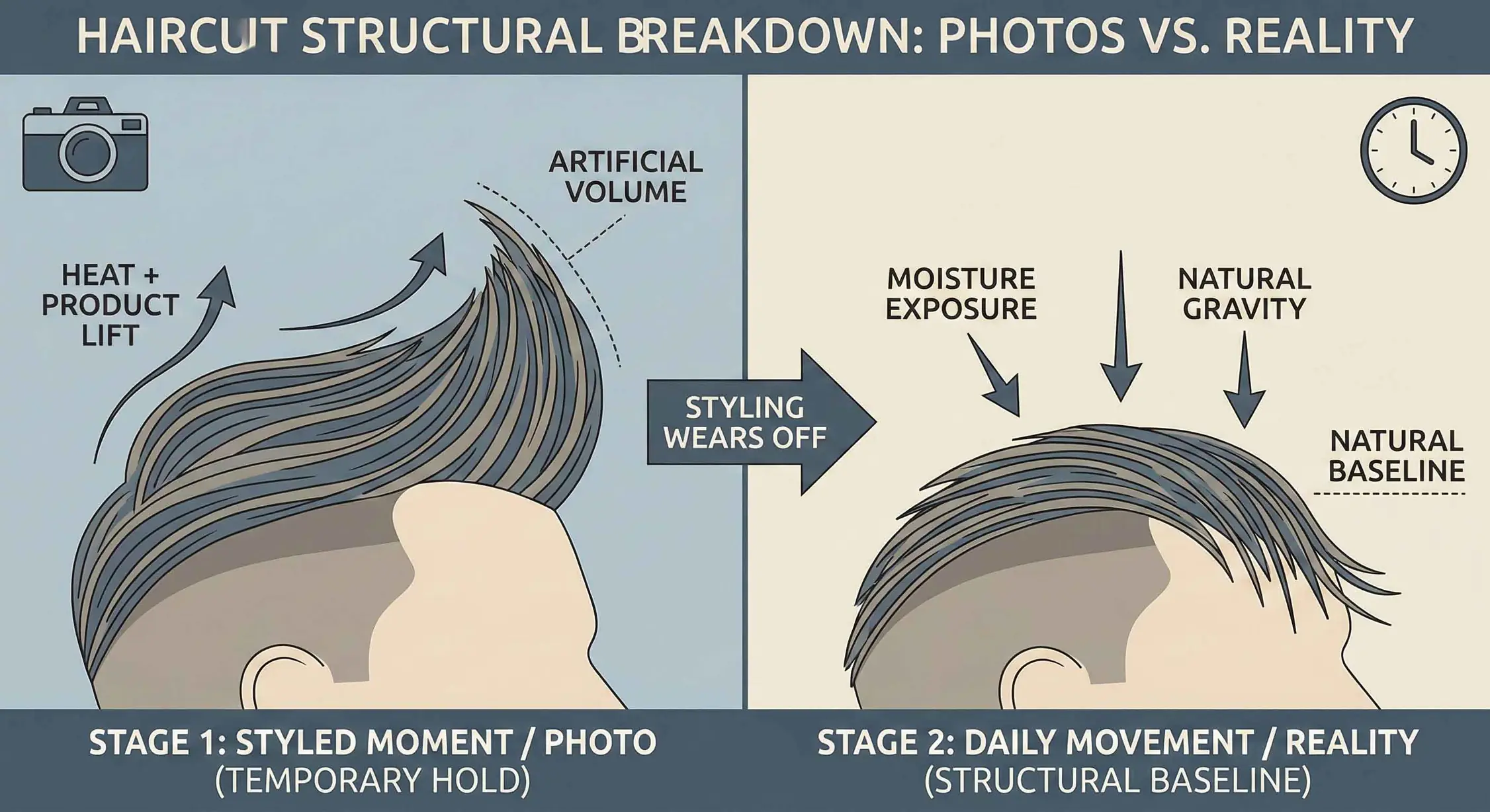
The diagram illustrates how balance shifts once artificial lift and product hold are removed.
A haircut engineered for daily wear anticipates this shift and redistributes weight accordingly. Instead of resisting gravity, it collaborates with it.
When evaluating any reference image, always consider how it will behave beyond the camera. That is the practical meaning of Haircut Photos vs Reality.
FAQ: Why Does My Hair Never Look Like the Photo?
Q: Why does my hair look flat the day after leaving the salon?
A: Professional blow-drying stretches the hair from the root, creating temporary volume through heat and tension. When exposed to moisture, hydrogen bonds break, and the hair returns to its natural structure.
Q: How can I tell if a reference photo shows a haircut or just a hairstyle?
A: If the shape depends heavily on curls, lifted roots, or dramatic volume that requires hot tools, you are primarily seeing a hairstyle. The haircut underneath may be far simpler than it appears.
Q: Should I stop bringing reference photos to my stylist?
A: No. Reference photos are useful for communicating length, silhouette, and overall direction. The key is discussing how that shape behaves with your natural texture and minimal styling.
Ultimately, Haircut Photos vs Reality is governed by physics — weight distribution, perimeter integrity, density compatibility, and environmental response.
When these variables align, the haircut functions in motion, not just in a frozen frame.