


Layered haircuts are engineered systems of structural weight redistribution—not decorative trends. In professional hair design, a layer modifies perimeter mass, internal support, and movement logic within the haircut. When layering is applied correctly, it enhances structural integrity. When misapplied, it weakens density and perimeter stability.
Most people ask, “Will layers suit me?” A more accurate question is: “Does layering align with my hair’s density, curl expansion, and perimeter tolerance?” The outcome depends on fiber behavior, gravitational load, and internal support—not trend photos.
Before choosing layers, it is essential to identify your hair type at home to understand density, texture, and structural tolerance for weight removal.
In This Guide
The Core Mechanics Behind Layered Structure
Layering functions by altering internal lengths relative to the external perimeter. This is achieved through elevation — lifting the hair away from its natural fall during cutting.
At 0° elevation (blunt cutting), strands fall to one perimeter line, concentrating weight at the ends. At 90° elevation, internal lengths are shortened more evenly, diffusing mass throughout the structure. Higher elevations increase graduation and reduce perimeter concentration.
- Weight Redistribution: Elevation above 0° removes surface or internal mass depending on sectioning.
- Movement Logic: Shorter internal strands carry less gravitational load, allowing freer motion over longer layers.
- Volume Engineering: Structured layering can reduce bulk in dense hair or build internal scaffolding in controlled designs.
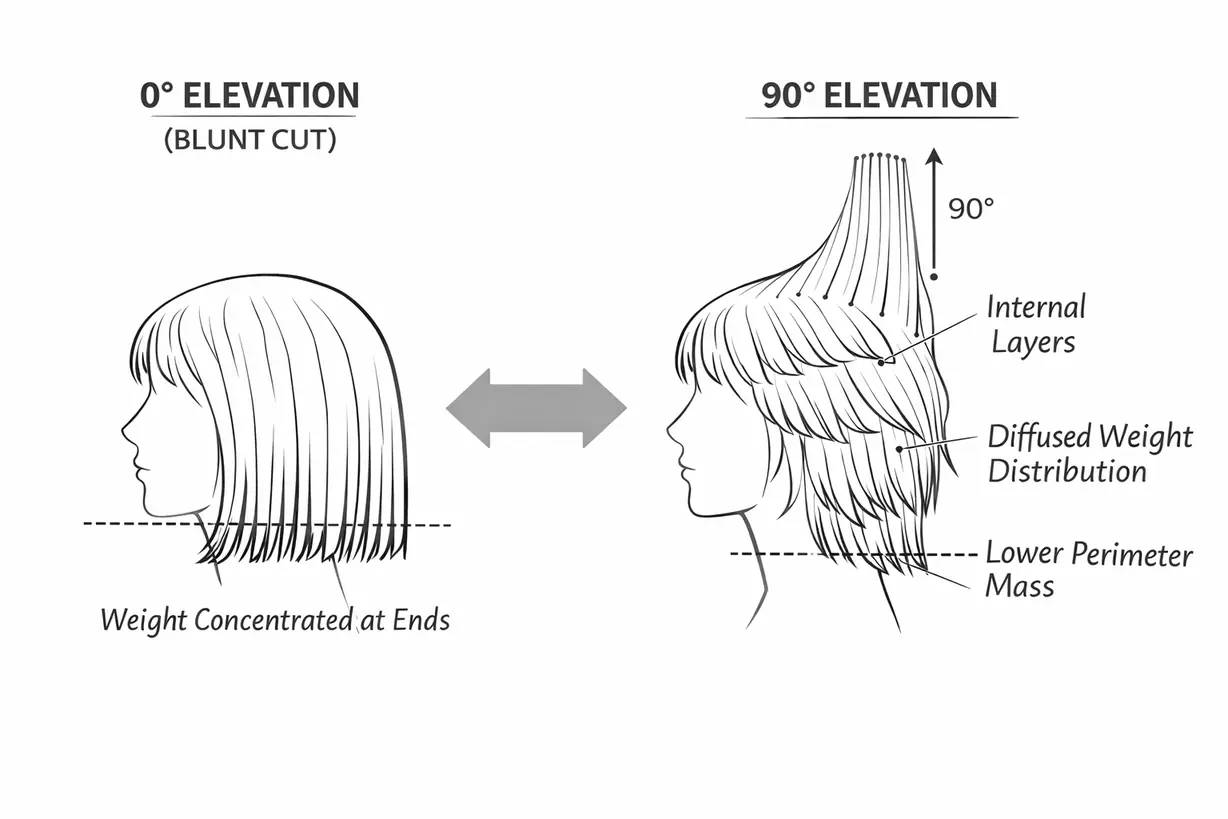 Structural comparison of perimeter weight concentration versus internal diffusion.
Hair Type Compatibility: When Layering Works — and When It Fails
The success of layered structure depends on physical fiber properties rather than aesthetic trends.
1. Density and Texture Response
High Density (Thick Hair): Internal layering is often structurally necessary. Without weight removal, dense hair accumulates mass at mid-lengths and ends, forming a triangular silhouette. Strategic graduation reduces bulk while preserving a stable outline. See haircuts for thick hair structure for deeper analysis.
Low Density (Fine Hair): The perimeter functions as visible scaffolding. Excessive layering removes critical support and creates thin ends. Controlled surface layers with perimeter preservation maintain fullness. Learn more about structure-based volume for thin hair.
2. Curl Geometry and Expansion
Curly and Wavy Hair: Curl geometry expands outward as length increases. Without graduated structure, weight concentrates at the base, creating bottom-heavy imbalance. Proper layering redistributes expansion vertically for silhouette control. See curly haircut structure and maintenance.
Straight Hair: Straight fibers do not interlock, which exposes cutting inconsistencies. Any abrupt elevation change creates visible steps. Precision sectioning and controlled graduation are critical for seamless blending.
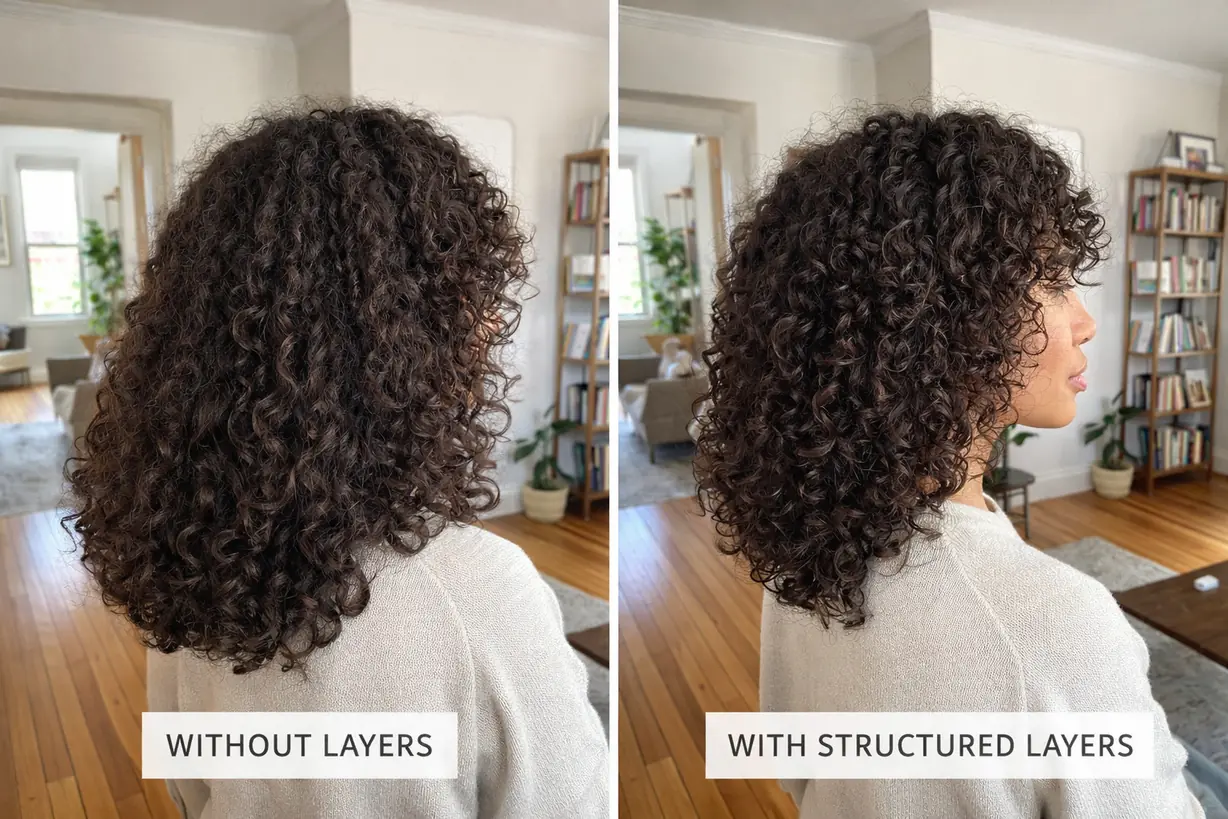 Balanced expansion achieved through internal graduation.
Face Shape and Proportion Engineering
Layering shifts visual mass. By repositioning internal weight, stylists adjust perceived width and vertical proportion. Understanding face shape and haircut structure strengthens elevation strategy.
The termination point of layers controls emphasis:
- Elongation Effect: Vertical internal structure keeps mass close to the head, visually slimming wider proportions.
- Widening Effect: Horizontal graduation builds controlled width along longer face shapes.
FAQ: Structural Questions About Layering
Q: Do layers automatically make hair look thicker?
A: No. In low-density hair, aggressive internal cutting reduces visible perimeter mass.
Q: Why do layers sometimes appear choppy?
A: Abrupt elevation transitions create graduation imbalance, especially visible in straight textures.
Q: Does layered structure require more maintenance?
A: Yes. As hair grows, internal distribution shifts faster than blunt structures.
Structural Conclusion
Layered haircuts succeed when density tolerates weight redistribution, curl expansion requires vertical balance, and facial proportion benefits from mass repositioning. They fail when perimeter support is sacrificed or elevation lacks planning.
For foundational cutting theory on elevation and graduation principles, see this overview of layered haircut fundamentals.
A layer is not decoration. It is structural engineering applied to fiber behavior. When logic governs design, the result is controlled movement — not accidental volume.